
The ferry, written off by the Norwegians and patched up by the Uruguayans, keeps shaking. Finally, the outlines of Buenos Aires appear in the distance. It seems huge – houses spread out like an octopus along the entire horizon, glass giants of skyscrapers advance directly towards us. The City of the Most Holy Trinity and port of Santa María de los Buenos Aires, known to the whole world simply as Buenos Aires, greets us with inclement weather.
But the weather here is changeable, especially in recent years: last winter, for the first time in 90 years, the portenos – residents of Buenos Aires – saw snow.
The splendor of glass high-tech is deceptive: there are only a few modern skyscrapers, located in the banking sector of the city near the waterfront. And then you are picked up by a battered black-and-yellow Peugeot (most taxis are old and worn-out cars), and in a stream of chaotic traffic you get onto the widest highway in the world – Avenida 9 de Julio. There is not much to catch your eye here. Except perhaps the famous Teatro Colón, on whose stage Chaliapin and Anna Pavlova once performed. Now it is sadly clad in scaffolding. And here is another 67-meter obelisk towering in the middle of the avenue, symbolizing the heart of the 'Paris of Latin America'.
The farther from the center, the lower the houses, and the numerous barrios (neighborhoods) are often individual homes. The architecture of Buenos Aires is diverse: a mix of modern, Renaissance, and Stalinist-style buildings. And the avenue is marred by faceless buildings from the mid-70s with huge dirty windows and outdoor air conditioners. You can reach the most notable monuments, such as the National Congress building (a reduced copy of the Washington Capitol), on an old metro where the cars are narrow, benches are wooden, and stations are decorated with garish mosaics and painted in the colors of their respective lines: blue, green, and red. The most interesting things in Buenos Aires are located in the central part, closer to the waterfront.
It is said that the presidential palace owes its apolitical color (often called the 'Pink House') to the two main political parties – the Whites and the Reds. To avoid fueling unnecessary passions, the building was painted a mixture of white and red. On the same Plaza de Mayo are the city cathedral and the old town hall – one of the colonial buildings of the capital, where in 1810, after days of debate, independence from Spain was declared. On the nearest column to the entrance of the cathedral, you can see a large Orthodox icon. It is a copy of Our Lady of Kazan, brought by our compatriots. The center is home to many luxurious buildings that gave rise to comparisons of this Latin American capital with Paris.
Many of the architectural masterpieces have been cleaned, restored, grilles and chandeliers gilded, stained glass washed. But either there are so many masterpieces, or the Argentine economy has not yet sufficiently recovered after the crisis at the turn of the century, but not all are so lucky: some abandoned buildings continue to decay and fall apart, and on the roofs, among the darkened gods from time, young trees have taken root. So they stand side by side – a restored beauty and its impoverished brother. This is very similar to the current state of Argentine society, where glamorous luxury and glaring poverty coexist. But the proud portenos even beg alms full of self-respect! We stop at a traffic light, a clean-shaven and culturally dressed elderly gentleman appears in front of the cars. He holds a sign: 'Father of three children. Lost job.' He calmly approaches each car, also calmly accepts change if given. By the way, for this pride, Argentines really dislike the capital's residents, considering them arrogant and haughty.
I look from the tenth-floor hotel window at the grimy courtyard well. The view is depressing – sagging wires are stretched everywhere. But getting a room with interior windows in a mid-range hotel is a great stroke of luck. There is no view, but you can sleep. How different it was during my previous stay when the windows faced Avenida Corrientes: on Fridays and Saturdays, the revelers would disperse from the streets around five or six in the morning. For Buenos Aires, this is absolutely normal – the city is known precisely for its nightlife: dinner here starts late, around 10 p.m., and then dinner can smoothly turn into non-stop dancing or a trip to the cinema or theater, some of which open their doors closer to midnight.
The most traditional food of the country is, of course, gaucho asado. By asado, they mean both a barbecue-style meat meal in general and a narrow strip of beef from the backbone, which in ordinary preparation you wouldn't eat. You wouldn't eat it because it's tough. But in the hands of a real asador, it turns into a delicacy: small layers of meat are fried in fat and become tender and unusually aromatic.
Ask for asado de tira – the waiter will respectfully approve your choice. They grill the meat without any marinade or salt, in large pieces on huge grills, and serve it with grilled vegetables and papas a la ploma (very reminiscent of our 'Little Potato'). Most often they cook this magnificence 'a punto', that is, moderately seared, slightly rare. And they wash it down with wonderful local wine, relatively inexpensive. You can also have it with beer, for example, Patagonia.
Food in Buenos Aires is diverse, tasty, and quite inexpensive. That is, if you don't count the popular grill bars. However, the most famous 'eating' waterfront, Puerto Madero, with its stylish restaurants, can significantly lighten your wallet. The few eateries with affordable prices in this place are visible to the naked eye – by the abundance of visitors and sometimes, at the end of the week, even by the queues.
Many 'guests of the capital' prefer to combine the pleasant and the useful with the simply pleasant and go to a tango show. As a rule, the performance and dinner are combined into a 'cena-show': guests are first treated and then they dance. Here you need to remember the following: the dances are almost always good, but the dinner can disappoint.
There are many tango venues in Buenos Aires. The most hyped show is 'Senor Tango'. And from 'Complejo Tango', a personal limousine and a polite driver in full dress and bow tie will pick you up from your hotel. But the most traditional tango in an interior of polished wood, mirrors, and marble columns is performed in the old-fashioned way at the café 'Ideal' on Suipacha Street. This street is generally a Mecca for lovers of the passionate dance. Here, at the intersection with Diagonal Norte, there are shops and shoe workshops where you can buy everything needed for tango: shoes, costumes, and music recordings. At the most famous workshop 'Flabella', there are always people: they say tango in Argentina is currently experiencing another renaissance. In addition to numerous studios, the Tango Academy has opened, which trains certified specialists (course duration – three years). Indeed, in Buenos Aires, both young and old dance.
The real – not refined salon-style, but truly real – tango needs to be watched in the city. Couples of all ages can be found on pedestrian Florida Street and in La Boca, but the most famous place is the antique boutique district of San Telmo. In this two-story colonial district with little mansions in Spanish and Italian style, where wealthy citizens lived until 1870 (the yellow fever epidemic later drove them to Barrio Norte and Palermo), tango can be both seen and heard. Near the church by Dorrego Square, the scene is always the same: an orchestra of eight people led by a pianist plays tango. They set up right on the street, together with a piano tilted on the narrow cobblestone street.
Another variety of tango dancers – singer performers (male or female). They have no orchestra, but many, with their trained vocals, don't need any orchestra at all. With the orchestra, and with the performer, a couple may dance in circles. They get the whole crowd going, people start to get excited – and then, to the languid rhythms, some rogue dashes through the crowd with the belongings of a distracted tourist. This is San Telmo, gentlemen, not a criminal district, but with a huge density of tourists per square meter – pickpockets and thieves are aplenty.
On Sundays, lovers of fine arts and antiques come to Dorrego Square: until evening, some unimaginable jugs, coins, porcelain, glass, gramophones, old books, postcards, and calendars gleam in the sun with polished sides... Paintings hang on stretched wires. There's a crowd, impossible to push through. Around, in bars and cafés, at tables right on the street, almost along the path of the crowd, languid foreigners relax. On every corner, barkers for shows thrust leaflets with drawings of terrifying thick-legged female dancers. And from all windows – tango.
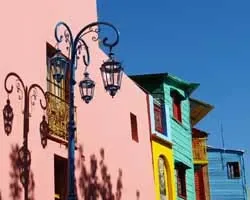
And tango was born where the city itself was – in the old port of Boca. In this slum district, whose tin houses are traditionally painted with paint left over from ship repairs, at the end of the century before last, ships arrived with live cargo. Crisis-ridden Europe abundantly supplied girls who were promised work and marriage, to local auctions that more resembled slave markets. From there, the newly-minted prostitutes went straight to brothels, where they received up to several dozen clients a day. For each one serviced, the madam gave a token. One of the first tangos is called 'Give the Token' because the first women to start dancing tango were precisely representatives of the oldest profession. Before them, only men danced tango.
No less devotedly than to tango, portenos worship football, and its most outstanding representative, of course, is Grand Diego. His weathered-by-temptations image is everywhere: on glossy covers, in sports shows, and on the walls of houses in Boca, the cradle of Maradona's home team 'Boca Juniors'. If you tell a fan of 'Boca' that his team's colors are blue and yellow, he might take offense: the colors of 'Boca' are blue and gold (the color of triumph). In fairness, it should be noted that 'Boca' has long ceased to be the undisputed leader of Argentine championships. However, this does not stop violent fans, and when 'Boca' plays at the 'Bombonera' stadium, especially when it plays against 'River Plate' – its most bitter rival – you should stay away from the area. The statistics of fan clashes are discouraging: injuries are frequent, and sometimes deaths occur, so the authorities take this very seriously. Before my eyes, tourist groups were evacuated into buses, souvenir shop owners hastily lowered metal roller shutters on windows, and the police cordon stretched along the alleys adjacent to Caminito: in half an hour, the end of the match at the 'Bombonera' and the mass exodus of fans were expected.
After the game, the green field of the stadium becomes almost white from paper confetti and rolls of toilet paper. This cute activity – throwing toilet paper as serpentine – has become a distinctive Argentine tradition.
Barrio La Boca is one of the poorest working-class neighborhoods of the capital. It is known not only for its brightly painted tin walls, football team, and high crime rate, but also for the Riachuelo river. An unhealed wound for local ecologists and a scourge for the government, this river is considered the most polluted in the world. Not without hidden masochism, locals claim that if you drink a glass of this water, you have at most 20 minutes to live.
In Barrio Norte, on the contrary, everything is polished and elegant. Here the cream of society reside. Among rosewood trees are rich mansions of embassies and important offices. But the district is interesting not so much for this as for another attraction of Buenos Aires – the ancient Recoleta cemetery. All the city elite are buried here.
The architecture of the crypts and the variety of sculptures are striking. Here is a sailor shipwrecked. The sides of his boat are broken, the vessel half-filled with water. And you will not pass by a young girl made of snow-white marble. Next to her is a beloved dog that, as the tombstone inscription says, died of grief, holding a bouquet of fresh flowers in its paw. Probably, this grave is tended to. The same cannot be said for many others: dusty coffins peek out from under half-destroyed and moss-covered walls.
But at the crypt of the beloved Argentine Eva Perón, there are always visitors, candles, and large white bouquets. The 'people's path' to Evita never grows over. At the cemetery entrance is the old Church of Santa Pilar. If you look closely at the apostles and cherubs decorating the alcoves, you can notice traces of Indian carvers' work: the cherubs' faces are dark and somewhat resemble the faces of free children of the pampas, and feathers are clearly visible in the saints' halos.
On weekends, a spontaneous fair bustles in front of Recoleta: artists and craftsmen of a hippie-like appearance sell paintings and handicrafts. And more serious men sit in numerous coffeehouses and confiterías, slowly sipping coffee and reading morning papers, occasionally distracted by watching ladies passing by. Indeed, there is something to look at. No wonder they say that the ratio of psychologists to plastic surgeons per capita in Buenos Aires is the highest in the world. And so the wealthy capital's female residents glide past the confiterías, all as if selected – full-lipped, voluptuous, long-haired divas in tight-fitting clothes and sky-high heels.
The standard of beauty 'Argentine-style' can be considered the great lover of expensive outfits and bags, the candidate for future president and current first lady Cristina Kirchner. No less popular is TV presenter Susana Giménez. She started as a film actress back in the days of black-and-white film, but to this day this large blonde dresses in provocative dresses and pours out her soul to the gossip magazine 'Faces': 'I am alone again and appreciate this short time of peace…'
So that fashionistas and simply residents of the metropolis do not get bored, Buenos Aires offers another world-famous attraction – shopping. Here, as in Greece, there is everything, only much cheaper. Argentina is known for its leather, furs, shoes, knitwear, lingerie, and leather goods. Numerous high-fashion houses also flourish here. The range includes both local Argentine brands and various Lacoste, Cacharel, and Cristian Dior, because they are produced here under license. In different areas of the city, there are large modern shopping complexes, but in addition there are entire shopping streets and even neighborhoods. The thrifty capital resident will leave the expensive Florida Street to tourists, and instead head to Córdoba Street, where from house no. 4000 on both sides there are as many as 10 blocks of outlets of well-known brands. Or to the intersection of Avenida Corrientes and Nazca Street – the same story, but there is a greater chance of getting a fake, since shrewd Chinese dominate there.
In general, in Buenos Aires you can be easily scammed. But overall, the level of urban crime has significantly decreased since the default, as ubiquitous taxi drivers assure. And as an indicator of stability – the abundance of tourists from different countries on the city streets.
The ferry speeds back to Colonia, a calm sea. Buenos Aires releases with a light heart, and I mentally say goodbye to this amazing city, which at first seemed dusty, somehow bald, and uncomfortable. With its angry sun on the white-and-blue flag, terrible buses dangerously speeding along narrow streets, pimps from Florida literally grabbing sleeves, dog walkers walking 10–15 dogs at a time, arrogant ever-hurrying residents who would not toss a centavo to a miserable Peruvian with an asthmatic child in his arms... Not immediately, not from the first visit, but I began to feel that Baires is a city of moods, with its so different neighborhoods – the dynamic business center, melancholic San Telmo, provocative La Boca, sedate Palermo. Definitely, this city has a soul. It is most likely female, fickle. In the fresh issue of the magazine 'Faces' – as always, Susana Giménez. Her loneliness did not last long, and now she is pictured next to a young boxer. Good luck to her, and goodbye, Buenos Aires.