
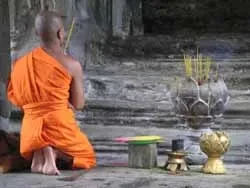
Together with Buddhist monks from the Drepung Monastery, whom I was lucky to meet three years ago while traveling through Karnataka, I was heading to the Indian town of Amaravati to behold the living embodiment of the Buddha of Mercy and to attend his revelations of the Kalachakra Buddhist teachings.
The proverb "in close quarters but not offended" is the best description of Indian trains. People patiently crowd, sitting seven or eight on berths, settling under and between them, in aisles, vestibules, and even in toilets. "Chai, dal, chapati" — a vendor selling his simple goods — tea and lentil soup with flatbread — moves over the bodies, legs, and heads of passengers sleeping on the floor. Three in the morning. Neither the yellow hot porridge dripping on sleepers, nor the stuffiness in the carriage, nor the "aroma" emanating from shoes lovingly placed on the grilles protecting the powerful duct fans — none of this irritates the locals. The Indian people are patient.
The train's final stop is the city of Guntur. People flow out of the carriage onto the platform, and I along with them, stretching my numb legs and inhaling a dose of hot and almost fresh station air. Volunteers from the Kalachakra organizing committee politely direct arriving pilgrims towards scheduled buses heading to Amaravati.
Here rickshaws also crowd — drivers of Indian three-wheeled motor taxis of the Bajaj brand, luring pilgrims with gestures eloquently promising: "Oh, I'll give you a ride!" Many newcomers, especially foreigners, agree to the offers of their Indian Kozlevich brethren — the wheel of time begins to spin.
On the Banks of the Krishna
Amaravati is the place where, according to legend, Buddha Shakyamuni imparted the tantric Kalachakra teachings to the ruler of the kingdom of Shambhala and his 26 attendants.
In our days, the 14th Dalai Lama, whom Tibetan Buddhists believe is the reincarnation of Buddha Avalokiteshvara, gathers impressive audiences of followers. This time, all these followers from 48 countries of the world, among whom I found myself, gathered on the banks of the Krishna River to receive the Ocean of Wisdom and to see the living embodiment of the Buddha with their own eyes.
The pilgrim tent city was set up in record time. People came to Amaravati from Tibet, Nepal, Tibetan refugees who found shelter on Indian soil, Chinese from the PRC and Taiwan, Indians — all of them settled in separate communities.
The organization of the event deserves the highest praise. Participants were registered and issued ID cards, concert venues, markets, food stalls, and — public toilets, so rare in India — were set up. 100,000 pilgrims is no joke!
In the evenings, when it became a bit cooler, pilgrims came to the huge ancient brick stupa built in honor of Kalachakra, the teachings once given at this place by Buddha Shakyamuni. They lit thousands of candles and performed kora — a ritual circumambulation around the shrine in complete silence, in memory of the great Teacher.
The Buddha Above Gods
The teachings began early in the morning, so we all got up while it was still dark, queuing up for the audience. Foreigners went through one queue for security checks, locals through other entrances. The seating sectors were also divided on a local-foreigner basis. We sat to the left of the podium, upon which rose the throne of the Buddhist monk Tenzin Gyatso, His Holiness the 14th Dalai Lama, Ocean of Wisdom and Nobel laureate of the 1989 prize — the spiritual and temporal ruler of Tibet, albeit in exile. The Tibetans themselves often call him much more simply — Kundun, meaning "presence." Since 1970, Kundun, or the Buddha, has publicly imparted the Kalachakra initiation to all who wish.
One did not need to know Tibetan to understand what the smiling, witty, and vigorous 71-year-old Buddha was talking about. About peace and mutual understanding, non-violence and flexibility in solving human problems—that is, love for one another.
The Dalai Lama's speech was accompanied by simultaneous interpretation into several languages, including Russian. One could listen to it via a pre-purchased FM receiver, tuning it to the necessary frequency.
According to Tibetan Buddhist concepts, the cycle of time includes inner, outer, and changing spheres. If one understands the changing sphere, one can become free from the power and influence of the first two. The Dalai Lama, however, clarifies that "only the initiated can understand this." Nevertheless, he believes that any mortal will gain enormous benefit from attending the teachings.
The Kalachakra teaching is conducted for the purpose of improving karma and strengthening the spirituality of people throughout the world. In 2424, the last great battle of light and dark forces is expected, after which the golden age of Shambhala will reign on earth again. But only if the forces of light win. Buddhists sincerely believe this, striving to improve global karma.
Embodiment of God on Earth
After attending the Kalachakra teachings, I headed to the south of Andhra Pradesh state, where in the town of Puttaparthi lives and works miracles Sai Baba — the embodiment of God in human form.
On the way to the ashram "Prasanti Nilayam," which translates as "Abode of Highest Peace," I spoke with local residents. Some called Sai Baba a magician and charlatan. Others, who have lost faith in official medicine, head to the saint hoping to be cured of cancer and blindness — they claim Satya Sai Baba can even resurrect the dead. Still others, and they are the majority, are cautious: shaking their head from side to side, they only listen to others, saying "acha-acha."
This gesture is very popular in India, probably because it means absolutely nothing. Just "acha-acha" and that's it. Indians do not like categorical judgments. But even if we dismiss the reality of the numerous stories about the materialization of sacred vibhuti ash from thin air, gold watches and rings, mind reading and healing of the paralyzed, then what else but a miracle can we call the fact that a poor village boy literally built a city out of thin air?
In 1940, a 14-year-old teenager named Satya Narayana Raju suddenly declared that he was the successor and reincarnation of Shirdi Sai Baba, a saint who had left this world 22 years earlier. Hearing about this and overcoming a difficult journey of 1,500 km, several residents of the village of Shirdi, who personally knew the previous Sai Baba during his lifetime, came to Puttaparthi. They came with one goal - to expose the little deceiver and impostor. But when the young man called each stranger by name and even reminded them of some details from their personal lives, those who arrived fell prostrate before him - the prophecy had come true - the saint had appeared on earth again, only in a different form.
Over 67 years of his asceticism, Sai Baba "materialized" in Puttaparthi: a super-hospital with 300 beds where everyone can receive the most complex medical care completely free of charge, an airport, a planetarium, a stadium, an institute, a music college, primary, secondary and higher schools. A poor, unknown Indian village turned into a flourishing city. The number of devotees of the Teacher numbers in the millions, and centers of Sai Baba's followers exist in more than 150 countries! Among the list of celebrities who visited Puttaparthi are the 14th Dalai Lama and Steven Seagal, George Harrison and Svyatoslav Roerich, Mstislav Rostropovich and Boris Grebenshchikov.
Upon arriving at the Prashanti Nilayam ashram, I first went to the registration office, then to the accommodation office, from where I was sent to a shede (dormitory), where a day's stay costs 20 rupees. Meals at the ashram's restaurants are not much more expensive.
Many residents of the post-Soviet space have found in Puttaparthi the fulfillment of their dream of a victorious communist country. They come here with whole families, grandmothers stroll with grandchildren in strollers, young people in white and orange punjabi and shalwar kameez chat by the statue of the elephant-headed Ganesha, the most popular meeting place among compatriots.
Some seek self-discovery and the world under the meditation tree, while many immediately head to the wish-fulfilling tree located on a hill. I also went up there. I did not make wishes, but instead admired the magical view of the surroundings. They say that in childhood, the saint often entertained himself by materializing simple childhood treasures ordered by friends on the branches of the tree - sweets, pens, and notebooks.
The saint Satya Sai Baba predicted that he would leave his earthly body in 2021, being reborn after 8 years in the city of Mysore in southern India. And he even materialized a photograph of his third incarnation. His successor, named Prem Sai Baba, will be very similar to iconographic depictions of Jesus Christ.
Sometimes Bhagavan Sri Satya Sai Baba appears before people during darshan and communicates with them. This time he preached that "his goal is to help man realize that God is within everyone. People should respect, love, and help each other regardless of skin color or creed." The listeners sitting in the hall listened to him with reverence.
It seemed to me that the saint was quoting the Dalai Lama. But most likely, this is exactly what a wise man in Amaravati spoke about, one who managed to become a Buddha, enlightened, more than 2,500 years ago.