
The Bend
All travel agencies offer excursions to the Danube Bend, where historical fortresses, famous cathedrals, and wine cellars are located, all against the backdrop of expansive views of the river squeezed between hills, which, making a turn, offers the opportunity to admire its picturesque banks.
The most popular route runs to the town of artists and craftsmen, Szentendre. Streets with doll-like houses and neat little shops filled with local handicrafts are crowded with tourists stopping by bright shop windows. It is the right time and place to buy souvenirs - from ceramics, packets of spices and goulash recipes to marzipan bunnies and bears. An acute desire to buy something made of marzipan arises after visiting the Marzipan Museum, where you can see a life-size marzipan Michael Jackson and a sweet model of the Hungarian Parliament. This museum is as tiny as everything in Szentendre. At the entrance, in a glass-walled room, real confectioners prepare marzipan paste, performing simple manipulations with it.
A bright blue spot stands out: a shop selling traditional calico fabrics and clothing made from them. Why blue? Because all the fabrics are indigo-colored, with a white printed pattern that is obtained by applying a wax ornament to the fabric.
And, of course, no one passes by the extensive wine cellar “Labyrinth” with underground galleries where collectible wines are stored. The tasting is accompanied by a tour with a detailed account of the characteristics of each variety and becomes a revelation for many, since most of us can judge Hungarian wines only by the low-quality Tokay sold in local shops. Meanwhile, the fine white wines of the Mátra region and the soft red wines of Eger have been valued in Europe since the Middle Ages. But Louis XIV called “Tokaji Aszú” “the king of wines and the wine of kings.”
The goal of the next trip to the Bend is to see the largest cathedral in Hungary. To do this, you need to drive 40 kilometers from Budapest along the so-called Amber Road to Esztergom, the former capital of Hungary, where the residence of the head of the Hungarian Catholic Church is located. Esztergom, which lives not only in the past but also develops future technologies, is now called the “city of Suzuki” - after the Japanese automobile plant Suzuki built there.
The enormous St. Stephen's Basilica, conceived as the Hungarian answer to the Vatican, overwhelms with its grandeur. The cathedral houses the world's largest altarpiece (13.5 x 5 m), painted by Titian and depicting the Virgin Mary. Ferenc Liszt once played the organ and conducted the orchestra here.
From the fortress observation deck, the famous Bend opens up, the figure of St. Stephen above the cliff, a white chapel on the hill, houses with red tiled roofs. On the opposite bank of the Danube, another state is already visible - Slovakia. And yet, the most beautiful panorama of the Danube is considered to be the view from the 13th-century fortress in Visegrád. To see all the splendor of the Bend, you need to climb steep steps to the very top of the stone fortress wall. Around, wherever you look, a protected forest stretches with foxes, deer, wild boars, rabbits, and other creatures.
Left Bank, Right Bank
The Pest district, located on the flat left bank, is often compared to Paris for its abundance of restaurants and shops. And although the words “pedestrian” and “Pest” are a coincidence in sound, this part of the Hungarian capital seems made for walking. On a white-stone-paved square begins the pedestrian Váci Street, and all walks around the city start and end here, at the monument to the poet Vörösmarty, where young people gather with guitars in the evenings. No matter how much we wander, our feet themselves lead to the Gerbeaud confectionery, which has preserved the atmosphere of the early last century and the tradition of selling the most delicious pastries in Budapest.
On the right bank, the ornament of Buda's hilly landscape is the colossal Royal Palace.
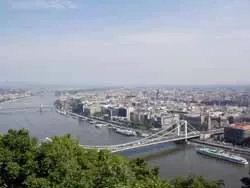
Nearby on a hill is the castle district with the Fisherman's Bastion, the main attraction of Buda Castle. Its snow-white towers resemble a fairy-tale sandcastle from afar. From the viewing platforms of the Fisherman's Bastion, the city below appears in shades of white, ochre, and emerald, with the greenish ribbon of the Danube. The stereotype of the “blue Danube” stops working, but you suddenly realize that this picture before your eyes is the main miracle of Budapest.
Another way to see Budapest in all its glory is to take an evening boat trip. What opens up to the eye - illuminated handsome bridges and lit churches and buildings, including the Parliament on one bank and the Royal Palace on the other - has been listed by UNESCO as a world cultural heritage. Just think: a view as heritage! Right there on the ship, we get to touch the culinary heritage as well - the national Hungarian dish of meat soup-goulash and Tokay wine.
The glow of the evening lights magically transforms everything around, ennobling even the heavy buildings of five-star hotels on the embankment, past which the number 2 tram rattles. On the terraces of the Danube Promenade cafés opposite the Royal Palace, tourists and the idle public gather in the evenings. Thus, from individual details, the image of Budapest is formed - a brilliant European capital with the atmosphere of a small resort town.
Baths
Thermal pools are scattered throughout the city, and many hotels have their own baths, such as the historic Hotel Gellert or on Margaret Island. Budapest's main bathhouse is located in Városliget Park on Széchenyi Island and was built for the millennium of Hungary (in 1896). In the shade of spreading flowering chestnuts, plane trees and maples, you forget that you are in a city of two million. Above the artificial lake there is a Baroque castle, and in front of it on a bench sits a stone monk with his head bowed in a hood - though the hood is empty, there is no face. This is a monument to Anonymus, the unknown chronicler to whom Hungarians owe their knowledge of their history.
The Széchenyi Bath, more like a palace, is the oldest spa complex in Europe. The pleasure is available to anyone with 2,000 forints in their pocket. If you bathe for less than three hours, part of the money is refunded. In addition to the open swimming pool, there is also, outdoors, a thermal bath with warm streams of healing water springing from everywhere, in which swimming is impossible - you just bask in it. There is also an indoor pool and steam rooms. In warm weather you can meet people with wet towels over their shoulders, strolling leisurely along the streets of Budapest on their way back from the baths.
The forint (Ft) is still used for monetary transactions, with €1 equal to roughly 250 forints.
A three-course lunch at an inexpensive restaurant: Ft1,500-3,000; one hamburger at a fast food place: Ft200-700; one liter of wine in a store: Ft350-2,000; entrance to Visegrád Castle: Ft800; a discounted Budapest tourist card for 48 hours: Ft4,700 (for 72 hours: Ft5,900), a three-minute call from a payphone: Ft20.
Waiters and taxi drivers are usually tipped - approximately 10% of the bill. But leaving tips on the table in a café or restaurant is not customary; they should be handed directly to the waiter.
Typical Hungarian souvenirs are embroidery, openwork napkins, branded porcelain (also openwork), goose liver, spices, goulash cooking sets, Tokaj wine (Aszú and Szamorodni).
In Budapest, from 118 hot natural springs and drilled wells, up to 70 million liters of healing water gush daily at temperatures from 21 to 78 degrees Celsius. The city has about 50 baths, five of which are hydrotherapy establishments known worldwide.
Gellért Bath. Built in 1918 at the hotel of the same name in Buda. Decorated with statues, columns, and mosaics.
Király Bath. Has existed since 1565, from Turkish times. Open: one day for women, one day for men.
Lukács Bath. Opened in 1894. Thermal spring and pool with healing water.
Rudas Bath. Created by the Turks in the 15th century. Sauna, pool on the spring, steam room.
Széchenyi Bath. Europe's largest and most beautiful bath with pool, whirlpool, and steam room. Open year-round.