
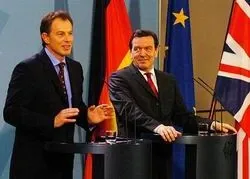
To say that Tony Blair's name is not particularly popular among Europeans is, in effect, to say nothing. The European Union is meeting its new Council chairman with perhaps the deepest crisis in its entire history, and this crisis, by common consent, was provoked by none other than the British prime minister. It was he who, at the recent summit of EU member states - or rather, the failed summit - turned out to be the instigator of disagreements on the most sensitive issue: who should pay how much in the future and who should receive how much from the common European budget. With his unyielding demand to reduce subsidies to European farmers, the British prime minister literally prompted representatives of several countries to also make unheard-of demands.
Unsurprisingly, in the last ten days of June, only the laziest political commentators did not have Tony Blair's name on their lips. The French and Germans accuse him of abandoning the idea of European integration and of 'pushing' British interests at the expense of the other partners in the Community. The Spanish and Portuguese do not like Blair's vague hints that 'some countries, which have developed quite sufficiently on European money, might as well stand on their own feet already'.
Even some Russian experts, let us say, of extreme views reacted to Blair's arrival. In Britain's six-month rule, political scientists saw the age-old striving of the damned Americans (and their 'sycophantic Englishmen') to push Russia out of Europe. This conclusion was supplemented by yet another call for the creation of a 'Moscow - Paris - Berlin axis' and for countering pernicious American imperialism.
On the eve of the 'throne speech' before European parliamentarians, Tony Blair was warned that the meeting could turn out to be, to put it mildly, chilly. However, these well-wishers experienced perhaps the greatest astonishment of their lives: the British prime minister needed only a ten-minute speech to completely convert not only the European Parliament, but also the majority of EU citizens to his faith. At the beginning of his speech, Tony Blair declared that he was a 'convinced European', which drew snickers and disapproving hums from the most unconscientious elected representatives. But then Blair switched to the classic 'blood and tears' manner: 'I have come to call Europe to radical renewal, otherwise we risk simply falling apart!' he told the parliamentarians, and they involuntarily listened.
It turns out that the demand to cut the EU agricultural budget, which led to the collapse of the EU summit, was dictated not at all by Blair's miserliness. A million here, a couple of million there - these games do not particularly worry the British prime minister. His main goal was to use cuts in agricultural subsidies to increase funding for new technologies, education, and know-how. Blair the Conqueror set himself the task of carrying out a restructuring of the European Union along the lines of some loss-making enterprise.
Behind that very Tony Blair whom, just a couple of years ago, the 'Euro-giants' Gerhard Schröder and Jacques Chirac often did not take into account, numerous supporters are now forming their battle formations. These include Poles, Slovaks, and all three Baltic republics. From the north, Scandinavian Vikings, led by Swedish leader Göran Persson, are rushing to help the British flagship. The Dutch newspaper De Volkskrant ironically comments on this: 'The British government taking on the role of a plumber for a leaking European boiler sounds too good to be true. However, perhaps the time for this has come - after all, the German-French scenario for Europe has discredited itself.'
In fact, in Germany and France, Blair already now has established new allies, replacing the 'worn-out models' Schröder and Chirac. The leader of the German conservatives, Angela Merkel, and the rising star of French politics, Nicolas Sarkozy, agree with Blair that the EU should be urgently reformed. And the influential German business newspaper Financial Times Deutschland sums up: 'Thank you, Mr. Blair!'
Tony Blair, according to his own words, is sick to death of the petty bargaining over discounts, premiums for olive oil production, and cattle breeding. He wants to turn the European budget to face global realities: 'India produces twice as many qualified specialists in a year than all of Europe combined, and invests five times more in biotechnology research than Europeans. China spends three times more on science than we do, America works four times more productively!' And what about Europe? The European Union pays its meat exporters €2 per kilogram sold in West Africa - to keep dumping prices there, suppressing competitors from the southern edge of the Sahara Desert. EU member states pay billions of euros into the European budget, only to begin a lengthy struggle a month later to get the same money back in the form of subsidies...
The blitz attack from London may well turn out to be very useful for Europe. Tony Blair's New Labour Idea sounds quite attractive: to create a social base through the creation of new jobs. The British prime minister flatly rejects the Franco-German model: 'What kind of social model is it in which 20 million people remain unemployed?' he asks. However, for success on the European stage, the new chairman of the EU Council will need not only pressure, but also diplomacy: if the British go too far in their desire to 'break Europe apart and put it back together', many allies will recoil from them.