The results of a social survey of British teenagers commissioned by the Daily Telegraph showed that one in five schoolchildren is seriously "floundering" in history. Moreover, it's not about the times of William the Conqueror and his legendary opponent, the Saxon king Harold Goldenhair, or the history of the mysterious Picts. The questions concerned historical figures known throughout the world. But, as it turned out, not in Britain. For example, one in five schoolchildren believes that one of the greatest statesmen and political figures of Great Britain, former Prime Minister Winston Churchill, Lord Marlborough, is a fictional character.
47% of respondents consider the English king Richard the Lionheart, who ruled in the 12th century, as well as his unfortunate brother Prince John Lackland, to be fictional characters, and all these 47% have simply never heard the story of how the British raised money to ransom him from Austrian captivity. Meanwhile, 51% of British children believe that the non-existent robber Robin Hood, who according to legend was a companion of King Richard, actually existed. They are convinced that he really lived in Sherwood Forest, robbed the rich and gave money to the poor. Why the real, as they believe, Robin Hood collected three million gold marks to ransom his fictional overlord Richard the Lionheart, they could not answer – some heard about it for the first time, and those who bothered to read the legend did not think about such trifles.
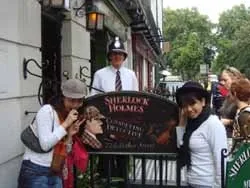
British schoolchildren consider two other heroes to be quite real - the great detective Sherlock Holmes and King Arthur Pendragon. 58% of respondents are confident that the famous private detective, invented and immortalized by writer Arthur Conan Doyle, really lived in London at 221b Baker Street – indeed, that is where his museum is located. 65% of respondents believe that King Arthur and the Knights of the Round Table actually existed. However, some Saxon chronicles mention a certain King Artos ("Bear"), so historians still argue about Arthur's reality. In any case, Sir Richard Malory's book "Le Morte d'Arthur" was for a long time considered a quite truthful historical epic. But that was long ago, and in our enlightened age such confusion cannot but surprise.
Overall, as the study of 3,000 boys and girls under the age of 20 showed, schoolchildren in the United Kingdom have a very vague idea of their country's history. Many do not even have a basic set of knowledge in this area. The survey also showed how much the British interest in history has fallen. In particular, 77% of respondents admitted that they do not read historical books at all, 61% – that they change the TV channel if there is a program about history. So, it seems that in the near future, understanding the history of the British Isles will be mainly by foreigners who have passed the residency exam.
Boris ALTNER.