
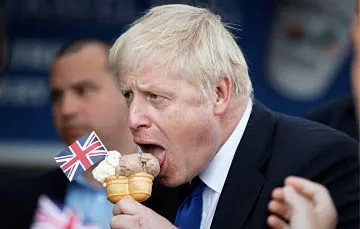
Brexiteer Boris Johnson
After the Conservative Party, led by Brexiteer Boris Johnson, won an absolute majority of seats in the snap parliamentary elections in December, the new parliament quickly and without unnecessary debate approved the terms of divorce from the EU, and on January 24, Boris Johnson in London and the heads of the European Council and the European Commission in Brussels signed the agreement on Britain's withdrawal from the EU.
In the daily life of Britain and its European partners, no major changes will occur immediately from February 1, because a transition period will last in UK-EU relations until the end of 2020. During this period, everything that matters in these relations from the perspective of ordinary citizens – trade, border crossing, and so on – will remain as before.
Nevertheless, as BBC notes, January 31, 2020 is a crucial milestone. From this point, there is no turning back.
Until now, the British government could at least theoretically simply withdraw its notice of withdrawal. Now, if Britain ever wants to return to the EU, it will have to go through the entire process of a newcomer, which Eastern European countries recently underwent – and it is still unknown whether continental Europeans will want to take the British back after this whole story.
Britain does not plan to introduce visas for tourists from the European Union and does not intend to change the entry procedure for citizens of third countries in the near future. But those EU citizens (for example, from Latvia or Lithuania) who still plan to move to Britain without unnecessary formalities to live and work should hurry: this can only be done until the end of the year.
All EU citizens living in Britain (estimated by authorities at about 3.6 million) must submit a very simple online application for resident status. It can be submitted until mid-2021, but the application must be accompanied by proof – a so-called "national insurance number" or, for example, a rental agreement confirming that the applicant settled in Britain before December 31, 2020.
Those who have lived in Britain for more than five years receive settled status, while those who have lived less receive pre-settled status, which can then and must be changed to settled status. This registration scheme for EU citizens has been in place since 2019, and according to the British government, at least 2.5 million people have already registered under it. Only a handful have been refused – mainly due to criminal records.
After the final exit at the end of 2020, Boris Johnson's government promises changes in immigration rules that will affect all foreigners: Johnson intends to introduce a unified so-called "Australian" system, in which potential immigrants are automatically awarded points depending on age, education, profession, and so on – and those who score a "pass mark" get the right to move to Britain.
In addition, separate types of visas are planned for the most highly qualified and the lowest qualified arrivals from the EU: talented scientists and seasonal workers (for example, fruit pickers), as well as those coming to work in the British healthcare system – the NHS.
The main tangible change that occurred on the night of February 1 is that Britain lost representation in all EU bodies. That is, for another year, Britons will be subject to EU rules and decisions, but will no longer be able to participate in their adoption. The British Prime Minister will no longer sit at the quarterly summits of the European Council – the highest authority in the EU structure.
British ministers will stop attending meetings of the Council of the European Union, where decisions are discussed and adopted on ten main areas of EU activity: from foreign policy to agriculture and fisheries. British diplomats will no longer be invited to jointly prepare these decisions within the Committee of Permanent Representatives.
Britain will also no longer have an envoy to the European Commission, where each country is represented by one person. True, there is already none: Johnson's new government decided not to appoint one. Finally, 73 British MEPs are giving up their mandates, including 29 from the Brexit Party led by Nigel Farage, the main eurosceptic in British politics.
Britain has written into the law on leaving the European Union an obligation not to extend the transition period after December 31, 2020. Therefore, the country faces a non-trivial task: within this unprecedentedly short period, by the end of the year, to negotiate free trade both with the EU and with major partners like the US, in order to avoid a sharp, potentially economically traumatic "cliff-edge Brexit," which again, as in 2019, looms not far off. But that is another chapter in the fascinating saga of Brexit.