
Christopher Columbus once noted, “If you don’t know where you are going, you will not go far.” In this sense, Boston delights those who love to walk and discover new places by treading on historic stones. That is why the Freedom Trail exists here, a four-kilometer path that connects about two dozen monuments of the colonial era and the struggle for independence. Boston’s Trail has been declared one of 16 “National Millennium Trails” approved by the White House in 2000. It ties together the main historical landmarks like a red ribbon, which is clearly visible on the map. By following the Trail and checking the map, one can easily reach any store, museum, or subway station. In short, there is virtually no chance of getting lost.
To feel the spirit and drama of the American Revolution, we set off along the Trail to see these monuments, at least from the outside — among them churches, government buildings, meeting houses, memorial cemeteries, and even a museum ship. All the monuments are of considerable age — around or over 300 years old — and they look very touching against the backdrop of gleaming skyscraper giants that surround them on all sides.
On the Trail
The path of red brick, laid on the light-colored pedestrian strip, begins in America’s oldest public park, Boston Common, leads past the State House — a pink building with a golden dome housing the state government — and goes into the stone labyrinth of downtown. Beautiful decorative brick was supplied here for construction, wholesale supplies of which only reliable manufacturers could afford. In places where it meets the red tile of the sidewalk, it turns white.
Soon the Trail leads to the “Old Corner Bookstore,” which for all of its nearly three hundred years has been considered the city’s literary center. There was a time when this compact brick Victorian-style house served as a meeting place for future classics of American literature. And the bookstore’s contemporary — the three-story Old State House, with its cute miniature chapel — saw the colonial government in action. The stern building nearby is Faneuil Hall, where colonists gathered to develop battle strategy. Now it hosts formal ceremonies, in particular, it is where newly minted U.S. citizens receive their passports; on the second floor is the Artillery Museum.
Thus, from monument to monument, we reach the Quincy Market shopping area, which no normal tourist can pass without lingering for an hour or two. Quincy Market is a realm of souvenirs under the roof of a long colonnaded pavilion, along with adjacent boutiques, cafés, restaurants, and fast-food outlets. We quickly indulge in shopping, rest, and refuel. By the way, the portions here are inhumanly huge, so it’s not worth ordering many dishes. Moreover, ahead of us is the North End neighborhood, which has the best Mediterranean cuisine restaurants in Boston. This is “Little Italy,” and at every step you encounter the realities of Italian life. Colorful signs like “Mamma mia,” flowers on balconies, saint figures in gardens, gesticulating Italians on the streets.
Soup and Tea
In Boston, you must try seafood, and if lobsters are beyond your budget, the tender and aromatic clam chowder in a bread bowl is affordable for everyone. This Boston soup even has its own annual summer festival, “Chowderfest,” when crowds of volunteer tasters gather in front of City Hall to vote for their favorite recipe. The city’s best restaurants participate, and each chef prepares chowder according to their own recipe. Another key word is tea. In the historic Old South Meeting House, a theatrical performance is held once a year. To the sound of flutes and drums, Bostonians reenact the event that went down in world history as the “Boston Tea Party.” It was here, in this Puritan meeting house, that the movement for colonial independence was born, and the protest against the duty-free import of English tea was planned — when an entire shipment of tea was thrown overboard. As a result, the British government sent warships to New England, which served as a signal for the resistance of the North American colonies and ultimately led to the formation of the United States. So much for tea! The performance continues at the Boston Tea Party Museum, located on a sailing ship; “chests of tea” are thrown into the water, and then everyone is treated to a symbolic “duty-free” tea.
Left Bank, Right Bank
Boston is a city of East Coast bankers; its residents have earned a reputation as workaholics. Those who have managed to amass a fortune live in red-brick mansions in the elegant elite neighborhoods of Beacon Hill, Back Bay, and prestigious Newbury Street. Boston’s old respectable neighborhoods resemble the Old World more than the New, and the quality of life here is also closer to European. In this rich and expensive city, good manners and loyalty to traditions are highly valued, and many famous families still continue to host balls.
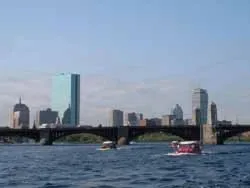
Over the past 20 years, however, the city has gained new life and become the second most important business center in the country after New York. The gleaming outlines of downtown towers and skyscrapers on the hill are visible from different points of the city, especially beautifully from the water — in America this view is called the “skyline.”
A completely different picture unfolds as soon as you cross the bridge to the other side of the Charles River. This area is called Cambridge, where the intellectual elite of Harvard University and the Massachusetts Institute of Technology live, study, and work. Among the students of the world's most highly rated universities, there are also our compatriots; Russian speech can often be heard on the streets, in shops, and restaurants. Almost all buildings in Cambridge are made of the same red brick, almost all built at the same time and in the same style. The city authorities do not allow changes to the historical appearance of Cambridge.
Greater Boston includes other areas, dominated by low, charming houses surrounded by gardens. But "one-story America" is a different story.
«Indian Summer»
October is considered the best time to visit Boston, because the autumn leaf fall in New England is a must, which in the language of modern tourism means something that absolutely must be seen. In early October, the summer heat is finally replaced by "Indian summer," named so, apparently, because of its unusually bright palette dominated by all shades of red. Imagine our "Indian summer," mentally combine it with our "golden autumn," add more colors, bright sun, fresh ocean wind, and in combination with lush vegetation, you get a picture of amazing beauty. People come specially from other regions of the country to admire this splendor. Newspapers print daily reports for tourists indicating the coordinates of the most picturesque groves, bushes, and trees. And along the roads and at flower markets, mountains of golden pumpkins of all sizes are already laid out. It's time to prepare for Halloween.