
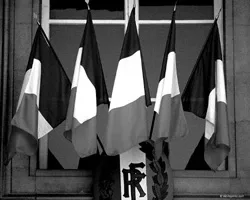
The State Council of France supported the corresponding order of Interior Minister Nicolas Sarkozy. It rejected the lawsuit of the human rights organization "SOS Racisme", which accused the minister of violating the European Convention on Human Rights.
"If you want to live in France with a residence permit, you must be law-abiding... Immigration laws allow deportations. I am the Minister of the Interior, and I will apply the law," said Mr. Sarkozy. According to the press service of the Interior Ministry, the deportation procedure is "in the process of being implemented" with regard to 120 people accused of participating in the riots that broke out on October 27.
The Interior Ministry sent instructions on the deportation procedure to the prefects of regions and departments. In every case where legislation formally does not allow immediate expulsion (minority of the deportee, poor state of health, possession of a long-term residence permit), the prefects must report to the Interior Ministry. There they will look for an alternative solution to the problem. As the newspaper "Le Monde" reports, deportations will begin this week.
Meanwhile, the wave of violence in France is subsiding. The number of burned cars was aptly and figuratively called a "barometer of the riots" by the American CNN. In the capital, thousands of police and gendarmes are concentrated around the Eiffel Tower, on the Champs-Élysées, at train stations and metro stations. A ban has been introduced on nighttime mass gatherings of people that could "provoke or encourage unrest." Of the serious incidents in the capital, only an attempted arson at a gas distribution station was noted.
Last Saturday, Nicolas Sarkozy visited several districts of Paris. Some Parisians greeted him with enthusiastic cries, others with curses, accusations of racism, and demands for his resignation. The intensity of passions around the issue brought to mind that Minister Sarkozy's father came to France from Hungary. Be that as it may, Nicolas Sarkozy's popularity rating still exceeds 50%.
The Parisian newspaper "Journal du Dimanche" published the results of a poll: 71% of French people do not believe that President Jacques Chirac is capable of solving the social problems that caused the mass riots. A quarter of the country's residents are ready to entrust the task to the leader of the far-right "National Front", Jean-Marie Le Pen. He has already unveiled a program called "Zero Immigration". Philippe de Villiers, leader of another far-right party, the "Movement for France", called what is happening in the country an "anti-French war".
Against the backdrop of a surge of nationalist emotions, French media are commenting on the deportation decision with conspicuous restraint. The newspapers "Le Monde" and "Le Figaro" published almost identical reports about the authorities' decision and that the deportation procedure is "in progress".
It is worth recalling that the practice of deporting from France persons who have broken the law but who had a residence permit is not unusual. In 1996, a similar case was even examined by the European Court of Human Rights. A Tunisian citizen named Bouganemi came to France in 1968 at the age of eight and obtained a residence permit. He retained Tunisian citizenship but moved his parents, as well as ten brothers and sisters, to France. During the 1980s, he received four convictions, including for robbery and burglary. By order of the Minister of the Interior, in 1988 Bouganemi was deported to his homeland for "creating a threat to public order." The European Court of Human Rights recognized the deportation as lawful, primarily based on the fact of his conviction by a French court.