
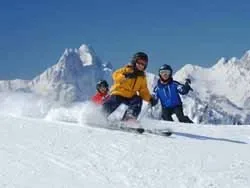
A Very Ski Story
They say skis were invented back in the Stone Age. In any case, rock carvings of hunters on something like skis have been preserved. The age of planks resembling skis extracted from Scandinavian peat bogs reaches 4,500 years. The oldest skis are kept in the Ski Museum in Oslo. Their length is 110 cm and width 20.
Norway is considered the birthplace of alpine skiing. The first treatise on skis was written by polar explorer Fridtjof Nansen. He described in great detail how to control skis when descending a mountain.
The first ski competitions took place in 1844 in the Norwegian city of Tromsø. They included cross-country running, downhill skiing, and ski jumping. And the first exclusively alpine skiing competitions also took place in Norway, on Mount Huseby. That happened in 1879. Residents of the village of Telemark challenged skiers from Christiania (present-day Oslo) and put them to shame.
Nevertheless, the founders of modern alpine skiing are considered not Norwegians, but Austrians. This is because Austrian Mathias Zdarsky invented the "snowplow" in 1896 and showed the admiring public a non-stop descent with turns. He also proposed a new design of boots and bindings, and even wrote the first textbook on alpine skiing technique. And in general, the first alpine skiers of the Alps are considered to be the British, because in 1741 two British lords went on skis to the foot of Mont Blanc.
In 1924, the International Ski Federation was founded, which now unites 100 countries. World Alpine Ski Championships have been held since 1930, and since 1936 they have been part of the Winter Olympics. At the first championship, the gold went to the British, but they were soon displaced by representatives of Alpine countries: Austria, France, Germany, Switzerland, Italy.
Very Ski News
This season, the news is almost no different from last year's. Their main topic is global warming and its impact on snow cover in the mountains of Europe.
Global warming affects all European mountains, but it primarily worries Alpine countries. According to meteorologists, over the past two years, the air temperature in the Alps has risen by about 3.3 degrees. This causes quite rapid melting of glaciers.
Due to warming, not only glaciers but also ordinary winter resorts are suffering. This season, the French resort of Abondance has closed. In recent years, due to warm weather, snowmelt, and avalanches, Abondance has lost popularity among tourists and finally went bankrupt.
Snow Melts, Ski Pass Prices Rise
Despite warming, ski pass prices continue to rise at Alpine resorts. That's the second news, also already familiar.
For many years, Switzerland was considered the most expensive country in Europe, but now it yields to France. The price of a six-day pass for the lifts in the French Three Valleys this season will reach a record €220. This ski pass gives the right to ski on the slopes of the resorts of Méribel, Les Menuires, Val Thorens, Courchevel, and La Tania. For teenagers aged 13 to 17, you will have to pay the full price; children up to 12 years old can ski for €165. People aged 60 to 74 get small discounts; children under four and their grandparents over 75 can ski for free. The ski pass of the Mont Blanc region shares the first place in cost. The right to ski for a week in Chamonix costs the same €220 for adults and €176 for children over four.
Ski pass prices in Italy and Andorra are rising faster than in France, so perhaps in the coming years these countries will become leaders in the cost of lift passes.
And in Switzerland, there is some price reduction. This is caused both by fluctuations in the Swiss franc exchange rate and by the policy of resorts trying to attract more tourists.
Good News
There is also good news from the Alps. For example, from Italy: in the ski region of Madonna di Campiglio, this season you can ski on new routes. Here in December, a new lift will open in Daolasa.
And in Switzerland, the world's highest toboggan run, Alpine Coaster, was opened in the summer. It appeared on Glacier 3000, located near Lake Geneva. The Alpine Coaster accommodates 560 sections with circular motion, 10 turns, six waves, three jumps, and two bridges. The track allows a toboggan to accelerate to 40 km/h. The mountain offers stunning views of Mont Blanc, the Matterhorn, and the Jungfrau. Children under 9 are only allowed on the track accompanied by adults; the cost of a ride is just under $5. When buying four tickets, the fifth is given as a gift.
ALPINE GEOGRAPHY
It is impossible to describe all Alpine slopes: the Alps are a special country, snowy and beautiful. In summer, the cowbells and bicycle bells ring on the mountain slopes, and in winter they explode with confetti of colorful sportswear. There are no state borders in the Alps, and its loyal residents are citizens of the world with the most diverse passports.
Germany
Germany's ski resorts are located in the Bavarian Alps. These are Berchtesgaden, Mittenwald, Garmisch-Partenkirchen, and Oberstdorf. The highest mountain in the region is Zugspitze at 2,963 m.
Oberstdorf is located in a picturesque valley in southwestern Bavaria, right on the border with Austria. There are both well-groomed slopes for beginners and sports slopes where World Cup stages, the Four Hills Tournament, and World Championships in ski flying take place. Overall, Oberstdorf mainly attracts residents of Germany; there are few foreigners there.
Garmisch-Partenkirchen lies between Munich and Innsbruck, at the foot of the Zugspitze. The season there starts in November and lasts until May. A ski pass allows skiing in neighboring Mittenwald and in Austria - at the resort of Seefeld. Berchtesgaden stands on the shore of Lake Königssee, which never freezes. Skiing here is on Mount Jenner, the upper station of the cable car stands at an altitude of 1,800 meters, on a ridge overlooking a snowy cirque. Almost all slopes on Jenner are red, the terrain here is diverse.
Italy
In Italy is also the most beautiful alpine region - the Dolomites. This mountainous country has a single ski pass 'Dolomiti Superski'. It gives the right to ski on 1,000 km of slopes and use 465 lifts. Among the true gems of the Dolomites: Cortina d'Ampezzo, Val Gardena, Val di Fassa, Val di Fiemme.
Madonna di Campiglio is one of the most prestigious ski resorts in Europe. The town lies at an altitude of 1,550 m, and directly from its center one can ascend to 2,600 m. There are 26 lifts operating around the resort. Slopes connect Madonna with Folgarida and Marilleva. Total slope length is 150 km. Of these, almost half are easy, 40% are 'red' and 16% are 'black'.
Courmayeur is considered the most democratic and attractive resort for actual skiing.
Sestriere lies right on the border with France. Together with four other resorts, it forms the ski area 'Milky Way'. Bormio is also located near the border - where Italy, Austria and Switzerland converge. It unites with Santa Caterina and Livigno into one ski region, allowing skiing on 200 km of slopes with altitude differences from 1,225 to 3,148 m.
Another famous Italian resort is Cervinia. Here is the longest slope in Europe: the length of this descent is 25 km. In Cervinia, skiing takes place at altitudes from 2,050 to 3,500 m on the slopes of the Matterhorn and Monte Rosa. The slopes are interspersed with vast expanses of untouched snow, attracting extreme skiers, and require good preparation.
Liechtenstein
Despite its tiny size, Liechtenstein also claims to be a center for winter holidays, especially skiing. In the southeast of the principality is the main ski resort - Malbun. Here there are 20 red and blue slopes and four black ones. They are complemented by two first-class ski schools.
Switzerland
Switzerland also needs no introduction. Mountains cover two-thirds of its territory, and the Swiss level of slope preparation is considered the benchmark. Listing Swiss resorts looks like a list of Oscar winners: Bern, Engelberg, Grindelwald, Diablerets and Villars, Gstaad, Valais, Champéry, Zermatt, Saas-Fee, Crans-Montana, Verbier, Graubünden, Arosa, St. Moritz, Davos...
Switzerland has everything outstanding in the ski world. For example, the most prestigious and expensive alpine resort is St. Moritz. The largest ski center in Switzerland is Davos. Around it are 332 km of excellent slopes of all levels. The longest slope - Weissfluhjoch-Parsenn - stretches for 12 km. The most venerable and beloved Swiss resort is the quiet Zermatt at the foot of the Matterhorn (4,500 m). A cable car takes skiers to the top of the Klein Matterhorn. A seven-kilometer slope with a vertical drop of 2 km allows you to ski directly into the town, almost into the very center of Zermatt. Or go down another slope to Italy, to the resort of Cervinia. Skiing in Cervinia and Zermatt is possible with a single pass, the total length of slopes is more than 250 km.
Austria
It's even somewhat awkward to introduce Austria: it has been known and loved by skiers around the world for many years. 'Ski country number one', 'Winter capital of the Alps' - Austria is called many things. Four luxurious glaciers provide year-round skiing. And numerous ski schools are ready to help a beginner get comfortable on the slopes.
Austria has remained the number one ski country for many years. Two-thirds of its territory is covered by the Alps. There are 71 ski regions, and the number of resorts is 800 - almost all towns, villages and settlements in the mountains.
Four glaciers - Kaprun, Stubai, Pitztal and Tuxer - allow skiing all year round. On other slopes, the season lasts from November-December to April-May. Austria maintains more than 22,000 km of slopes. Most lifts are new, all slopes are carefully groomed, and Austrian ski schools are considered the best in Europe. The country confidently tops rankings for service level at resorts. 85% of skiers in the Austrian Alps are foreigners.
The highest alpine region of Austria is Tyrol. Its main magnet is St. Anton, where the greats of the world came for winter holidays even in the time of the Kaiser. Its calling card is 280 km of ski slopes, including 80 km of black slopes, and the famous 'Austrian Instructor School'. Extreme skiers are attracted by wild snow-covered slopes, where the total length of descents exceeds 200 km. St. Anton is considered the cradle of Austrian skiing. In 1901, the first alpine ski club was founded here, the first cable car was built, a ski museum operates, and a living exhibit - the champion of champions Karl Schranz, whom Austrians call nothing less than Charlemagne, keeps his own hotel.
Another famous ski region is the Ötztal valley with its surrounding three-thousanders. Here is the ski resort of Sölden. Every year from October to May, Sölden attracts thousands of skiing and snowboarding enthusiasts. They are drawn by the resort's modern infrastructure and excellently groomed slopes. The highlight of Sölden is the BIG 3 rally slope.
In total, the Ötztal valley has 147 slopes of varying difficulty with a total length of more than 50 km. The ski area includes three peaks over three thousand meters: Tiefenbach Glacier, Schwarze Schneid and Gaislachkogl. This is a real ski maze, elegant, well-thought-out lift lines and colorful descents, fantastic ski tunnels and cozy mountain huts.
The highest panoramic road in the Eastern Alps leads to the world of glaciers from Sölden. Observation platforms are equipped on the peaks of the "big three". "Felssteg" hangs at an altitude of 3,309 meters with a futuristic bridge, where you can feel like you are above a real abyss. The natural platform "Schwarze Schneid" is located at an altitude of 3,340 meters, offering a 360-degree view. "Gaislachkogel" allows you to look at the world from a height of 3,058 meters.