
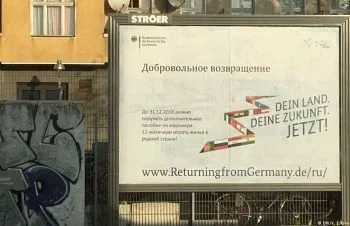
Refugees who notify the German authorities of their voluntary departure to their homeland by December 31 will be compensated for one year's rent at their new location
"Additional allowance for a maximum of 12 months' rent in your home country!" – the advertising campaign, launched on November 13, is scheduled to run for 10 days. As Deutsche Welle notes, the German Interior Ministry will spend around 500,000 euros on it. The posters are produced in seven languages – English, German, French, Arabic, Pashto, Farsi, and Russian.
Bonus for voluntary departure from Germany
The target audience of the large-scale advertising campaign is foreigners who have been denied refugee status in Germany. With additional financial incentives, the German government seeks to encourage migrants to voluntarily leave the country, which just three years ago was plastered with posters saying: Refugees Welcome.
The slogan of late 2018, according to the Interior Ministry, is different: "Your country – your future. Now!" and all additional information can be obtained online at the telling address ReturningFromGermany.de, that is, "Return from Germany."
In the first half of 2018, according to tagesschau.de, 10,669 people voluntarily left Germany. And 12,261 were forcibly deported. Naturally, voluntary departure is much more humane than forced deportation – no police escort, no forced boarding of a plane. Moreover, those who agree to leave the country voluntarily receive financial assistance for purchasing tickets and resettling in their homeland.
It is also more advantageous for the German authorities both from the point of view of public opinion (forced deportations draw a wave of criticism from human rights organizations) and from a financial perspective. The cost of a charter flight for deporting migrants per passenger can be four to five times higher than the cost of a regular one-way economy class flight.
Deportation twice as expensive as voluntary departure
According to authorities, the cost of forced deportation of one migrant is estimated at an average of 1,500 euros. In the case of voluntary departure, the financial costs for state structures are halved – to 700 euros (on average). To optimize expenses, Germany implements "voluntary return" programs aimed at incentivizing migrants with money to go home.
The compensation package is regularly expanded. For example, those who decide to leave Germany while their asylum application is still being processed can receive 1,200 euros. And 800 euros will be paid to those who do not appeal a rejection and quietly leave Germany within the prescribed period. Wags call these payments "get out of here" bonuses.
Pre-New Year special offer from the Interior Ministry
The German Interior Ministry is headed by Horst Seehofer, chairman of the Bavarian Christian Social Union (CSU), which promised to tighten migration policy in the Bundestag elections. With Seehofer's appointment as head of the Interior Ministry, the prefix "for homeland affairs" was added to the ministry's name – and from billboards in the Berlin metro, the "Federal Ministry of the Interior, Building and Community" hints to migrants that they have their own homeland, as the campaign runs under the motto "Your country – your future."
According to German Interior Ministry spokesperson Eleonore Petermann, the special offer valid until December 31 is aimed at easing the resettlement of voluntary "returnees" by compensating rental costs for a year (the maximum compensation amount is limited to 3,000 euros).
In addition to financial payments, departing families can also count on material assistance – for example, for building or repairing housing, as well as for equipping a kitchen or bathroom.
Hotline for returnees
The website ReturningfromGermany.de has a Russian-language version, which details the compensation amounts and provides addresses and contacts of organizations assisting with voluntary departure. However, the telephone hotline for returnees operates only six hours a day, only on weekdays, and only in German and English. This website – launched in May 2017 – is a joint project of the Federal Office for Migration and Refugees and the International Organization for Migration (IOM).
According to Linda Gertner, spokesperson for the German branch of the IOM, the "Your country – your future" campaign in the Berlin metro, initiated by the Interior Ministry, is aimed at advertising temporary additional incentives for the reintegration of those who voluntarily leave Germany. How many migrants have already taken advantage of the Interior Ministry's special offer is currently unknown.