
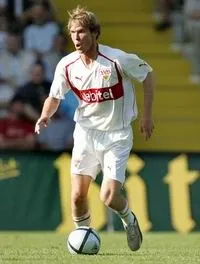
One of them is 24-year-old midfielder Alexander Hleb, who this summer moved from the German Stuttgart, where he spent five seasons, to the English Arsenal. The transfer of the Belarusian footballer became one of the most significant events in both the German Bundesliga and the English Premier League.
And this is not surprising, since over five years in Stuttgart, Hleb earned a decent reputation in serious football circles. In the summer, besides Arsenal, he was also courted by English Liverpool and Italian Milan - the winner and finalist of the 2005 Champions League, effectively the best clubs of the Old World.
The career of the current London club player began in the city of Borisov, with the BATE team. Hleb speaks of his first professional club with great respect and warmth. It was in Borisov that he was given the opportunity to display his rich football talent. Incidentally, even during Alexander's time playing for BATE, scouts from Kyiv Dynamo had shown interest in him. But they were a bit late. By then, Stuttgart had appeared on the horizon, and to make the Ukrainian coaches back off, Hleb decided to play the fool: at the tryout in Kyiv, he showed absolutely nothing. The disappointed Dynamo turned down the Belarusian footballer, and he set off to Germany with a light heart.
At that time, Stuttgart was going through hard times. The once famous and formidable team was floundering at the bottom of the standings and fighting for survival. The situation was saved by coach Felix Magath, who took charge of the team, and a group of young footballers, among whom was Hleb.
Alexander's first season at Stuttgart was incomplete. He arrived in winter, during the break between the first and second rounds. At first, the newcomer was carefully observed and was given the opportunity to participate in only seven games. But already by the summer of 2001, the attitude towards the Belarusian legionnaire became more respectful. Hleb was more noticeable than everyone else and, surprisingly, organic in the Bundesliga meat grinder: he dribbled, got kicked, jumped up, received the ball, passed sharply, and argued with referees with the authority of a senior player. German TV people began to focus on him. Hleb began to be called the successor to Stuttgart's long-time attack conductor, Bulgarian Krassimir Balakov. Felix Magath, who after his brilliant work in reviving Stuttgart was invited to the best club in Germany, Bayern, was asked at the time: "What are your strongest impressions from a year of work with the team?" He did not think long for an answer: "How Alex Hleb is progressing."
Magath, an excellent midfielder in the past, appreciated Hleb's abilities and potential. He noticed him already in the first months of the guy's stay in Germany. Stuttgart's amateur team destroyed Eintracht, which was then coached by Magath, in the German Cup, 6:1. Hleb provided three assists and earned a penalty, after which Magath suggested the Stuttgart side sell the player. And he was refused...
Having taken charge of Stuttgart, Magath began to treat the Belarusian like a strict father - he did not allow him to relax, forced him to work on himself, and sometimes loaded him more than others. Alexander in numerous interviews with the Belarusian media more than once complained about the strict coach, but now he can only thank the mentor who raised him to be a true fighter. At the same time, Hleb retained his main football qualities - the ability to read the game, technique, the skill to give a precise pass to a partner and score himself. Under Magath, the Belarusian progressed year after year, as the numbers show. In his second season in Germany, he played 32 matches and scored two goals; in the third - 34 matches and four goals; in the fifth - 31 matches and five goals. And only when Matthias Sammer replaced Magath, who had left for Bayern, did Hleb's statistics drop (34 games, two goals), and Stuttgart also performed worse than under the previous coach.
The Belarusian footballer was clearly lucky with his mentor. Magath taught Hleb discipline. In the first days of Iron Felix's work at Stuttgart, the young footballer went to the Belarusian youth team for some international tournament against the will of the club. And on top of that, he was one day late. Under the previous coach, Ralf Rangnick, such behavior by Hleb went unpunished. Magath turned out to be incomparably stricter. The angry coaching monologue addressed to Sasha, emotionally delivered in front of the whole team, concluded with a paradoxical summary: "However, this lateness of Hleb is not so terrible for us. After all, he is not in the lineup today..."
His words did not diverge from deeds. In none of the eleven rounds remaining for Stuttgart in that championship was the Belarusian legionnaire even included among the substitutes. Moreover, Hleb was suspended from training with the first team and spent the entire spring with the amateurs. The footballer's agent, Nikolai Shpilevsky, was already looking for suitable options for his client, but then Magath, who had resolved the issue of Stuttgart's continued residence in the elite division of German football, announced his desire to bring Hleb into the summer training camp. The footballer correctly understood the coach and tried to prove himself. He was included in the squad for the season, and in the fourth round he made three assists and finally regained his spirits.
At the same time, Magath had no intention of placing the Belarusian midfielder on his usual playmaker position (central midfielder performing the functions of a dispatcher). Hleb played both on the right (even in defense and attack) and on the left. Magath made Alexander into a universal footballer capable of playing in various positions with the same degree of effectiveness. Moreover, after such a harsh school, Hleb is now able to withstand any pressure from partners, coaches, or opponents.
In Belarus they consider Sasha a true phenomenon and are hardly mistaken. He arrived in a foreign country when he was 19, and he did not lose heart, did not rest on what he had achieved, although a Mercedes and a four-room apartment for two with his younger brother Vyacheslav in a suburb of Stuttgart, where half the team lives, preferring quiet to city noise, could well have relaxed the footballer. Gleb quickly became one of his own in the new team. Although at first it was very hard: “If in BATE everyone helped, advised, teased, and in general we lived like one family, then in Stuttgart it was like going to war. Everyone is a wolf to everyone else, every man for himself. Anyone is ready to tear a comrade’s throat out for a place in the lineup. There they battle in training even harder than in games. Everyone immediately forgets who is whose friend and pal; they can hit you from behind so hard that you can barely crawl off the field.
You won’t get any psychological support from the coach. Yes, at practice they’ll tell you whether you’re working well or badly, but off the field you can only rely on yourself. And when you make a mistake on the pitch, in Germany the young one is always to blame. Especially if that young man is a foreigner, and on top of that from the former USSR. There, Germans and foreigners even eat separately, each at their own table.
At first I felt like a second-class person. Sometimes I even cried from all this pressure. Of course, so that no one would see. It’s good that my manager Nikolai Shpilevsky was always there. And my brother too. Their support and the help of my parents, who also said, “Sanya, don’t give up,” allowed me to hold on. And now that I’ve achieved something with my play, the attitude has naturally changed. Now I am a respected person whom they don’t hesitate to consult on many matters.
What struck me in Stuttgart was the level of organization of the entire football operation, where there are no little things. For example, medical supervision. Regular tests, analyses. Players here are trusted completely. They themselves choose what lifestyle to lead, how to eat. No one follows the footballers, and the coach doesn’t care when his charges go to bed. The main thing is to work properly in practice and in the game. And there are no tedious trips to the training base. The footballers gather on the morning of match day at a hotel, and immediately after the match they go to their homes. I also learned with surprise about the system of fines. In Stuttgart they punish many offenses: if you are late for practice or for the departure, if your mobile rings in the dressing room or on the bus, if you take even a sip of cola...”
In 2002, Gleb was named the best player of Stuttgart in the season that had ended. They gave him a Samsung mobile phone, and a local brewery offered an advertising contract under which Alexander was to have a case of beer delivered to his home every week. The team itself managed to qualify for the European cups, on which occasion a banquet was held: “We sat modestly,” the footballer told journalists. “We gathered in a restaurant, drank champagne... I never cease to be amazed at these Germans. They don’t know how to have fun from the heart. However, there are two sides to every coin. It is commonly believed that strict external supervision is the main path to success for our people. In Germany, almost everyone is convinced of this. The newspapers here constantly write that Russians are drunkards and brawlers. Yuran and Kiryakov (footballers from the USSR who played in German teams in the 90s. - Author’s note) are still remembered. But I think everything depends on the person. Set a goal and strive for it, no matter how hard it may be. Even if not everything works out sometimes.”
By the way, Gleb expresses himself about alcohol as follows: “I don’t drink vodka. I tasted it at age 15 and came to the conclusion that it’s not for my organism. At most, I can sip a little cognac. But I love good red wine and beer. In Germany, almost every day after training we drink beer – three bottles each. I am the most inveterate teetotaler in our Stuttgart. Those devils drink so much that there’s hardly any space left. If someone had seen how they drank vodka in the club after the last match of the season. They pour a huge glass of Absolut, add a little Red Bull – and go. One after another, one after another. They poured me one glass, and I spent the whole evening sipping it through a straw. And they laugh: ‘What kind of Russian are you if you don’t drink vodka?’ Well, I explained to them competently, of course, that Belarus is not Russia, and anyway, we have new trends, the essence of which you will understand when we drag your national team around Munich like kittens. They almost fall under the table laughing: ‘Who’s going to drag us around? You and your brother?’ These are all jokes of the Bulgarian Balakov. When he learned that I had become the best footballer in Belarus, he followed me around all evening. ‘Explain to me,’ he says, ‘Alex, who came second for you, probably your brother? I don’t know any Belarusians at all.’ They really don’t know our players. I was shocked. I named Belkevich and Khatskevich to them. Like, they’re serious guys, they play for Dynamo Kyiv. No reaction...”
Sasha moved to Arsenal, having been the sixth-best player in the German Bundesliga according to the average ratings of the local press. And that’s better than any letter of recommendation. But a new country means new living conditions, new features, new partners: “First impressions are excellent,” Gleb comments. “I even like the weather here. It seems that those who say that it always rains and fogs in London have simply never been here. And, of course, the city is very beautiful. The difference between the English and the Germans? The British are probably kinder. And they treat foreigners better. As for the terrorist attacks, at the time when explosions were thundering in London, we were training in Austria. And when we arrived, I didn’t notice anything special – the city was living a calm life.”
In Arsenal they received me well. I already feel almost like one of the team. It's just a pity that my knowledge of the language is not always enough. But I'm sure I'll cope with the problem. The club has assigned me a teacher, a Scotswoman who knows both Russian and German. And in Arsenal, coach Wenger and players Lehmann, Ljungberg, Senderos, Bergkamp speak German quite well. But I try to talk to everyone in order to learn English faster. I have considerable experience of living abroad. It's nothing compared to the situation when I came to Stuttgart five years ago.
It remains to add that Arsenal's head coach Arsene Wenger speaks highly of the Belarusian footballer, who has already scored several goals for the new team (albeit in friendly matches): “Alexander Hleb is a player I have admired for some time now. I am sure that he will help us significantly diversify our play. He proved his highest class in the Bundesliga, and he has every opportunity to become one of the stars of the English Premier League.”