
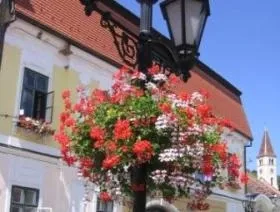
Hungarians lack roads, but European officials generously finance the installation of flower pots
We are sitting in the office of the Hungarian branch of Intrum Justitia, an international debt collection company. The office of debt collectors is located on the northern outskirts of Budapest, a city where more than 20% of the country's population lives. Here and there in beautiful Budapest you can see frozen construction sites – developers have halted construction during the crisis as soon as the credit stream that fed the country's economy dried up.
"For thirty years we have seen active growth accelerated by credit," says Péter Felfalusi, executive director of the Hungarian branch of Intrum Justitia, about the European economy. Having opened up to the Western financial system and established themselves as a small but reliable assembly shop of Europe (just look at the Audi plants), Hungarians immediately began to partake in the credit wealth.
"More than 90% of loans in Hungary were taken in foreign currency, primarily in Swiss francs. If someone wanted to buy a house, the question of whether they could afford it did not arise. People stretched their capabilities to the limit. They calculated the minimum amount they needed per month to live and used the rest of their income to pay off the loan, without making any reserves. They did not worry about risk, exchange rates, and so on. They bought an apartment of 100 square meters even if 80 meters would have been enough. That was the prelude," recalls Mr. Felfalusi.
The exchange rate of the forint collapsed within weeks. Loan payments for citizens who received salaries in forints skyrocketed. "Disposable income in European countries fell by 6-10%, except for Poland, which is doing better. In Hungary it fell by 18%. If people had not taken out loans up to the maximum possible amounts, it would not be a problem, but now they have to repay them. About 100 thousand Hungarian families may lose their homes.
Of course, people themselves are to blame for taking out loans, but financial products have become too complicated even for professionals. And these uneducated people did not understand anything at all. I think 95% of them did not understand the essence of the loan. The rich did not need large loans; they usually have reserves to pay off the debt. Most of those who took out loans are the poor and the lower segment of the middle class. If you see advertising on television, it’s all about "you deserve." You deserve the Seychelles, you deserve a house, you deserve this and that. And the person thinks: indeed, I deserve!
That is why I would introduce regulation at least on how banks can advertise certain types of loans. Now you are not advertising a loan, but a product. You are advertising a trip to the Seychelles or a large apartment," reflects Mr. Felfalusi.
The credit crisis, which hit the middle and lower classes, sometimes takes strange forms in Hungary. A few months ago, local media eagerly reported on a young Hungarian woman who put her virginity up for an online auction to pay off her parents' mortgage debt. The story, which fits perfectly into the tabloid theme, however, demonstrates the intensity of the problem.
After several years of a more or less comfortable life, tens of thousands of families could indeed end up on the street. And this, in turn, could lead to serious social unrest. After all, only four years ago, demonstrations swept through Budapest, during which protesters against the government even rolled a museum tank T-34 onto the city streets.
"There have been many such examples in Hungary's history. In the 1930s, residents attacked and killed police officers if they tried to evict peasants from their homes. Peasants made weapons. Today, politicians are more cautious about these issues," says Ferenc Chasthi, vice-chairman of the Hungarian Chamber of Bailiffs. Mr. Chasthi is an hour late for the meeting in the renovated office of the Bailiffs' Chamber, and when he arrives, he resembles a big bear. Broad, sturdy, with large facial features, he wears flip-flops over thick socks and proudly points to the walls of his office, where large and small judicial gavels, symbols of power, are abundantly placed.
"Convince to pay the debt in installments? No, we do not work like Intrum Justitia; we are a state structure, we can force payment," he says, slightly suppressing a smirk and winking meaningfully.
According to Mr. Chasthi, the main problem of fighting poverty in Hungary is not leniency towards the poor, but social justice. "Where is justice for ordinary people? For those who faithfully pay their loans, who work and pay taxes from which social assistance is provided? If we are too lenient, everyone will declare bankruptcy. Then we will have to evict not a hundred families, but thousands. The state must send two signals to society: first, we are ready to use force to ensure contracts are honored; second, no defaulter will be able to avoid a court decision," he says, chopping the air with his hand.
The German entrepreneur Andreas Mellendorf doubts that the state's iron hand can solve Hungary's problems. He has lived in Hungary for many years and is convinced: the social situation of many Hungarians has reached a critical point.
"Food and gasoline are no cheaper in Hungary than in Germany, and sometimes more expensive. Milk is more expensive here than in Germany, sugar is more expensive, and so on – because large chains profit from low competition. If you compare salaries in terms of purchasing power, local salaries are about 25% of German salaries. Even in Germany, it is increasingly difficult for people to make ends meet – what can you say about Hungary?" reflects Mr. Mellendorf.
The Mellendorf house is located in a prestigious district of Budapest, streets are parked with cars with German and Slovak license plates – by registering their cars abroad, wealthy Hungarians evade taxation. However, one way or another, inflation affects everyone.
“The cost of living is constantly rising, and many aspects are not reflected in statistics at all. For example, the fact that the possibility of free street parking is disappearing. Or that some roads are becoming toll roads. These cost-of-living factors will not be mentioned in any inflation calculation formula,” says the German entrepreneur.
The result of the growing social pressure, Andreas Mellendorf believes, could be a real explosion: “Hungary has approached the brink of acceptable social conditions. I have a Hungarian businessman friend, he and his friends expect a possible civil war – to the point that they have chartered an Antonov cargo plane and keep it on standby,” says Mr. Mellendorf.
But if Budapest still manages poverty more or less successfully, mainly through tourism, things are much worse in the Hungarian provinces. The village of Muchi lies just a couple of hours' drive from Budapest and fifty kilometers from Hungary's tourist Mecca – Lake Balaton. Founded a hundred and fifty years ago by settlers from German Hesse, today Muchi, with about 500 inhabitants, presents a rather pitiful sight.
“Almost the entire village population is unemployed, nobody has any money. If people work, in the vast majority it's illegal odd jobs,” says pensioner Bernhard Schilling. A few years ago, upon retiring, Schilling, a resident of Baden-Württemberg, decided to move from Germany to a quiet, poor country and settled on Muchi. At that time, he did not yet know that instead of a peaceful old age, he would get full-time employment as an emissary of the German charitable organization 'Konvoi der Hoffnung' (Convoy of Hope). Truck after truck, Schilling accepts used clothing and old furniture, dishes and household appliances. The premises from which Mr. Schilling distributes goods to local residents is a small mud hut in the center of the village. On the wall hang huge rosary beads. “This was also donated by someone,” Schilling explains.
The main distributed item is clothing. “Besides used clothing donated by private individuals, a lot of new clothing comes from retail chains – with minor defects. I try to repair such clothing and also give it away,” says Schilling's wife. At one time, some donors tried to offload completely defective items to the 'Convoy of Hope,' and the organization had to introduce a fee for donations: one box for one euro. As a result, donors became more responsible in choosing items, and the 'Convoy' can partially cover transportation costs.
There are quite a few cars in the village – mostly Trabants, abandoned by East Germans when they fled to the West through Hungary twenty years ago. But the main problem is not cars, but gasoline. “In the village, many residents are so poor that they buy gasoline for saws and tillers in liter bottles – they cannot go to a gas station for fuel and wait for someone from the wealthier residents to bring it,” Schilling explains.
The main obstacle to the village's development is the complete lack of work and isolation from the world. The road to Muchi is partly unpaved, so there is no direct bus route from the nearest town here. To reach the nearest place with work, one must take a roundabout route with many transfers. The village headman, Kornél Binder, a huge, burly man with thick black mustache, throws up his hands: “To pave the road, we need money. The European Union is ready to give it, but no more than 25% of the project cost. 75% must be financed by the village itself. We don't have that kind of money, so we live without a bus.”
A few months ago, Muchi applied for another project – one that had money. Under the European program for the improvement of villages to increase their tourist attractiveness, now throughout the village, cut off from the outside world, every fifty meters, excellent flowerpots for live flowers have been placed. This clearly demonstrates the effectiveness of European funds for supporting the lagging countries of Europe. Kornél Binder seems to fully understand the absurdity of such decoration. “Only fools stay here,” he mutters, answering the question of whether he wants his two children to remain living in Muchi.
With Bernhard Schilling, we walk through the village. The German pensioner points to houses, explaining where thrifty owners live and where spendthrifts live, not taking care of what they have. “Look, this is the yard of a good owner, everything is clean and well-kept. But that's an exception. And the next yard – everything is already falling apart. I know this owner well, a couple of months ago he dismantled his well, sold all the bricks from it, and now asks a neighbor for water to water his plants. In general, there are many abandoned houses here, people dismantle them and sell the bricks. Or dismantle their cowsheds. This was done even after the war, when Hungarians and Gypsies seized abandoned German houses,” says Mr. Schilling.
“It gets even worse, they ask for seed potatoes and don't plant them but eat them,” laments Mr. Schilling's wife. “Or here's a family: the wife became pregnant with twins, they asked to get a stroller for twins from Germany, but with the children sitting one behind the other, otherwise it wouldn't fit through the door. We got it. And then it turned out that one of the children was born sick. What would you think? The stroller is abandoned, the mother doesn't take care of this child at all, just waits for him to die, doesn't even take him for walks.”
An elderly woman suddenly seems to switch and throws up her hands: “Listen, you have no idea how hard it is for these people. A day laborer gets 3,500 forints for a fourteen-hour workday, that's 11-12 euros. They don't eat meat every day. Right next to the village there is an almost finished pig farm for several hundred head – almost everything is ready. I know, in Russia there are many rich people, businessmen. I beg, let someone invest here, this farm would be a salvation for the village, simply a salvation. This is the only thing these people can really do well.”
Read also material on the topic: POVERTY IN EUROPE: LATVIA
Sergey SUMLENNY,
Alexander KOKSHAROV.