
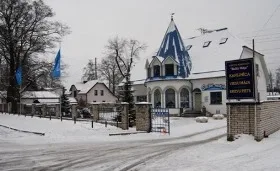
The organization Balta Maja is trying to help the city's residents acquire skills that can ease their existence in a difficult economic situation
A good thousand kilometers from Muci, in the Latvian town of Livani, you can hear the same complaints and hopes. A small town in eastern Latvia, in the historically poor region of Latgale, is a typical example of a poor town with closed industry that has lost a significant part of its population. "Almost every family has someone who left for the UK or Ireland. I have two sons in Ireland, and a granddaughter was born there," Lolita Beča, the manager of the charitable community center of the organization Balta Maja in Livani, tells Expert. Beča—a tall, beautiful Latvian woman—simultaneously tells about the situation in Livani in Russian, German, and English.
For many years, Balta Maja has been trying to help the city's residents acquire skills that can ease their existence in a difficult economic situation: in cutting and sewing courses, they are taught how to mend torn clothes, and with the help of Western funds, Balta Maja distributes cows and bee swarms to residents. "As long as the person works. And the next year, the one who received the swarm must give bees to another family or pass on a calf," says Ms. Beča.
"Of course, we are not in Riga, we work more. Everyone has vegetable gardens; already in February, everyone is growing tomato seedlings on their windowsills. Or this year there were many mushrooms—I think you can survive on just mushrooms and berries. It's natural, it's like a second shift after work," echoes pensioner Veneranda Caune, noting with some pride: "We have learned to make beads, hats, and socks—we sell everything to Europe, to Christmas markets."
The problems of Livani are typical of the Latvian provinces. At the central office of the charitable Catholic organization Caritas in Riga, activist Inese Micule says that in some cities Caritas has opened special soup kitchens for children from poor families, where children can at least have a hearty meal. "Sometimes parents do not let their children go to school because they have no money for a backpack, boots, or books. I personally know a family where the parents say: this child will not go to school this year. Others go, but this one does not. Of course, the school comes looking for these children. But social workers cannot always find them—parents lie that the child is not at home," Ms. Micule says bitterly.
"Beggars are people without work. But the poor are working people. For example, a teacher receives 200 lats. And he works all day, has a higher education—but he is poor. 200 lats is enough for him to pay for an apartment and eat modestly. For him, of course, there is no question of vacation, clothes, and so on. Or a policeman: he can also get from 200 to 300 lats, if he doesn't work overtime, doesn't take one and a half positions. The same with doctors, nurses.
"We had a truly outrageous case. The head of the traffic police of the large city of Liepaja went on vacation every year to a fur farm in Denmark to earn extra money doing unskilled work—he skinned fur animals. Everyone tries to earn extra: a teacher as a tutor, a policeman as a security guard," says Yuri Sokolovsky, a politician from the Latvian party "ZaPChEL" ("For Human Rights in a United Latvia") emotionally.
An energetic, thin man with an open face, Sokolovsky details how a Latvian resident can become and does become truly poor: "If you lose your job, for the first two months you receive 70% of your salary, then for two to five months, depending on length of service, 50%, and then only 45 lats per month. That is about 65 euros. At the same time, just the payments for a two-room apartment in winter can easily amount to 100 lats. Recently, EU funds paid for a program of six-month employment for the unemployed in street cleaning—with a salary of 100 lats. So the city streets instantly became clean," Mr. Sokolovsky chuckles.
At the central office of the Latvian trade union of science and education workers LIZDA, there is a huge poster on the door: a tight belt cinching a group of people. "This symbolizes the suffocating austerity policy," one of the employees explains to me. Public sector employees, including teachers, are among the main candidates for the poor population of Latvia.
"Since 2009, there has been a sharp reduction in spending in the education sector. The budgets of educational institutions were cut: by 40% for schools, 50% for universities, and 60% for research centers. I myself teach at a university and today I receive only a third of what I received two years ago, because first my salary was cut, and then my teaching hours were reduced. Above all, women without a professorship are subject to cuts," Ilze Trapenciere, one of the leaders of LIZDA, tells Expert.
Although Ms. Trapenciere's face remains calm, you can feel her agitation as she tells how thousands of science and education workers have become poor: "Ask teachers how they survive. I don't know how they manage. A full-time teacher's salary is 255 lats per month, or a little over 300 euros. Of course, they receive bonuses for working with notebooks, for preparing lessons, for homeroom guidance, and so on—altogether that adds another 30% to the salary. But it's still little. Three years ago, I was sure that being a teacher was very good, that it was a secure place with a good salary, and I advised everyone to go work in a school. And now? Last year, 58 schools were closed, another 84 were merged. This year, 9 were closed, 24 merged."
Worst of all, however, is the situation for scientists – for them, cuts in funding mean the complete collapse of all hopes of making a career in research. "There is no money for research. No research – no publications, no citations, and we become uncompetitive on the European market. Many of our pharmacological and chemical research centers are forced to sell their services to Swedish companies. Such researchers are in demand, but the Swedes take all the results, they publish them, obtain patents, and do not even name our researchers."
"And our scientists do not have the right to write articles about this. They are modern slaves: they cannot speak, they can only work. Even at European conferences, they are forbidden to talk about it. One of our researchers was at such a conference, he sat next to a Nobel laureate, and he asked him: "What do you do?" But he could not talk about his research!" – Ms. Trapanciere laments.
Read also related material: POVERTY IN EUROPE: GREECE
Sergey SUMLENNY,
Alexander KOKSHAROV.