
Greeks have not yet managed to build communism on the ruins of history
“One of the most important factors in the reproduction of poverty is children dropping out of school. In agricultural and tourist regions, children leave school before the ninth grade to work. The share of such children has grown from 10,000 per year in 2007 to 17,000 this year. And this is a tragedy.
These children are not just low-skilled, they are completely uneducated. Many of them cannot even write their own name. They say: ‘My family needs money.’ But this is the wrong path. As a result, poverty is inherited just as wealth is inherited,” says Nikos Bouzas, analyst at the Greek National Centre for Social Research EKKE.
Nikos Bouzas is one of the leading researchers on poverty in rural regions of Greece. According to his calculations, in some regions the share of the poor significantly exceeds 30%. This is due to the peculiarities of Greece's social system, which often ignores the problems of women in rural provinces, as well as the low educational level of the population.
When Mr. Bouzas talks about child labour, I imagine high school students who have dropped out to earn money, but within a day reality corrects me. In a street tavern in the town of Ioannina, near the border with Albania, I see a girl of about seven working as a waitress: taking orders and serving food. It is already past midnight, and the girl’s presence in the tavern looks exactly like hard work, not a spontaneous desire of a child who dropped in for lunch to help his father. Reporting to the police is useless in this case – every policeman knows perfectly well what is happening in the tavern on the main street of the city.
One of the problems of poverty in Greece is that for the poor segments of the population, the family is both a support and a system that suppresses any attempts at social advancement, Greeks explain to me. “The family is the only support for people, it is the rock on which everything rests – but at the same time it is a burden. Most people live with their parents until they are thirty or even older,” says Ioannis Skandalis, a young Greek from Ioannina who worked for a long time in the humanitarian organization Humanet and is now employed in pharmaceutical logistics. Ioannis is lucky: despite his youth, he has a job that can support him.
Others in Ioannina and its surroundings are less lucky: “Almost every family has unemployed people. There are almost no new jobs. The company I work for is new, few people know it, but every day people just ring the doorbell and ask if there is any work for them. Agriculture was the only job that people here knew how to do. For many years they said that we need to work in some other industries: people left their homes and moved to cities, now in Thessaly and other regions there are masses of abandoned houses. But there is no work in the cities. The only way to escape unemployment is to return to agriculture and feed yourself,” says Mr. Skandalis.
The idea of forced return to agriculture is popular in the poor region of Ioannina. “We are an agricultural region, there are many farmers here. But if it is a family, only the husband is listed as a farmer, and the wife is formally an assistant. She does not exist for the state, she has no rights to hospital, medicines, and so on. Previously, farmers were not poor, but now they are poor. Because of EU policy, the region stopped growing oranges, we buy them from Brazil! Many farmers destroyed orange trees because the EU demanded it.
Look further: today we produce 350 thousand tons of wheat per year, but we need a million tons. But in 1980 we produced two million tons. Then we could feed ourselves, today we cannot,” says Fotini Tsolou, a communist party activist in Ioannina. Tsolou has been in the Communist Party for twenty years, “half her life,” she says. “The communist idea is not only the most correct. It is based on knowledge, not just ideas,” says Ms. Tsolou.
Ioannina is an ideal region for the Communist Party, although Greece is generally a leftist country. The official unemployment rate here is 12.5%, but in reality it is much higher. Statistics do not count as unemployed people who worked at least one day in the year. Around the city, as in Athens, posters are hung with politicians from the government of the PASOK party – against the background of a noose. On the doors of dilapidated houses there are signs saying “For Sale”.
Thanks to its nature, Ioannina could be a tourist centre, but the lack of decent hotels and undeveloped infrastructure make it uninteresting for tourists from the EU, and the poverty of Greece itself and surrounding countries closes the possibilities of domestic tourism. “People work two jobs, from morning to night, and still there is not enough money. And officials say: you are to blame. This is their main idea, that the poor are to blame for everything, and for the crisis too. People suffer from depression, many suicides – because of stress,” sums up Ms. Tsolou.
I heard the emotional words of the communist party activist from Ioannina again in Athens. At the central office of the Communist Party of Greece, it seems as if a piece of the USSR has emerged on Greek soil. In front of the office entrance stands a monument to Lenin and a red flag flies, employees walk along the corridor with a volume of selected works by Karl Marx, and it seems that this is the only opportunity in Athens to ride not a German OTIS elevator, but an old Greek elevator. The huge concrete building itself is surrounded by a three-meter steel fence, the massive gates are opened by a guard sitting in an armoured booth.
“Communists are a traditional target for provocateurs,” explains in Russian Elezios Vagenas, a member of the Central Committee of the KKE. A huge poster on the end of the building, depicting a fist smashing the inscription “PASOK”, the name of the ruling party in Greece, is apparently the answer to all possible provocations.
"The problem of poverty in Greece is very acute. According to official data, more than 20% of the population, that is over two million people, are poor," says Makis Papadopoulos, a member of the Central Committee of the Communist Party of Greece (KKE). "For example, according to a study by the private sector workers' union (this is a pro-government union, not communists), a person needs 800 euros if they own a home and 1100 if they rent."
"One of the important indicators of rising poverty is the increase in loan applications. 60% of Greeks have loans, 20% have difficulty repaying them, and nearly 3% have stopped repayments altogether. If in 2007, 3.7% of mortgage loans were serviced irregularly, then in 2010 it was 8%. For consumer loans, these figures rose from 6% to 20%. One in ten Greeks cuts spending on clothing, one in twenty on food," says Mr. Papadopoulos.
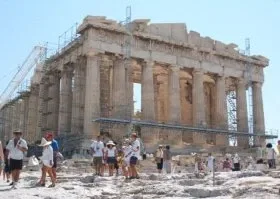
Here in Athens, it is difficult to assess how accurate the accusations of the communist opposition are. Yes, in the very center of the city one can see begging children, and there are many homeless people in the squares. Yet Greece still remains a country where the indicator of housing space per person is one of the highest in Europe. While some Greeks work in well-paid state sinecures, others go months without seeing a salary – like, for example, the freelance workers of the Acropolis, who blocked the entrance to the historical monument demanding payment of salary arrears.
"Greece is a poor country of rich people," a journalist colleague tells me. Truly wealthy Greeks try not to pay taxes, and the social system is overloaded with a very complex pension system, including inherited pensions, for example, by children of officials. As a result, those truly in need often lack money.
However, in the situation of economic crisis, the government can do little, believes Nikos Bouzas from EKKE: "The scale of tax evasion has always been well known. It is purely a political problem. If the government wanted to solve it, it would be easy – other European countries have solved this problem. Our society is built unjustly, and that is the main problem. About 70% of the income taxes collected by the government are taxes on salaries and pensions. That is, these are taxes paid by the poorest citizens. This situation must change. I don't know how or when."
It seems that the only force that could benefit from the ongoing impoverishment of Greek society here, as in many European countries, are left-wing populists.
Read also related material: POVERTY IN EUROPE: SCANDINAVIA
Sergey SUMLENNY,
Alexander KOKSHAROV.