
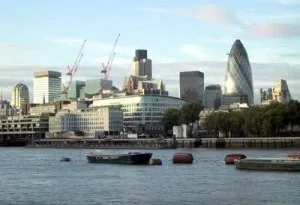
From the wealth of the skyscrapers in the business district, many Britons are separated not only by a few kilometers, but also by a huge gap in income, education, lifestyle, and life prospects.
The towers of London's Canary Wharf district are visible for many kilometers around. Tens of thousands of bankers, traders, accountants, lawyers, and other skilled workers labor in the glass and steel skyscrapers. True, after the workday ends, most of them travel quite far from Canary Wharf – a district in East London where, over the last fifteen years, a new financial center has been built on the site of abandoned docks and warehouses. And none of them head to the concrete boxes of social housing scattered throughout East London.
One such complex is the Aylesbury Estate in Southwark, just four metro stops from Canary Wharf. From the windows of most apartments in this gloomy high-rise complex, the lights of the business center's skyscrapers are visible. But this corner of London is separated from their wealth not only by a few kilometers, but also by a huge gap in income, education, lifestyle, and life prospects.
"Most inhabitants of such social housing complexes lead a life that workers from Canary Wharf or the City on the other side of the Thames cannot imagine. Many have not only no job, but also no bank account, no savings. They live in apartments with minimal furnishings and often in unsanitary conditions. Worst of all, many of them have fallen into a poverty trap that has caught not only them but also their children. And it will be very difficult for them to escape," Gemma Covini, an employee of the City Parochial Foundation humanitarian fund, tells Expert.
Her words are confirmed by the surrounding reality. Lonely young mothers, looking no older than 20, in tracksuits from cheap stores, take their barely walking children to the playground. They are met by a modestly dressed woman with a tired face, carrying bags of food from the inexpensive supermarket Morrison's. The transparent plastic of the bags allows a view of the contents – mostly canned goods and semi-finished products, the cheapest and quickest hunger-satisfying food.
A little further away, teenagers play football, discussing where to find money for a subway ticket to go to the center. "At this time of day, schoolchildren should be doing homework. But in this housing complex, many children do not place much importance on studies because they see no prospects for themselves. It's hard to believe, but many children from this complex have never been to other districts of the city, including Canary Wharf, which is visible from many windows, because their parents don't have money even for public transport," says Gemma Covini.
However, poverty in Britain is not limited to London's social housing districts – across the country, more than 13 million people live in poverty, or almost one in five. "A serious problem of poverty in Britain, and in Europe as a whole, is that the very fact of being born into poverty affects many things – from chances of getting a job to life expectancy," says Peter Kenway, an economist at the London New Institute for Economic Policy (NPI). For example, according to British statistics, the probability that men born into poverty will never find a job is three times higher than for those born and raised in families with middle or high incomes.
By school age, children from poor families begin to lag in academic performance compared to middle-class children. According to Oxfam statistics, a child born in a poor area of Glasgow, Scotland, will live on average to 54 years old. While a child born in the richer area of Lenzie North in the same city will live to 82. And the latter's years will be happier: nearly 7% of British families cannot afford to celebrate Christmas, the most important holiday in Britain. Parents in poor families complain that they are torn between balancing the family budget and buying gifts for children. "After all, children still believe in Santa Claus," a single mother from the Aylesbury Estate tells an Expert correspondent.
Another group most vulnerable to poverty is the unemployed. Although unemployment in Britain today stands at 7.7%, about a third of these people remain unemployed for very long periods; they are not affected by economic cycles.
"The economic reforms of the Thatcher government left a very harsh legacy in many former industrial centers of the country – from Newcastle and Birmingham to Manchester and Sheffield. Expectations that laid-off steelworkers, miners, or machine builders would find new jobs were not fulfilled. Our research shows that 40-45% of people who lost their jobs in the 1980s never returned to the labor market, remaining on social welfare, often via disability benefits. Their income level allows them to survive, but places them in conditions of poverty. After all, unlike a number of other European countries, such as Germany or the Scandinavian states, Britain's social system is not so generous," Tom MacInnes, an employee of the New Policy Institute branch in Liverpool, tells Expert.
The most obvious victims of poverty in Britain are welfare recipients, whose financial prospects are highly uncertain due to the ongoing government spending cuts. But they are not the only ones who are poor; those with jobs are also poor. The minimum wage in Britain (introduced only in 1999) is currently $9.4 per hour (before taxes). With a 40-hour work week, that amounts to $1,340 in net monthly income. Given prices (especially for housing), such a wage means poverty.
"Those types of work for which people get minimum wage – waiters, cleaners, supermarket salespeople, and so on – mean poverty if working a normal work week. To avoid poverty, they have to work 60-70 hours a week, often in several companies," says Marion Farrell, an employee of the Joseph Rowntree Foundation charity. "As in Dickens’ time, having a low-skilled job does not mean escaping poverty."
Also read related material: POVERTY IN EUROPE: HUNGARY
Sergei SUMLENNY,
Alexander KOKSHAROV.