
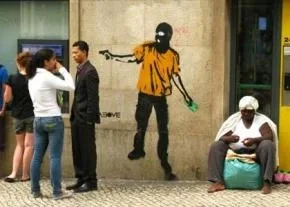
In Portugal, poverty is perceived as a constituent part of an unequal society
"In Portugal, as in many other Southern European countries, they were unable to build a social system similar to that existing on the north of the continent. For a long time, Portugal was too poor to afford a social security system, the construction of which essentially only began in the 1980s, after the Carnation Revolution of 1974. However, it does not allow for effective redistribution of income, especially under a far from ideal tax system.
"A similar situation – a combination of late creation of the social system, average income levels, slow productivity growth, problems in tax collection – leads to the persistence of high poverty levels in southern Europe. Mediterranean poverty is not endemic to Portugal," said Leonor Vasconcelos-Ferreira, an economist at the University of Porto, to Expert.
Indeed, in the countries of southern EU, the share of the “gray” sector of the economy, which is effectively tax-exempt, is large. This share varies from 23% in Portugal to 28% in Greece and Spain, which limits the ability of governments to collect taxes and redistribute income in favor of the poorest.
The limited capabilities of the government lead to the fact that many Portuguese do not even apply for social benefits. Thus, only half of the unemployed register with the employment office. The rest resort to help from relatives – after all, in southern Europe, family ties are still strong.
Cultural differences also play a role. "In southern Europe, including Portugal, poverty is perceived as a kind of innate given. Those born into poverty often do not even try to change anything, because it is perceived as an integral feature of the community in which people are born and live. This sharply distinguishes the perception of poverty in northern and eastern Europe, where people are more individualistic, which stimulates them to improve their standard of living through work and career. In Portugal, poverty is perceived as a constituent part of an unequal society, in contrast to the more egalitarian approach in northern EU countries," says Tiago Nunes, an employee of the charity foundation Caritas in Lisbon.
Indeed, according to Eurobarometer surveys, 53% of Portuguese consider poverty an innate condition; a slightly smaller share of respondents (45 to 50%) in Spain, Greece, and Italy agree with this view.
But the current economic crisis is leading to poverty affecting an ever larger share of Portuguese. Thus, over the past year, the number of recipients of aid through the Caritas foundation grew by 30%, or 60,000 people. The organization is unable to help everyone who turns to it for assistance. Another charity foundation, NutriAction, conducted a study that showed that 600,000 Portuguese do not get enough calories due to poverty. Moreover, some are on the verge of actual hunger. According to estimates by the social organization Banco Alimentar, which daily provides food for 240,000 Portuguese, 27% of the country's 10 million population are forced to go without food at least one day a month.
"This is absolutely terrible, ten years ago it would have been impossible to imagine. The situation with poverty in Portugal has deteriorated greatly since 2000, especially outside large cities. In rural areas and small towns, poverty is only increasing due to the economy's inability to ensure economic growth. The crisis has strengthened these trends," Isabel Branco, an employee of Banco Alimentar in the town of Braga in the far north of Portugal, told Expert.
This even affected the nature of migration: if until recently Portugal was a magnet for Brazilian migrants, then in 2009 the number of Portuguese heading overseas to rapidly growing Brazil exceeded the reverse flow for the first time.