
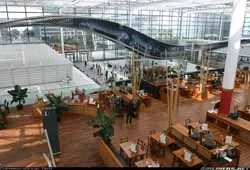
But the main air gateway of Bavaria - the largest and one of the richest federal states of Germany - lives not by beer alone.
Gateway to the Heart of Europe
Today's Munich Airport is two huge terminals from which 95 airlines operate their flights to 220 cities around the world. Among the air carriers are Air Canada, Air France, Air Baltic, British Airways, Germanwings, Air China, Finnair, Air Adriatic, Royal Air Maroc, "Aeroflot" and many others. A special place is occupied by the largest German airline Lufthansa, which not only performs a huge number of domestic and international flights from here, but also, as a partner with the city municipality, manages the airport.
The airport, named after the legendary Bavarian politician Franz Josef Strauss, who headed the state government for more than ten years, is also the largest center of domestic air transportation in the country. Every day, 90 flights operate from here to 21 German cities.
In the European ranking, Munich Airport ranks eighth in passenger traffic. But this is only for now. Experts consider it the fastest growing airport in the world, so there is every chance to squeeze competitors in the next two or three years. In 2005 the air harbor served 28.6 million passengers, and by 2008 it is expected to increase to 50 million people per year. To reach this level, the airport will need a third terminal and a third runway. Preparation for construction is already in full swing.
Non-Stop Service
Under this motto work the services of Flughafen Munchen. Everything here is the "most": the shortest transfer time in Europe - just 30 minutes, the most modern transfer terminal, the largest covered forum and car park... The list could go on. There is even a clinic where you can be hospitalized if necessary. You quickly go through all the formalities here - both on the way there and on the way back. Lufthansa, for which Munich Airport is almost a home, strives to reduce passenger check-in time to a minimum. Automatic check-in here, as in many European airports, is a matter of course, but the carrier went further: now you can automatically "check in" your luggage as well. As a result, you will have enough time for shopping, for which Munich itself and, of course, its air gateway are famous.
Shopping Tour
Any other airport would envy the shops here. The shopping area occupies a huge territory, where there is absolutely everything: supermarkets, boutiques of fashion and jewelry houses, souvenir and wine shops, pharmacies - in total about 200 stores. A pleasant detail: having recognized you as a Russian-speaking tourist, the Duty Free shops will not pointedly and politely speak to you in German or even English, but will immediately switch to Russian. The Germans have long realized that many Russians have problems with languages, and therefore in all expensive stores near the cash registers you can see Russian-speaking girls. After all, Russians spend a lot here: according to Global Refund, they make purchases in airport stores for €15.5 million a year and are considered "top buyers" here. Half of the guests are business travelers and businessmen.
After shopping, you can admire the airport's airfield: planes land, planes take off... The workaday life of the airport always fascinates the passenger-observer, who is still on the ground but will soon be in the air. By the way, this is the only observation terrace for visitors in the world opened after the tragic events of September 11, 2001.
Aero-Gourmania
Munich Airport is an Eldorado for gourmands. Here there are 33 restaurants, cafes and bars. Cuisines - Italian, French, Asian, international (snacks and fast food) and, of course, Bavarian. The most popular beer hall is Airbrau, the very one where the local, airport beer is poured. To fly to Munich and not try it would be unforgivable. At the threshold, guests are greeted by a waitress dressed in a dark green "Tracht". That is what the national Bavarian costume is called in German, which locals simply adore - both old and young. It is considered a certain chic to show off in Bavarian leather pants or a long, almost floor-length dress on the weekend before friends. "Gruss Gott!" the woman smiles at us sweetly (the greeting "Guten Tag!" more familiar to our ears is unlikely to be heard in southern Germany) and leads us to a large round table, right opposite the holy of holies of the restaurant - its own brewery.
Copper beer vats glow in the half-gloom of the establishment with a fiery red luster. In them, a divine hoppy drink is brewed. The beer here is live, from the barrel to the tap at the bartender's counter - two steps, and therefore it is drunk easily and with pleasure. Light, dark, filtered or not - for every taste. Snacking on salty Bavarian pretzels and Bavarian white sausages Weisswurst with sweet mustard, passengers and those who came to meet or see them off while away the time in Airbrau. Believe me, it is the highest pleasure... Beer and football
Germany has already been gripped by "pre-Olympic" fever: souvenirs, flags, T-shirts, mugs - everything is dedicated to the upcoming World Cup. The country literally lives in anticipation of the football championship, which starts on June 9. Munich will host six matches of the championship, including the opening match. It is clear that the city's Olympic Stadium cannot accommodate everyone. Those who don't get there will be able to watch the game... from the airport. A huge LED screen with an area of 44 square meters and a stand for 1,300 spectators will be installed in the forum area. All 64 games of the championship will be broadcast at the airport. And to make you even feel like you're at a stadium, an artificial lawn will be "planted" between the stand and the screen.
And finally, more about beer. Back in 1516, the "Beer Purity Law" was adopted in Bavaria. So, to this day, beer is brewed in strict accordance with this document, which defines the number of ingredients. Since then, their number has not changed: water, hops, malt, yeast, and no preservatives. Perhaps that is why Bavarian beer remains one of the best in the world.
Many tales, legends, and historical anecdotes are associated with beer here. One of them goes as follows: once during Lent, a rumor reached the Pope that Bavarian monks drank a lot of beer and therefore were too cheerful. He ordered this "strange" drink to be brought to him for a taste. The cunning monks gladly sent messengers to the Vatican with barrels of the freshest beer. There were no refrigerators in those days, and by the time the beer was delivered, it had duly turned sour. The Pope tasted it and grimaced: "What nasty beer this is. So let them drink it from now on - as punishment for sins and debauchery." That was exactly what the monks had counted on...
Natalya TIMASHOVA.
Novye Izvestia