
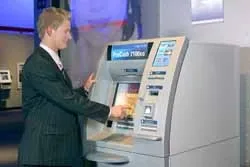
They say that the Russian version of Microsoft Word still doesn't know the word "bankomat," underlining it in red. Progress, as usual, leaves the lumbering software giant far behind. Or maybe Microsoft employs people who don't need cash on a Saturday morning, as happened 40 years ago to UK resident John Shepherd-Barron.
He worked at De La Rue, whose main business at the time was producing security paper for banknotes. But Shepherd-Barron was left without banknotes for the entire weekend because to get cash in those "olden days" you had to stand in line at a branch, and English banks were open only five days a week, from 9 a.m. to 3 p.m., and not a minute longer.
History (and the inventor himself, who at 82 lives comfortably in northern Scotland) does not reveal what exactly was not bought with the uncollected money, but by evening Shepherd-Barron was in the bath. Whether John Shepherd-Barron ran out of the water with a triumphant cry of "Eureka!" is also unknown. But it's no secret what exactly the inventor imagined while soaking in the bath and thinking about his problem: a chocolate bar vending machine. After his bath, Shepherd-Barron sat down to a family dinner. By then, the idea in his head had taken shape so clearly that the inventor was already discussing the concept of a personal identification number – a PIN – with his wife.
Shepherd-Barron knew his six-digit army number by heart and initially thought of making six digits the standard for the authorization code. But his wife Caroline confidently said she couldn't remember more than four digits. So the PIN code became four digits once and for all.
The subsequent history of the ATM, apparently, should make anyone who has dealt with ideas and their implementation not in "conservative" England but in the Eastern Bloc weep.
After washing up and talking with his wife over the weekend, by Wednesday Shepherd-Barron called a meeting at his paper company and presented the project. On Friday of that same week, De La Rue's management met with Barclays bank employees over a cocktail of gin and bitter from Trinidad and Tobago. The bankers agreed instantly. A few months later, the first ATM was grandly opened at a bank branch in north London. Today, these devices in the United Kingdom dispense £5,455 every second, 24 hours a day, 7 days a week.
De La Rue, it must be said, chose the right partner. Barclays had ordered the first bank computer in 1959, and a year before the events described, issued the first credit card. At that time, however, the concept of "cards" had nothing to do with the ATM. After the polonium story, this sounds a bit creepy, but the role of the plastic card in the first ATM was played by paper checks marked with radioactive carbon. As the inventor himself recalls, over time, as radioactive materials became more concerning, he calculated how dangerous such technology was. As it turned out, to harm your health, you would need to eat and digest 136,000 checks.
After recognizing the marks and entering the PIN, the ATM dispensed an amount not exceeding £10. However, as Shepherd-Barron recalls, that amount was quite enough for a carefree weekend.
At first, the ATM was called a "robot cashier," as these were times of romantic enthusiasm for progress. Over time, English settled on the professional term "automated teller machine" or ATM, the neutral "cash machine," and the colloquial "hole in the wall." Barclays, not shy about novelties, even registered the latter phrase as a trademark, and now all ATMs of this bank bear that inscription. In our country, the word "bankomat" has taken root, as in many other continental European countries, where along with this, other similar constructions are found (e.g., German Geldautomat and Bankautomat).
Nowadays, an ATM can be found everywhere except in orbit – there, not everything is free yet, but cash is still not accepted. On Earth, it seems the ATM will outlive both the demise of cash and the development of more advanced means of human identification than PIN codes and plastic cards.
It's hard to say where the northernmost ATM is located. It's possible that this London idea was pushed to the top of the planet by a resident of the British capital and governor of Chukotka, Roman Abramovich. The southernmost ATM is clear: it is simply located at the South Pole.
Guide dogs are now being trained to use ATMs, and this seems not too difficult a task, because, according to surveys, one in eight Britons admits to having successfully withdrawn money from an ATM while so intoxicated that they cannot recall how it happened.
Soon, there will be no need to remember numerous (corresponding to the number of cards lying around everywhere) PIN codes. Apparently, in the near future, ATMs will recognize cardholders by their faces. The concept of the PIN code may also be updated. Banks in the US are discussing the idea of introducing a so-called "emergency PIN." This system works as follows: if bad guys force you to withdraw money, you should enter not the usual code but an "emergency" one. The ATM will dispense money as if nothing happened, possibly saving your health, but at the same time, it will call the police to the transaction location, watch the scene with all hidden cameras, and maybe even give you marked bills. However, it's clear that this won't work in our homeland due to the well-known sluggishness of our law enforcement.
Cash is getting less and less room in this world. Servicing it costs money. It must be printed, transported, guarded, counted, disposed of, and so on. ATMs, however, easily handle such new tasks as paying for services and all kinds of tickets (from lottery to philharmonic), selling ringtones and other ephemeral goods. They can even accept donations: in one German monastery, slotted boxes were replaced with special ATMs that allow a charitable transaction without touching sinful banknotes. Finally, you can now get rid of banknotes by stuffing them all into the same ATM and increasing your non-cash assets by the amount present.
Thus, it's not long before the ATM returns to the function of its forefathers – selling chocolate bars, because by adding a laser barcode reader, you can replace a cashier in a supermarket... Already today in the UK, ATMs not only dispense 95% of cash but also sell stamps.
The ATM is a contemporary of Pamela Anderson and the Beatles album Sgt. Pepper's Lonely Hearts Club Band. For people who get their salary on a card, the sight of this gray box is perhaps just as charming, and the sound of the rising shutter of the cash dispenser just as pleasant as Lucy in the Sky with Diamonds. And until the cash withdrawal limit is exhausted, we will feel only gratitude to John Shepherd-Barron.
Yevgeny Paperny.
Lenta.ru