
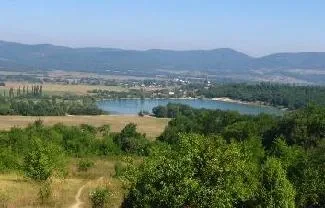
A trip through the Baydar Valley will be interesting for any tourist: here you can find monuments of ancient history, admire breathtaking views, visit waterfalls, descend into caves, and go horseback riding
The Baydar Valley – even its name, researchers do not know how to translate. There is the Turkic word "baytar" – a herbalist, there is "paydar" – magnificent, or Bay-dere – a rich valley, that is, generously filled with the gifts of nature – game, berries, mushrooms, springs. It is even allowed that the name could have come simply from an ancient clan name. The old names of its villages: Baga, Urkusta, Haito, Sakhtik, Savatka turned out to be so ancient that it is unknown to which language group they can be attributed.
However, it is not surprising that the valley has been inhabited since time immemorial. It is surrounded on all sides by mountains, has a length of 16 km and a maximum width of 8 km, while the natural amphitheater of the area is raised 260 meters above sea level. This unique configuration gave the Baydar Valley its own special climate.
In summer, while on the Southern Coast of Crimea and on the western coast the heat stands at around 30 degrees, in the valley it can be cool and even cold – 15-20 degrees. Of course, mini-hotels in Sevastopol will hide a tourist in air-conditioned coolness, but you can also get out of the room to plunge into real freshness. Clouds that come from the north may not pass the Outer Ridge for several days, filling Baydar with moisture. This feature allowed Soviet collective farms to harvest record crops of vegetables and grow high-quality varieties of tobacco.
Many tourists, who came to the sea but are drawn to ancient history or esotericism, spending holidays in Sevastopol or on the other side of the valley – in the villages of Greater Yalta, definitely visit Baydar to touch the relics left here at the dawn of humanity.
Here is a cult astronomical structure, presumably from the Stone Age – the Skelya Menhirs. These are vertically placed stone blocks carved from marble-like limestone. Only two remain: the large one – 2.8 meters high, and the small one – 1.2 meters. One can only guess where they came from, because there are no quarries nearby, and the cliffs are kilometers away from here.
It is hard to imagine how primitive people dragged stones weighing several tons. Occultists are sure that magic was involved. In support of this theory, facts are cited that the menhirs stand at the intersection point of underground rivers and have healing energy. It's easy to check – just touch the large stone – and your hand seems to feel a stream washing over it.
For connoisseurs of less distant history, the Baydar Valley has a mass of other relics, contemporaries of our era. Among them is known Tash-koy – Stone Village – one of the Taurian burial grounds, of which there are many in the valley. "Taurian boxes," as tourists call the tombs, are 2500 years old.
And would you like to walk the road that Roman legionaries paved 2000 years ago? The Baydar Valley is crossed by the Kalend Trail – Via Militaris, whose stones remember the sandals of soldiers of the legendary empire. Along this well-trodden path from such distant times, you can get to the village of Shirokoye – former Biyuk-Muskomya, from there it led along the slope of Mount Samnalykh to the village of Morozovka – Alsu, and from there along the bank of the Black River to ancient Chersonesus.
There are many wonders in the Baydar Valley – these are the surrounding peaks of Karadag, Syundyurlyu-Kobasy, Laspi rocks and mountains Chelebi, Kush-kaya, Shaburla, Ilyas-kaya, Sandyk-Kaya, and passes, and forest waterfalls and caves, where you can read greetings from pre-revolutionary tourists. To get acquainted with the valley, one day will clearly not be enough; it is better to stay here for the weekend or longer – especially since Baydar has comfortable recreation centers and private boarding houses.
_