
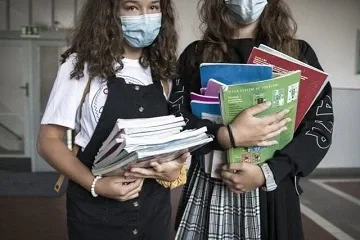
New system will help foreign children better master the Czech language
As Radio Prague notes, until now preschoolers and primary school students had the right to Czech language classes as part of preparation for education. However, the system was unrefined and inflexible, because kindergarten and school directors were forced to apply for special projects lasting one or two weeks only once a year.
The Ministry of Education's attention to this state of affairs has been drawn for several years by both specialized organizations helping foreigners adapt in the Czech Republic (for example, the Meta society) and schools themselves or regional administrations.
The current innovation is that each region must have at least one school where children in need of language preparation will receive Czech language lessons. It is important to note that this applies exclusively to children with foreign citizenship and zero or insufficient knowledge of Czech for schooling.
"This is indeed a so-called 'survival course.' Depending on the level of preparation, a child is entitled to 100, 150, or 200 hours per year, which is essentially very little. 200 hours are intended for children with zero knowledge. If divided over 10 months, that's only five hours per week. However, it is still better than what was available before.
It is also important that classes are held during school hours, and teachers must adapt regular instruction for these children. This was not the case before. Of course, teachers were accommodating, but now the methodological guide clearly states that such students should be assessed proportionally to their language knowledge so they can successfully integrate into the learning process," says Kristýna Titěrová, program director of the Meta society.
Although the new system does not apply to children for whom Czech is not native but who, for example, were born in the Czech Republic or have Czech citizenship, there is a separate system of support measures for them. To be included, a child must visit a Pedagogical-Psychological Counseling Center, where specialists determine their language proficiency level and then recommend additional classes.
The problem, however, according to Kristýna Titěrová, is that many parents do not want to take their children to such a counseling center, thereby depriving them of the help they could receive. Currently, only slightly more than 300 foreign students in the Czech Republic receive such support. Meanwhile, according to available data, over 28,000 foreign children are enrolled in primary schools.
"The Pedagogical-Psychological Counseling Center is a school counseling institution, and every school can provide parents with information about which counseling center pertains to that specific school. Of course, parents can also choose any other. But they should under no circumstances let themselves be talked out of it, because often these counseling centers say they are unable to test the child since their only limitation is the Czech language, and the centers are not yet accustomed to this.
And most importantly, there are indeed no specialists in Czech as a second language or specialists in educating children with a different native language. The psychologists and educators working there specialize in working with children, for example, with attention deficit disorders or learning difficulties. We strive for this to change, so we wholeheartedly welcome the new system."
The Meta society serves as a kind of link between families of foreign children in need of language preparation and the educational process in schools. The society's social workers help parents establish communication with the school where the foreign child enrolls and help them adapt there.
In addition, Meta conducts additional Czech language classes and language courses for children and adults. For example, there is a one-year course for children aged 15 and older who have recently arrived in the Czech Republic and thus have no opportunity to independently prepare for challenging entrance exams. This course helps them acquire communication skills in Czech and, with further support, integrate into the educational process.
The society also conducts courses for teachers working with foreign children and engages in advocacy. As Kristýna Titěrová explained, the existing system of final and entrance exams is essentially discriminatory towards foreigners. Therefore, now that changes have occurred in the language support system, the Meta society will have more opportunity to address this issue.
How will Czech language instruction proceed under the new system? "The school where classes will be held is determined based on the number of foreign children enrolled. An educational institution where the number of students with foreign citizenship exceeds 5% automatically enters the system. Regions were supposed to negotiate with these schools, find out whether they have the conditions for conducting such classes—teachers, premises, equipment.
All this happened in a very short time because the methodology was only made available at the end of the holidays. So there are still many uncertainties. Of course, it's not just about the formal 5%. These must be students who actually need additional language study, so testing is conducted first. I emphasize that this is really only for beginners with a maximum level of A2," explains Kristýna Titěrová.
A major advantage of the new system is that it will include a truly large number of schools. For example, in some districts of Prague – even all schools. As the program director of the Meta society added, although the project is not directly intended for children with dual citizenship or children from mixed families, this does not mean that such children cannot participate in it. Undoubtedly, if necessary, they too will be able to attend additional Czech language classes.