
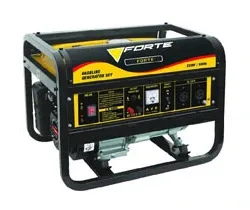
Mini power plant or generator – a backup power source for a country house
As a rule, mini power plants with a capacity not exceeding 6 kW are used as auxiliary or emergency power sources. They can have either a gasoline or diesel engine. The advantages and disadvantages of this type of unit are well known to those who have even a basic understanding of cars.
Diesel generators are significantly more economical than devices with a gasoline engine, they start more easily in automatic mode, and have approximately 20% longer service life. However, unpretentious and reliable diesel generators are much more expensive than gasoline ones – for comparable power, you will have to pay 2-3 times more for a diesel mini power plant.
For this reason, the benefits of purchasing a generator set with a diesel engine are obvious for frequent and prolonged (over 2 hours) power outages. If outages occur occasionally, it is recommended to buy a gasoline mini power plant.
Gasoline generators are equipped with two-stroke and four-stroke engines. The former are compact and lightweight. In addition, they have no oil sump – oil is added to the fuel tank, making the engine easier to start in cold weather. Mini power plants with two-stroke engines have become favorites among tourists, geologists, hunters, and reindeer herders. Their power is sufficient not only for heating and cooking outdoors, but also for powering radios or music-playing equipment.
The advantages of two-stroke engines are offset by their “gluttony,” noise, and limited 1 kW power, which is insufficient for emergency home power supply. In this case, a mini power plant with a four-stroke engine, whose cold start has been successfully solved by leading manufacturers, would be appropriate.
There is also a new development – inverter generators, in which the rotor is placed on top of the stator, not inside it. This design solution makes generators more compact devices. It is also important that generators of this type maintain high stability of output voltage and frequency, outperforming a regular electrical grid. When powering a computer and other expensive electronic equipment from such a generator, a household voltage stabilizer is not required – a simple surge protector is sufficient. Sometimes inverter generators are used as uninterruptible power supplies.
The power of inverter generators (due to design features) is low – from 0.7 to 6 kW. At the same time, their cost is approximately 2.5 times higher than that of comparable non-inverter generators. Using such devices solely for household purposes is impractical. But for users of computer, video, and audio equipment that require high-quality output current parameters, inverter generators are ideal.
We also note that a house typically has three-phase wiring. When using a two-phase generator as a backup power source, the most important consumers of electricity should be connected to it so that they all end up on the same phase. This can be achieved during the design stage of the house's electrical wiring.
According to experts, a mini power plant with a capacity of 5.5-6 kW (with a two-phase or three-phase generator) is optimally suited as a backup source for a country house, although a lower power device may suffice.