
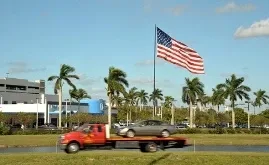
Americans know how to make good cars. So it's no surprise that new cars from the USA are shipped even overseas
The average American is the most polite, the most prudent, and always ready to help driver. In America, EVERYONE drives a car. Starting from 16-year-old schoolchildren and ending with the very elderly. For older people, driving a car is practically the only means of transportation and entertainment. Although the state tries to take away this right from them by arranging retests and driving exams after age 80, many 90-year-old elders continue to "lace" highways in sports convertibles.
In schools from the 11th grade, everyone drives their own cars. There is no stereotype here that a woman behind the wheel is a bad driver. A female driver is a more common phenomenon than a male driver. Children and the elderly feel comfortable driving, primarily because the manners on the roads are not as harsh as ours, and examples of domestic road lawlessness cause drivers' incredulous laughter.
Driver's licenses are the main means of identifying citizens and serve as a full-fledged identity document. Nobody carries a passport with them. It's pleasant to fly mile after mile in a car on smooth American asphalt! But although paid freeways in America are marvels of engineering, our patches on free local roads, holes in the asphalt from winter salt, and cast-iron manhole covers do not let us forget our beloved homeland.
There are three main sacred things of road traffic in America: the fire hydrant, the school bus, and His Majesty the Pedestrian. The reasonableness of the ban on parking within a 6-meter zone of an always functional fire hydrant is beyond doubt. The fines for this violation are mind-boggling!
In America, they have always taken very seriously the movement of children on roads and city streets. The school zone is marked by numerous flashing yellow traffic lights, various inscriptions on the asphalt, and signs prohibiting speeds over 20 miles per hour. In the morning and afternoon, when school starts and ends, special "child police," often women working part-time, block streets and escort children across the road to their homes. All cars obediently stand still.
When children are taken on a school bus to lessons or home and one of the schoolchildren needs to get off or get on, the driver flips out a special "Stop" sign on the side of the bus, turning on the light "police" signaling. At the moment when little Johnny descends the steps of the school bus into the arms of his waiting mom, the automotive life on the road completely freezes. Passing a stopped school bus with flashing signal lights is the worst crime for American drivers! In automotive America, yielding to a pedestrian is very demonstrative. The car freezes on the street that a person, still on the sidewalk, is about to cross.
The first feeling is that drivers in the USA are very passive. No one will overtake, even if the oncoming lane is clear for 2 miles ahead. Slow traffic jams forming on narrow roads do not bother anyone. It is customary to exceed the speed limit by 5-8 miles - they don't fine for that. But for 10 miles over, they will issue a huge fine of $200.
On major four-lane highways, the speed limit is 65 miles per hour, which is quite slow for these wonderful roads. With a permitted speed excess of 10%, it works out to just over 70 miles. And that's how they drive! Your car's speed can be measured from a moving police car in the same or opposite direction, as well as from traditional ambushes in the bushes on highways and forest roads.
In Massachusetts, only the police officer who physically measured your speed can stop and issue a fine. So they measure it, then chase and stop you. They will send you a fine receipt by mail with a photo of your car taken by a city video camera or a police operator from a helicopter. You can drink while driving, but a little. The limit after which an officer can issue a fine is two cans of beer.
There are also some funny details in American driving rules. When changing lanes, a driver in America is obliged to look over his shoulder to check if there are cars behind. The use of rearview and side mirrors is auxiliary. This seems strange to us. Also, our domestic motor tourist is puzzled by the presence of a "Stop" sign on every street leading to the same intersection. If the intersection is uncontrolled, they do without "right-of-way from the right". Approaching such a place, everyone first stops, and then the one who first arrived at the intersection goes first.
In many states, a right turn on red is allowed after stopping, if traffic permits and there is no prohibiting sign. A double solid yellow line has the same meaning as in Europe: crossing it is prohibited. But if you are turning onto a road leading to a house or exiting it onto a highway, crossing the double solid line is allowed and will not be equated by any American traffic cop to driving into the oncoming lane with subsequent arrest of your driver's license. A European driver must be constantly attentive even during the simplest lane change maneuvers on freeways, because in America overtaking from both sides is allowed.
And here is what is very important: in the USA, it is forbidden to stop cars for document checks outside of fixed checkpoints, roughly speaking, local traffic police. No one has the right to stop a person or a car for any inspection if there is no violation of the law or traffic rules. American police officers work for you and actually protect you.
To get used to the tension in the presence of a police officer, many of our citizens need a long time. Stories about the adventures of roadside militiamen with striped batons are perceived by Americans as jokes. If a police officer stops your car, getting out of the car and saying: “Listen, chief, let's come to an agreement...” is strongly discouraged. Police officers here do not take bribes.
Владимир МАШАТИН.
