
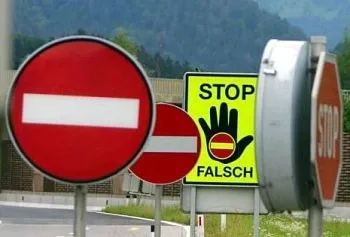
On German autobahns you can find special road signs
High speeds are a zone of increased danger with special traffic rules. Reaction time in critical situations is a matter of fractions of a second.
On autobahns, you must maintain a distance – at least half the speedometer reading in meters, i.e., 60 meters at 120 km/h, 100 meters at 200 km/h. Reversing is prohibited, including on the emergency lane (Standspur), not to mention making a U-turn.
The carriageways of the autobahn are separated by metal crash barriers (mittlere Schutzplanke) or concrete barriers (Betonleitwand). Therefore, entering the autobahn against the direction of travel becomes a kind of trap. It is impossible to turn around without police assistance without risking deadly danger to yourself and others. This is strictly prohibited.
In the event of an accident during such a maneuver, the offender faces imprisonment of up to five years, if they survive. If the driver, upon realizing the mistake, follows police recommendations, they may get off with a fine and a driving ban for several months. A panic reaction in such situations is understandable, but it is precisely this that leads to tragic consequences. Experts, however, emphasize that many people in such situations instinctively act correctly.
If such a problematic vehicle appears somewhere on the highway, radio stations broadcasting in that region immediately interrupt their programming. The start of emergency messages is accompanied by a signal to which radios respond by increasing volume, switching channels, or turning off the music player.
According to the General German Automobile Club (ADAC), such messages are broadcast about three thousand times a year, that is, eight to nine warnings per day (according to other sources, about five warnings per day). Experts believe that only one in these cases involves a real situation. The remaining warnings are the result of stupid jokes or false alarms.
At the end of each warning, a standard phrase is spoken, known by heart to most German drivers: "Bitte bleiben Sie äußerst rechts und überholen Sie nicht. Wir informieren Sie, sobald die Gefahr vorbei ist" – "Keep to the far right and do not overtake. We will inform you when the danger is over."
Three thousand warnings on air is just one figure. The German Ministry of Transport assumes that about 1,700 such situations actually occur annually on German autobahns, including those ghost drivers who go unnoticed, dashing to the next rest area where they turn around and disappear into traffic.
Once, the ADAC club analyzed the German press in detail for information about ghost drivers in editorial materials over a year. Nearly 150 cases were described in articles and reports. About 80 such trips against traffic ended without accidents, more than 60 in collisions. The number of fatalities was 20, and another 86 suffered serious injuries.
The real figure is higher. In 2015, 3,475 people died on German roads, about 380 of them on autobahns. At least twenty people – due to "ghosts," including the drivers themselves.
Drivers end up on the wrong side of the autobahn due to inattention, fatigue, alcohol or drug intoxication, poor visibility (e.g., at night, in fog, snow, or heavy rain), or intentionally, in the case of suicides.
The Federal Highway Research Institute (BASt) conducted a study to find out when and where drivers become ghosts. About 33% make mistakes at interchanges and entrances/exits of autobahns. In Italy and France, such problems are virtually unheard of. Autobahns in those countries are toll roads, and entry is only possible through toll booths.
Another 16% of cases involve U-turns on the autobahn carriageway. This often happens deliberately when someone misses the desired exit or goes in the wrong direction. Instead of reaching the next interchange or exit, some drivers, especially under stress and time pressure, decide to make a U-turn against all rules, hoping to slip through. Experts explain such behavior as nothing short of temporary insanity. This 16% also includes those drivers whose cars spun around on slippery roads or due to an accident, and then mistakenly drove against traffic.
About 7% of drivers enter in the wrong direction from rest stops or parking lots at roadside service centers (Autobahnrastplatz, Autobahnraststätte). Four percent – on sections under repair.
According to ADAC data, 26% of drivers notice their mistake almost immediately, i.e., stop within 100 meters or earlier; 34% – after driving less than 500 meters; 17% – less than one kilometer; but 23% continue driving... Several years ago, a suicidal driver managed to drive eight kilometers against traffic on the A28 autobahn. In a head-on collision, he and four people in a car that happened to be in the wrong place at the wrong time died.
Suicide is also one of the reasons for ghost drivers, as are so-called youth courage tests, but the percentage of such cases is minimal.
What to do if you become a ghost driver?
• Turn on the hazard warning lights and low beam headlights if you were driving without them. In Germany, low beams are not mandatory during the day, but on autobahns it is always recommended to have them on.
• Pull over as close as possible to the nearest edge of the carriageway and stop.
• If the car is closer to the left edge, that is, driving against traffic in the fastest lane of oncoming traffic, do not try to change lanes through one, two or several rows to pull over to the emergency stopping lane, but stop at the median divider.
• With utmost caution, leave the vehicle. If a reflective vest is available, put it on and place a warning triangle at a sufficient distance in front of the car. When moving, stay behind the guardrail.
• Call the police at 110 or via an emergency call box (Notrufsäule). They are installed every 500-2000 meters.
• Under no circumstances attempt to cross the autobahn, even if it seems empty.
• Wait for the police to arrive between the protective barriers in the central median of the autobahn if the car ended up in the left lane, or behind the metal guardrail on the shoulder if the car is in the side emergency stopping lane.
• Do not attempt to turn the car around on your own before the police arrive.
How to behave if you hear a danger message on your route?
• Immediately start reducing speed to prevent the car from skidding in case of an emergency maneuver.
• Do not overtake and move to the far right lane. In heavy traffic and if unable to change lanes to the right, significantly increase the distance.
• Turn on the hazard warning lights to alert other road users.
• If possible, pull into the nearest parking lot and wait for the all-clear on the radio.