
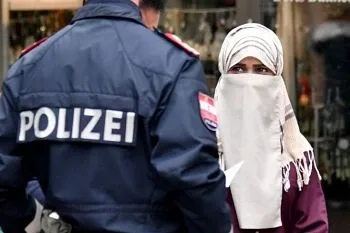
A law banning face coverings in public places has come into force in Austria
As RFI notes, a similar ban is already in effect in France, Belgium and Bulgaria. Despite the fact that such bans are usually called "laws against the burqa," they apply to all citizens of the country and may also concern motorcycle helmets, medical and carnival masks, balaclavas, and even scarves pulled up to the eyes.
The Austrian government has issued a booklet explaining the new law: under images of women in burqas and niqabs there is a clear indication "Forbidden," and under an image of a man in a clown mask – "Allowed under certain conditions." From now on, Austrians may wear a mask only during cultural events or in connection with professional obligations. Masks covering the mouth are permitted exclusively for medical reasons, and a scarf pulled up to the eyes – under appropriate climatic conditions.
The Austrian Ministry of the Interior will monitor enforcement of the law. Violators face a fine of 150 euros, and if they refuse to uncover their face, they may be taken to a police station.
The law is based on a similar document that was adopted in France in 2010 and came into force in April 2011. The Austrian government used the French law for one simple reason – it is a guarantee that the application of the new act will not encounter any legal obstacles.
In 2014, the European Court of Human Rights issued a ruling that supports the ban on wearing the burqa in effect in France and Belgium. The court's ruling states that "citizens do not wish to see in the public space a demonstration of customs and behaviors that call into question the very possibility of open communication between people, which, as is obvious, is an integral part of social life in society."
The Muslim community in Austria has already condemned the new law, calling it "Islamophobic." There is less criticism from politicians, as the law is supported not only by the far-right but also by the ruling coalition, which includes the Austrian People's Party (ÖVP) and the Social Democratic Party of Austria (SPÖ). The President of Austria, leader of the Green Party Alexander Van der Bellen, some time ago condemned the law, stating "that every woman has the right to dress as she wishes."
The new law was adopted two weeks before the parliamentary elections in Austria and, according to experts, cannot go unnoticed during the election campaign.