
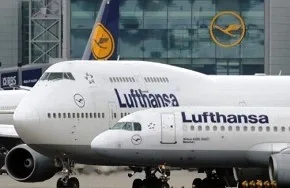
Starting next year, German airlines will pay taxes for each passenger depending on the distance the person flies
The German government has decided to introduce a tax on passenger air travel. From the beginning of 2011, airlines will pay taxes for each passenger depending on the distance the person flies. This will be a three-tier tax: 8 euros per passenger for short-haul flights, 25 euros for medium-haul (from 2,500 to 6,000 km) and 45 euros for long-haul (over 6,000 km).
At the same time, freight transport, as well as transit routes and private plane flights, are not subject to the new tax, since this market segment is actively recovering after the crisis.
The introduction of the air travel tax is part of the government's program to combat the budget deficit caused by the financial and economic crisis. In early July, Germany approved a new national budget plan. The state planned to cut spending by 3.8%, to 307.4 billion euros. Thus, over four years, Germany will be able to replenish the state treasury by 80 billion euros. The budget law is to be adopted in November.
With the help of the aviation levy, the authorities expect to replenish the treasury by 1 billion euros. As German Finance Minister Wolfgang Schäuble noted, the additional burden is quite acceptable for airlines. They will raise ticket prices, experts say: the cost of a flight will increase by at least the amount of the tax levied. The price increase will be from 10 to 54 euros, and consumers who use discount airlines will suffer the most, says Dmitry Adamidov, co-head of the analytical department of Investcafe. The consequence will be an outflow of passengers.
But the measure is not to the liking of large companies either: a Lufthansa representative stated that he absolutely does not understand why a double-sized tax is proposed for long-haul flights, and suggested that air passengers would en masse prefer to depart from neighboring countries.
After the introduction of the new tax, Germany will lose up to 5 million air passengers annually, said Ralf Teckentrup, president of the Federal Association of German Airlines, who is also head of the airline Condor. In his opinion, this government initiative will lead to a shift of at least 10,000 jobs from Germany to airports and airlines in other countries where such a tax does not exist.
A similar tax was introduced by the Netherlands in 2008. However, as Gazeta.Ru notes, its example proved unsuccessful. The cost of a plane ticket increased by 11.25-45 euros per passenger departing from any Dutch airport, which led to a weakening of demand from customers. In the spring of last year, the country abandoned these levies. "The tax represented a loss of 312 million euros for the Dutch economy. Air transport is an important part of it. Abolishing the tax was the right decision... It will help boost the economy and build a competitive future," admitted Giovanni Bisignani, Director General of IATA (International Air Transport Association). "But this is only the tip of the iceberg," he added. "Last year, airlines experienced a crazy increase in taxes of $6.9 billion. This has completely negative results – weakening demand and new costs for businesses. Such collective madness must stop."
It is high time for the Irish government to follow the same path and abolish the new flight tax. It is also time for Britain to realize that its passenger levy is hindering the development of one of its main economic catalysts, while the government spends billions on helping other affected sectors of the economy.