
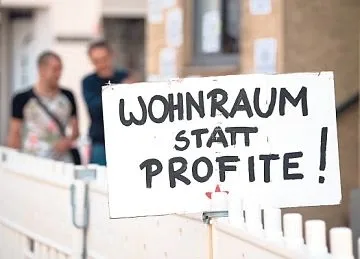
Germans hope for a reduction in rent for rental housing
In order to combat the shortage of cheap apartments, the Bundestag decided to tighten measures. Rent levels are to be limited and cannot exceed 10% of the average rent in that region. In addition, as noted by "Russkaya Germaniya", tenants will in future be able to demand their "overpaid" money back from the landlord.
All this, of course, does not apply to all apartments and all regions of Germany. As a rule, it concerns not new buildings but existing apartments (houses) in the event of a change of tenant and the conclusion of a new rental contract. In principle, this rent cap, which in German is called the "rent brake" (Mietpreisbremse), was introduced at the federal level as early as summer 2015.
After moving in and concluding a new contract, tenants cannot pay more than 10% of the average regional rent. This applies to regions with a so-called "tight housing market"; the federal states themselves determine such areas. Apart from new buildings, this rule does not apply to renovated apartments, nor to housing that was already more expensive than the "average" rent for the previous tenant.
The rent index (Mietspiegel) is regularly compiled in most large German cities. Previously, such an index was calculated for four years; it depends on the region, construction, and quality of the building. Under the new coalition decision, the Mietspiegel will now be determined for six years. "Local rents will thus be artificially kept at a low level," believes real estate expert Michael Voigtländer, an employee of the German Economic Institute.
The innovation introduced by the Bundestag in February 2020 will not affect all German cities. The "frozen" rent has covered, since 2018, only 313 of the country's 11,000 cities and municipalities. 28% of the German population lives in them – about 23.5 million people. First and foremost, these are large metropolises such as Berlin, Munich, Frankfurt and their suburbs; in addition, these are not very large but very popular regions for tenants, for example, Jena and Brandenburg.
In addition to the rent cap in these regions, tenants will also receive other benefits. For example, they will now be able to demand from the apartment owner overpaid amounts for rent "retroactively." Moreover, this can be done not even in writing, but by ordinary email. Until now, the landlord was obliged to pay the "surplus" rent from the moment the complaint was filed; in the future, it will be possible to demand Miete for the past two and a half years! The main thing is to file a claim within 30 months.
Incidentally, tenants have the right to demand overpaid amounts even after moving out of the apartment. With this decision, the Bundestag again protects the rights of tenants, because currently many citizens do not file claims for overpayment because they are afraid to get involved with landlords.
And how will the landlords themselves react to this innovation? Real estate expert Michael Voigtländer believes that the new rule will force many owners to convert rental apartments into those intended "for own use" and then sell them. However, the Social Democrats and Christian Democrats want to complicate even this, already not simple, path of changing the form of apartment use.
Large housing associations such as GdW, Haus & Grund and Bundesverband Freier Immobilien- und Wohnungsunternehmen also criticize that the rent cap will be extended while no real measures are taken against the housing shortage. The requirement to return "surplus" rent for the past 2.5 years will particularly affect small landlords, who already feel insecure in light of recent government decisions, according to the leaders of Haus & Grund.
Economist Michael Voigtländer sees a "very strong encroachment on owners' rights" in the restriction on converting rental apartments into housing for own use. The Haus & Grund association also agrees with this opinion: "Private landlords do not sell their apartments if they can make money from renting. They do so only if the government, which is hostile to owners, leaves them no other choice."
Incidentally, the new rules met with criticism not only, as expected, from owners. The Tenants' Association (Mieterbund) is dissatisfied that the "frozen" rent does not apply in all regions of the country. The parliamentary opposition also reacted skeptically to the Bundestag's decision. The leader of the FDP faction, Marco Buschmann, called this decision "adding fuel to the fire of an already difficult housing market." "We need to build more apartments, not expand bureaucracy," the faction leader is convinced. The member of the Greens faction responsible for construction and housing policy, Chris Kühn, even demanded that the federal government "urgently" create more affordable housing.
However, the new rules should partially ease the burden on homeowners as well, not just tenants. For example, when purchasing real estate, the broker's fee will no longer be fully passed on to the buyers as before, but will be split equally between the new and former owner. According to statistics, 500,000 apartments and houses in Germany change owners annually, two-thirds of such transactions are carried out with the help of a broker.
According to experts, the new rules will reduce the excessively high "broker fees." After all, from now on, the seller will be able to either directly negotiate prices favorable to themselves with the buyer of the property or, in principle, do without the help of an intermediary.