
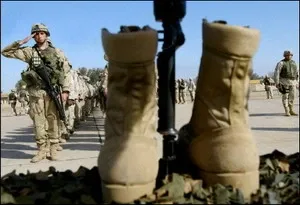
At the end of January, the Pentagon began a planned rotation of military contingents in Iraq and Afghanistan. Meanwhile, as the servicemen themselves heading to hot spots admit, the “planned” event is proceeding in an emergency mode. The fact is that, as became clear during the Iraqi campaign, the American army is acutely short of personnel. They are trying to solve the problem by a mass call-up of reservists. However, doctors, teachers and other civilians listed in the ranks of the National Guard will not solve the problem of a catastrophic shortage of personnel for combat units. The all-volunteer American army needs professional volunteers, who are becoming fewer and fewer among US citizens. The administration of George W. Bush sees a way out in expanding the practice of recruiting foreign mercenaries. As a reward for service, they are offered US citizenship out of turn. This recipe for replenishing the ranks of the nation’s defenders seems to be the only thing that makes the American army akin to the Russian one.
The Theory of the Boot
Military theorists have recently been sharply criticizing the classic postulate: a war can be considered complete only if the enemy’s territory is under the boot of the victorious army. And the Americans were at the forefront of the debunkers. In 1996, the doctrine of Harlan Ullman and James Wade, Shock & Awe, which elevates technological superiority to an absolute, came to replace the Decisive Force doctrine, which was professed by current Secretary of State Colin Powell in 1991 during his tenure as chairman of the Joint Chiefs of Staff and which placed the development of ground forces at the forefront. And at the first stage of the Iraqi campaign, it justified itself.
Problems began later, when it became clear that even in the era of high-tech wars, one cannot do without the reliable soldier’s “boot” – the notorious personnel. The crisis broke when, under pressure from congressmen and the public, the Pentagon had to declassify aggregate data on losses in Iraq. Even observers who had meticulously tracked scattered reports of incidents in which Americans were killed and wounded were, to put it mildly, surprised. According to Pentagon data, the number of so-called irrecoverable and medical losses of the United States in Iraq at the end of last year amounted to 9,248 people – almost a division. This number includes 420 killed and 1,967 wounded directly in clashes with Iraqi partisans. In addition, irrecoverable losses include those who were taken out of action due to illness, those killed and injured in aviation and automobile accidents, and simply those who were tired of fighting. According to American military officials, the “normal” level is considered to be eight to nine suicides per 100,000 servicemen, while in Iraq this figure was 17 per 100,000.
The Pentagon had to admit that the attractiveness of military service, despite decent pay and significant social benefits, has sharply declined among “real” Americans. When, on the eve of the new year, it became time to decide to bring up a second echelon to replace tired and war-weary units in Iraq and Afghanistan, George W. Bush had to sign the law “On granting citizenship to servicemen,” according to which the procedure for naturalizing foreigners serving in the US armed forces has been significantly simplified and accelerated (from three years to one year). Moreover, citizenship can now be obtained outside the United States as well. In fact, the medieval tradition of European armies is being revived, when professional recruiters rode around towns and villages, calling adventurers of all kinds to serve any king and fatherland.
However, that is not all. Foreigners have served in the American army before. But now they have a chance to turn from a military minority into a majority. The same guest workers who are currently under arms in the US armed forces have received the opportunity to become American citizens in the shortest possible time. And not only them. Recently, by order of the president, citizenship out of turn was granted to the parents, who had been living illegally in the United States, of two soldiers from Costa Rica who died in Iraq. In total, according to some data, about 40,000 US servicemen who took part in combat operations in Iraq did not have American citizenship.
It is possible that the simplified naturalization procedure for foreigners serving in the US army will to a certain extent contribute to solving the staffing problem. For now, however, the Pentagon has ordered seven thousand American soldiers from the Afghan and Iraqi contingents whose contracts have expired to remain on active duty.
The Legend of the Janissaries
Today, the share of foreigners in the US army is only 2% of the total number of servicemen, and a good half of them have been through Iraq. It is expected that with the entry into force of the new law, foreigners in the US army will already become 10%, or maybe even more. But will such an army be purely American and fully loyal?
In the Russian army, the situation with manning is very similar to the American one. It is well known how selflessly our compatriots can pray to gods, especially foreign ones. Having become infected with the concept of high-tech wars, strategists from the Russian General Staff not only scrapped many combat-ready ground forces units and subunits, but also eliminated the Main Command of the Ground Forces. Then they came to their senses and restored this "time-tested management body," but the statistics are still not in their favor. According to the Commander-in-Chief of the Ground Forces, Deputy Minister of Defense Colonel-General Nikolai Kormiltsev, today the share of ground forces in the U.S. Army is 46%, the UK - 48%, Germany - 69%, China - 70%, while in Russia, with its vast expanses and border length, it does not exceed 30%. To eliminate this disparity, more soldiers are needed. The military department expects to solve the problem through contract soldiers, recruited including from abroad (we are, of course, talking primarily about CIS citizens).
It is clear that this is being done out of necessity. Russia and the USA are today the only countries ready to attract foreign mercenaries in large numbers and grant them citizenship under a simplified procedure. It is noteworthy that even on the eve of the invasion of Iraq, Democratic congressmen Charles Rangel and John Conyers proposed restoring universal military conscription, abolished in 1973. First, so that those who make the decision to start combat operations know that their children could also end up in the war. Second, the congressmen suggested Americans think about whether their army should be manned mostly by people with low incomes (exactly like ours) and representatives of minorities. And now also foreigners...
At least historical experience shows that foreign mercenaries have not always served faithfully, and the loyalty of the Janissaries to their new fatherland is nothing more than a legend. For example, in France (in addition, foreigners are accepted into the armed forces of Saudi Arabia, the UAE, India, and the UK), citizens of other states can serve only in the Foreign Legion. The right to obtain French citizenship comes only after six years. And the Nepalese Gurkhas, no matter how long they serve the British Crown, cannot even count on obtaining a residence permit in the United Kingdom.