
Language schools around the world resolutely answer: in no way. It turns out that you can study not only at a desk. Today, many services offer free English learning for those who cannot get farther than their own home. But you can also learn English by traveling through rugged terrain, plowing water expanses, diving to the seabed, and soaring above the earth.
Of course, you can find adventures anywhere, even under the capital, not to mention various European countries. But is it so interesting to go kayaking along a familiar puddle or wander over hills crowded with tourists? Is that what a true adventurer craves? After all, there is so much interesting and unexplored in the world, and some countries seem to be intended by nature itself for seekers of adventure and lovers of active pastime.
On seas and corals
Take Australia, for example. This is a continent that is intriguing by its very geographical location - in the Southern Hemisphere, from a European's point of view, at the edge of the world. Of course, this country is quite civilized, and do not hope that they will paint you with a ritual tattoo like Paganel, or eat you like Cook. The times when English criminals were exiled here are also long gone. So you will simply be placed in a comfortable hotel or a hospitable family home and taught English using the most advanced methods. And in your free time from classes, you will reward yourself for your diligence, wholeheartedly quenching your passion for an active - so that it takes your breath away! - lifestyle.
The Australian language school Cairns College of English is very well located from this point of view - in the city of Cairns, which is considered the center of exoticism even on the exotic Fifth Continent. And no wonder: on one side is the Coral Sea and the famous Great Barrier Reef, on the other - wet jungles and mountain peaks. Therefore, extreme students will find it delightful here. In addition to English lessons (three days a week), you can choose the “Reef Safari” program - a full-fledged diving course with the issuance of a diver’s certificate, rafting on inflatable rafts along the stormy mountain river Tully, and, for variety, a trip to the mountain village of Kuranda, where you will be taken by an old-fashioned train along a prehistoric railway passing through tunnels, gorges, and forests.
Those who are not attracted to communicating with the inhabitants of the underwater world will probably prefer the “Tropical Safari,” which includes hikes around the islands of the Great Barrier Reef and horse riding. Plus, again, rafts and a trip to Kuranda. And participants of the “Eco-Safari” will face difficult forest hikes with overnight stays.
Traces of unseen beasts
No less exotic is New Zealand, which, contrary to the opinion of some not very sophisticated citizens, is not at all part of Australia, but a separate, very distinctive island state. Although it is located there, in the land of antipodes, that is, in the Southern Hemisphere. And surely after watching the movie “The Lord of the Rings,” the number of people wishing to visit New Zealand and take at least a glimpse of the amazing nature of this country has sharply increased. A country in the most protected part of which grow tree ferns, those that dinosaurs chewed, where you can stumble upon crawling ancients - a descendant of the same dinosaurs, the spiny tuatara lizard, or a giant snail - and meet the cutest bird, the yellow-eyed penguin. Where there are almost English green hills and meadows, mountains up to four thousand meters of volcanic origin, wild tropical bush and forest. And also geysers, hot mineral springs, lakes, waterfalls.
It must be said that the inhabitants of New Zealand, who call themselves “kiwis” (not to be confused with the bird and fruit of the same name), are big fans of various sports, from surfing and windsurfing to alpine skiing and bungee jumping (“bungee”). All sports are extreme, requiring great courage and considerable physical fitness. Being an athlete is truly a kiwi style, to which New Zealanders willingly introduce foreigners. Therefore, almost every language school in this country organizes all sorts of outdoor activities for students in fresh, ecologically clean air - from respectable golf to dashing vaulting and crazy bicycle races along mountain trails. Here you will be offered a wide variety of combined “Language +” programs, with the plus potentially meaning any type of active recreation: rock climbing, hiking and cycling, rafting on mountain rivers, as well as bungee jumping. Of course, it is not the same as the one hanging from a tree over your country pond: it is a real sports structure, and you will jump under the guidance of a professional coach.
And if you are not interested in extreme sports, you can be content with excursions, trips to national parks and amusement parks, and more “calm” sports. For example, in the very famous and respectable language school Canterbury Language College, you will be taught to play tennis and rugby, or gallop boldly on a horse. So along with knowledge of English and a document confirming completion of a course at a language school (and possibly passing an international exam), you will bring with you excellent physical shape and, of course, many unforgettable impressions.
One of the New Zealand schools is called: Taupo Language and Outdoor Education Centre. Its founders knew where to deploy their activities: on the shore of the country's largest lake, Lake Taupo, next to the Tongariro National Park. This reserve represents 2,273 square kilometers of pristine nature. Here flows the Tongariro River, famous for its trout, and there are several supposedly extinct volcanoes, one of which, also called Tongariro, suddenly “woke up” in 1995, ruining the lives of the ski resorts that had settled on its slopes. And, by the way, it is still vigorously smoking.
Among the activities that strengthen body and spirit, accompanying the English course, the school offers, firstly, all kinds of water sports - windsurfing, rafting and kayaking, sailing, as well as river or lake fishing. Secondly, the mountains are at your service: mountaineering, rock climbing, climbing the aforementioned active volcano Tongariro. Isn't that extreme?
But besides that, you will be treated to aeronautics on various flying machines, hiking of varying difficulty, and from July to October - also skiing.
We walked around Africa, picked figs and dates...
South Africa... That very name stirs the heart of an adventurer. Immediately remembered are brave travelers who conquered the Black Continent at the risk of their lives... And the childhood desire to run away from home to exactly there, to Africa, despite the warning of Korney Chukovsky, known to everyone from an early age: "In Africa there are sharks, in Africa there are gorillas, in Africa there are big evil crocodiles... Don't go, children, for a walk in Africa!"
And then we grow up, and the childhood dream of Africa still seems unattainable. And it's hard to imagine that actually getting to the Republic of South Africa is not difficult at all. Moreover, you can study English there, which is the official language of the country.
Imagine, you have arrived, for example, in the city of Durban - and there is the English language institute ETI, where general and business English are taught in groups and individually by teachers who have trained at British universities. And just a stone's throw from this hotbed of enlightenment are Zulu villages and safari parks, a visit to which is an integral part of the program.
Cape Town is also a good city, they say, the safest in the whole country. It is picturesquely spread at the foot of the beautiful Table Mountain. As for language schools, they are literally on every corner there. Among them are Cape Communication Centre, Cape Studies, Embassy CES, Shane, and inlingua... South Africa is just beginning to master the "planet EEL" (English as a Foreign Language) - in this country, the English learning industry is much younger than in Australia and New Zealand, not to mention Britain and the USA. And that plays into our hands, because every educational institution, wanting to attract more students, goes out of its way to invent more attractive programs.
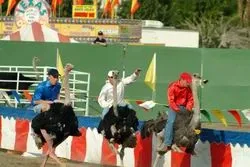
Perhaps those who consider themselves a "freebooter and adventurer" will like inlingua Cape Town the most. A weekly program "Travelling Classroom" has been developed here - a "hiking class". Why sit in a stuffy school, its authors reasoned, when you can ride around Africa by bus or train, and also on... an ostrich? No kidding: ostrich riding is indeed included in the program. A group of students is accompanied by teachers and a guide, and lessons are held daily in some unexpected place - in caves, in the mountains, or in an elephant reserve.
It would not be superfluous to note that the main "suppliers" of students to South African schools are Germany and Switzerland. Slightly behind are Brazil, Spain, and Italy. So you will be in good company. And there are still very few Russians there, as well as Chinese.