
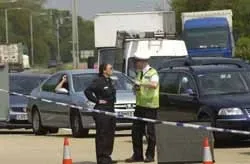
Before proposing such a radical idea, the British, as reported on the website of the Daily Telegraph, conducted an experiment. Last September, a section of the M42 highway near Birmingham was allocated for this purpose. This is one of the main roads in central England, stretching almost 90 km from northeast to southwest. On the experimental section, video cameras were installed, allowing dispatchers to turn on or off the 'hard shoulder running' mode. Moreover, entering this lane could be allowed not only during rush hour but also when collided cars blocked or significantly narrowed the highway.
The British Ministry of Transport considered the experiment successful and is so 'enthused' by its results that it is ready to extend this rule (or rather, exception to the rules) to other highways. Naturally, activists from various road safety organizations oppose this. They, in particular, believe that the effective elimination of hard shoulders will result in emergency services getting stuck in traffic jams like ordinary motorists. Currently, ambulances, fire engines, etc., can bypass a congested highway using the side lanes that law-abiding Britons leave free.
Interestingly, in our less law-abiding country, the 'Birmingham experiment' has been going on for many years, but on a voluntary basis - without any approval from authorities, and certainly without video cameras and dispatch services. Note that in their eternal struggle with traffic jams, domestic motorists are ready to do anything - not only to bypass traffic on the hard shoulder but also to mount the pavement and even push through roadside bushes. In Britain, however, they have not yet decided on such an outburst of transport liberalism and are unlikely to: there, if they allow driving on hard shoulders, it will only be on those with a hard surface.
Watching how thousands of cars try to squeeze into the narrow confines of the roads, our traffic police officers back in the last century took a common-sense stance and resigned themselves to this flagrant violation of traffic rules. Moreover, sometimes they turn a blind eye even to those impudent drivers who bypass Friday or Sunday traffic jams by driving in the oncoming lane. However, it is unknown how much this informal agreement between the government and the people helps cope with traffic jams – no such studies have been conducted here.
The only thing that can be said with complete certainty is that the fears of British public activists will inevitably come true. Neither fire engines nor ambulances can get through our traffic jams, which have expanded due to hard shoulders and median strips. However, it is not excluded that the British will be able to solve this problem as well: either with the help of the same video cameras and dispatch services, or through the high civic consciousness of citizens. Since they don't drive on hard shoulders without permission there, they will also be able to let emergency vehicles pass.