
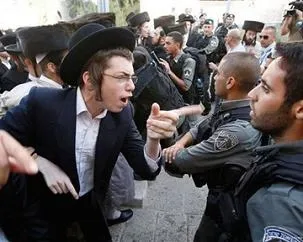
Israeli ultra-Orthodox try to impose their way of life on others
Orthodox – that's the colloquial term here for the numerous followers of various currents of Judaism that require living solely by the laws of the Torah. But recently, the Orthodox with the prefix "ultra" have been making themselves heard more loudly. This term often denotes not only the most conservative part of Orthodox Jews, but also those among them who not only follow certain principles but also try to impose them on other layers of society.
The acquaintance of one of your correspondents with Israeli religious "ultra" began during the New Year holiday, which I decided to spend in Israel. An elderly man in characteristic black clothing approached our company celebrating New Year on the street in Tel Aviv. Apparently mistaking me for a Jewish woman, he asked in English on what grounds I was celebrating a Christian holiday.
To my puzzled questions about what business it was of his what I was celebrating and why, he decided that New Year was related to Christianity, my unexpected interlocutor informed me that, as it turned out, December 31 is the day of Saint Sylvester, and having fun on this day is strictly forbidden for a faithful Jew. He left me alone only when he saw a cross around my neck.
"Just don't show him a Barbie doll, or he'll go completely crazy," advised my acquaintance living in Israel. For some reason, this doll evokes particular hostility among the local religious "ultra."
However, at the epicenter of scandals related to overly militant zealots of Judaism are much more often not visitors but locals.
Tanya Rosenblit, a student from Ashdod who had recently been demobilized from the army, boarded a bus heading to one of the religious neighborhoods of Jerusalem. She didn't know exactly where to get off and took a single seat right behind the driver, who promised to tell her when to disembark. Nothing foreshadowed a scandal until a group of male religious ultra-Orthodox entered through the front doors. One of them, noticing Tanya, demanded that she immediately move to the back of the bus. That is precisely where, in buses specially ordered for transportation by the ultra-Orthodox themselves, females sit.
Tanya categorically refused to move. The most interesting thing is that her position was supported by an Orthodox (note: without the prefix "ultra") sitting right behind her. Moreover, one of the entering ultra-Orthodox tried to calm down his too-rampant friend. It didn't work! The bus driver had to call the police. The arriving squad naturally sided with Tanya and arrested the hooligan. He has already been brought to trial and may even face imprisonment "for attempting to introduce gender segregation in public transport."
Nevertheless, such cases are far from isolated in Israel. Severe punishment awaits 44-year-old Shlomo Fuchs, who demanded that Israeli army soldier Doron Matalon, who was on a scheduled bus heading to the ultra-Orthodox neighborhood of Mea Shearim, again move to the back of the bus. Moreover, Fuchs also faces charges of sexual harassment: he insulted Doron by calling her a prostitute.
And recently, all of Israel watched the situation in the town of Beit Shemesh, located near Jerusalem, where an ultra-Orthodox teenager spat on a woman passing by their synagogue along a stretch of street not intended for women. The residents of Beit Shemesh were also outraged by another young ultra-Orthodox who decided to fight for morality in the same camel-like manner. He spat after eight-year-old Noa Margulis, a third-grade student at a religious Orthodox school who had recently repatriated from the United States. Noa was dressed, as he put it, "too immodestly for a religious schoolgirl."
Israeli society is currently debating how dangerous this phenomenon is – fighters for religious ultra-morality. Those confident that the threat to the secular character of the State of Israel is greatly exaggerated note that ultra-Orthodox who consider gender segregation acceptable are few in the country, only a few hundred families, mostly of European origin.
Those fearing religious radicals remind that the total number of Orthodox is large and is growing year by year due to high birth rates in Orthodox families. What guarantee is there that the number of "ultra" will not increase along with them?
Elena ANTONOVA, Valentin BOYNIK.
Jerusalem, "Novye Izvestiya"