
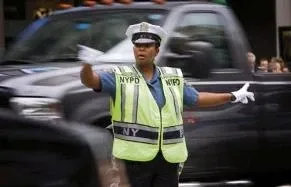
The United States – one of the most car-centric countries in the world – does without a cumbersome and corrupt traffic police
Escaping a Chase
A favorite plot of hundreds of Hollywood action films – police pursuit of fleeing offenders – is one of the most debated topics in the US. Two-thirds of such pursuits, which result in not only shopping carts being knocked over but also people, are initiated by the police themselves for minor traffic violations. Statistics show that 40% of chases end in accidents, resulting in about 300 deaths and 20,000 injuries per year – police officers, offenders, but most often third parties. Researchers on the issue, Geoffrey Alpert and Roger Dunham from the University of South Carolina, compare the pursuit to "a deadly weapon that a car becomes when speeding at 140-180 kilometers per hour."
Many states have already taken draconian measures against police pursuits – material compensation to victims of police actions is too burdensome for local authorities. Even in California, where by state law the police are not officially liable for damage to third parties if the pursuit was conducted in accordance with instructions and rules, it is increasingly difficult for authorities to win cases in court, especially in cases of fatalities. An alternative proposal is to equip the police with more helicopters, which reduces risks for people and the police themselves by tens and hundreds of times.
Supporters of "hot pursuits" – and there are many thrill-seekers within the police – say that a complete ban on chases would increase crime rates. According to statistics cited in the specialized journal The Police Chief, in California alone such a ban would allow 66 murderers, 190 robbers, and 4,000 less serious offenders to remain free. The public, in turn, calls for wider use of other techniques for apprehending criminals.
The voices of relatives of hundreds of innocent victims of chases in America are growing louder. Some district authorities and sheriff's offices in Baltimore, Austin, Salt Lake City, Miami, and Orange County (California) have already imposed strict restrictions on pursuits. Even in Los Angeles, the record holder for the number of chases (up to 781 cases per year), such operations are gradually being scaled back.
Incidentally, in California, not every officer has the right to engage in a chase. This action is regulated by a 56-page brochure, "California Law Enforcement Guide for Organizing and Conducting Pursuits." According to the document, only the most experienced and trained officers can carry out this mission. At least once a year they must undergo short-term retraining and additional training. Risks to the life and health of other drivers and other third parties must also be assessed before starting a chase. The rationale for the pursuit, taking into account factors such as weather, visibility, road conditions, traffic density, etc., is reported to the chief. The chase must be supervised by a supervisor and adjusted according to circumstances. And despite all precautions, the outcome of a chase is usually sad.
A strong advocate for legislative restrictions on police chases on highways is Senator Byron Dorgan of North Dakota, a member of the Senate Committee on Commerce, Science, and Transportation. In 1986, his mother died when a fleeing offender crashed into her car. The reason for the chase was the driver's frequent lane changes on a snow-covered road. "I could understand if the police gave hot pursuit after a bank robbery or shooting that threatened lives," the lawmaker says. "But what happened in reality is complete absurdity." And he is ready to continue fighting such absurdity.
Just as legislative battles were once waged against the practice of "living shields." In 1989, the U.S. Supreme Court ruled in favor of a certain Mr. Brower. He complained that the actions of the Inyo County police, who blocked the highway with an 18-wheel truck while he was fleeing, violated his rights under the 4th Amendment of the Bill of Rights, which prohibits "unreasonable searches or seizures." The Supreme Court's decision forced all states to adopt the most detailed laws regulating traffic order and specifying what, to what extent, and under what circumstances the police can do, including if they decide to block a violator's path. For example, the California Vehicle Code has as many as 42,277 sections. And notably, the police are not only inclined to comply with the laws but also know them by heart. Meanwhile, police officers in America do not have a narrow specialization like our traffic cops, who only need to learn the traffic rules and the Code of Administrative Offenses.
Universal Soldier
The United States never had a centralized federal traffic inspection. Thus, maintaining order on the roads of Washington is just one of the functions of the capital's police department and its bureau of patrol services and school safety. This fact is all the more surprising since America has long been a country of cars and motorists. It was here that many innovations were born, perceived worldwide as a model.
For example, in Detroit in 1917 the first booths with police officers directing traffic appeared. Three years later, a color traffic light, patented by officer William Potts, was first tested and then introduced into widespread practice. Also, since 1911 in New York, the first specialized police motorcycle units began to go to problem areas of city traffic and to serve patrol duty on the roads. This was an innovation for those times. But this kind of activity never gained autonomy within the law enforcement system. And an officer patrolling an intersection today can rush to the scene of a murder or robbery tomorrow.
True, the New York auto patrol service has some symbols by which it can loosely be considered something like our State Traffic Safety Inspectorate. They have patches with the inscription – NYPD Highway Patrol, while the rest of the police have New York City Police Department. They can also be distinguished by leather jackets and high boots laced with conspicuous blue laces, once a distinctive feature of American army infantrymen. In addition, the three-color "disco" on their Fords, Dodges, and Chevrolets is slightly larger and raised higher above the roof of the cars. In California, symbolism is only in the name of the service – CHP (California Highway Patrol), but in reality it is an ordinary state police with a large volume of duties and tasks, and by the way, the largest in the USA – 9,900 employees.
The practical conclusion from this brief historical overview is that in the USA, in a large city and its surroundings, especially in the capital region, you can be stopped for one violation by representatives of five or six different police units – federal, municipal, district, park, military, university... But the division of functions is quite clear – within the city, order, including on the roads, is mainly ensured by the municipal police, outside it – by the state police. Well, in remote local administrative entities, everything falls on the shoulders of the sheriff.
Since this seemingly complex hierarchy was historically built from the bottom up, and not vice versa, it is quite orderly, logical, and somehow everything works without chaos, mess, and lawlessness.
Wilson's Rule
For the most part, Americans have a fairly positive attitude toward the police, although they do not miss an opportunity to criticize. The tradition here is that local authorities, including the police as a 'level' of this government, again were built from the bottom up and with taxpayer money. In this sense, every American considers himself involved in government; he has learned from childhood that it depends on him, and therefore he is on an equal footing with it. And, apparently, police officers also understand that their job is to uphold law and order, not to humiliate fellow citizens.
In any case, ordinary citizens do not feel anxiety, discomfort, or fear when meeting cops. My modest experience communicating with police officers has shown that, as a rule, they are polite, very fit, and neatly dressed, and do not nitpick over trifles. They even forgive minor violations, especially if your 'driving record,' so to speak, is clean, that is, you have no sins on record. For many years I have been pestering acquaintances and even strangers, Americans and our former compatriots, with the question of whether they have tried to offer a police officer a bribe to avoid a fine. So far the answer is the same – surprised or indignant: "No, no, how could you!"
"There are, of course, corrupt individuals in the American police. Over 35 years of legal practice, I have encountered liars, cowards, and unscrupulous people among them," Maryland lawyer Mark Kotlyarsky told Itogi. "However, the phase of mass corruption, when American cops were no better than today's Russian 'werewolves in uniform,' is in the past. The tradition of respect for the law, passed down from generation to generation, makes itself felt. The very job of a police officer is a very respectable and honored profession, well paid during service and with a good pension upon its completion. Therefore, taking bribes for little things on the roads is not worth it; who needs such risks."
A CHP officer in the first year after leaving the police academy has a base salary of $65,185 with a 5 percent annual increase. He receives about $10,000 a year for overtime work. Good physical fitness is encouraged with $65 a month, knowledge of a second language – another hundred dollars. $920 a year is given for uniform updates, and about $5,000 a year for meals. In total, in the first year, the law enforcement officer can accumulate $87,300, and after five years – $110,000.
According to the expert, the temptation of corruption is also reduced by the fact that the police are engaged in their direct business – maintaining law and order. Such functions as vehicle registration, issuing driver's licenses, obtaining and exchanging license plates, technical inspections, etc., are all handled by local authorities. Most issues are now generally resolved automatically, via the Internet.
"The 'Wilson rule' also helps," continues Mark Kotlyarsky. "It is named after a police boss in Kansas, and later in Chicago in the 1930s. According to it, police officers are constantly rotated through patrol locations so that no one gets the feeling of 'their own territory.' I live in a practically rural area and see how during the day cars from at least four different police departments appear with us."
The most important "safeguard" in police activity is the court. It is in court that the question of who is wrong in a particular road incident and the measure of responsibility is decided. From my experience of attending several court sessions in Alexandria, Virginia, I came to the conclusion that the judge is even more demanding and strict with police officers than with those they have arrested. In any case, in the case of several drivers, the case was closed when the judge found the arguments of the police and prosecution unconvincing and reprimanded them sharply and unpleasantly. The experienced Mark Kotlyarsky disagrees with this; he is convinced that the opinions of police officers and prosecutors are still more weighty for most judges than the excuses of drivers.
According to another lawyer, David Benowitz, the relatively smooth and stable relationship between the police and the majority of the population is also helped by the fact that, again in accordance with historical tradition, the work of police departments at all levels is widely covered by the press and constantly monitored by human rights organizations and groups. The lawyer believes that these factors forced the head of the Washington police, Cathy Lanier, to admit the fact that from October 2008 to February of this year, eight out of ten available breathalyzers were not fully functional. District Attorney Peter Nickles has already announced a review of hundreds of cases involving this type of violation, including David Benowitz's clients.
That series of exposés of outrages by the militia and traffic police officers that appeared in the Russian internet and media is perhaps the first step in establishing new relations between society and law enforcement. If we look at the American experience, there are three more points left to fulfill – increase the salaries of police officers, make them more versatile, and establish a judicial process that is swift, merciful, and fair. And then order on the roads is not far off.