
US Independence Day
On July 4, Americans celebrate Independence Day, one of the two main national holidays. It is also associated with the emergence of two symbols of the USA: the star-spangled banner and the Liberty Bell.
The commonly accepted history of this holiday is as follows. On July 4, 1776, delegates of the Continental Congress (the forerunner of the modern Congress) gathered in Philadelphia and signed a declaration that the North American colonies of Great Britain declared themselves independent. At that time, 13 British colonies (which later became the core of the future United States) were under the rule of London. One of the reasons that prompted them to become independent was dissatisfaction with taxes imposed by the British Parliament and the king without consulting the colonists.
This dissatisfaction began to take organized forms in 1774, when delegates from all colonies gathered in Philadelphia to organize the Continental Congress. De facto, the Congress functioned as a shadow government. However, as historians note, at that time most colonists did not think about independence and did not intend to quarrel with the British authorities - they only wanted to appeal to the king and parliament. In Britain, however, proponents of the 'hard line' prevailed and first of all increased the number of British troops in the colonies. In April 1775, in the town of Concord, Massachusetts, an armed clash occurred between soldiers and militia. Historian David McCullough, author of the book '1776', notes that after this the colonists became convinced that peaceful coexistence with the British Empire was impossible.
In 1776, the Continental Congress established a special committee to prepare the Declaration of Independence. It was headed by Thomas Jefferson (future third president of the United States), and John Adams (future second president) and Benjamin Franklin (well-known inventor, scientist, publicist, and diplomat) also worked on the text. On June 28, the text of the declaration was submitted for consideration to Congress, and after making the necessary amendments, it was adopted. The document stated that 'the colonies are henceforth independent states and renounce all obligations to the British Crown.'
According to the reference book 'Signers of the Declaration of Independence', of the 56 people who signed the declaration, five were captured by the British and shot as traitors. Nine people died from wounds received during the subsequent war for independence. Many lost wives, children, and property. Jefferson and Adams, who later became presidents of the United States, died on the same day - July 4, 1826, exactly 50 years after the signing of the Declaration of Independence.
The text of the famous document was published on July 6, 1776, in the Pennsylvania Evening Post newspaper (now defunct). On July 8, it was first read aloud on the central square of Philadelphia. The townspeople were summoned to the square by the sound of a bell hanging in the tower of the city hall. Later it was given the name 'Liberty Bell'. Thus appeared one of the symbols of the United States. A year later - on July 4, 1777 - Americans celebrated Independence Day for the first time.
The first star-spangled banner ('Old Glory') was secretly made two months before the signing of the declaration. It was sewn by Betsy Ross at the request of the secret committee of the Continental Congress, which included the future first president George Washington. In 1776, there were only 13 stars on the flag. It is believed that Washington insisted on using six-pointed Star of Bethlehem stars, but Ross suggested five-pointed ones because they are easier to embroider.
The real history and chronology of these events were somewhat different. The future Americans did not particularly crave independence. Of the 13 colonies, only 9 voted 'for'. Pennsylvania and South Carolina voted 'against', Delaware did not make a definite decision, and New York abstained. Moreover, after the United States gained independence, thousands of people preferred to flee from the newborn state to Canada and the West Indies.
However, the inaccuracies do not end there. US independence was first proclaimed not on July 4, but on July 2. After that, the Pennsylvania Evening Post published an urgent evening edition in which a statement was printed: 'Today the Continental Congress declared the United Colonies to be free and independent states.' David McCullough in his book 'John Adams' cites the following fact: on July 3, John Adams wrote a letter to his wife. The letter contained a prophecy that July 2 'would become the beginning of a new era in American history' and that 'this day will be celebrated by subsequent generations'.
The Continental Congress celebrated Independence Day only on July 8 - at that time a traditional fair was taking place in Philadelphia, which opened with a military parade and fireworks. The colonists' army, led by future US President George Washington, stationed near New York, received the news of independence later - as a result, the military celebrated the event on July 9. The news reached Georgia only in August - there the holiday was held on August 10. Due to underdeveloped communications, London learned about the Declaration of Independence only on August 30.
The fact that the declaration was signed on July 4 in Philadelphia by all delegates of the Continental Congress is also nothing more than a legend. Most delegates signed only on August 2, and some - in late August. This first became known in 1884, when American historian Mellen Chamberlain checked the Congress records for 1776.
In 1776, the Liberty Bell did not summon the people to hear the text of the Declaration of Independence. Moreover, there is no evidence that it actually hung in the Philadelphia belfry at that time. Historian George Lippard, author of the book "Legends of the American Revolution", proves that the name "Liberty Bell" began to be used only at the beginning of the 19th century. It was invented by abolitionists - opponents of slavery, who needed a vivid propaganda symbol, and not a symbol of their country's independence, but of personal human freedom.
A similar story happened with the legendary Betsy Ross. In Philadelphia, one of the most popular tourist sites is her little house. However, as early as 1949, a special commission organized by the government of the state of Pennsylvania concluded that there were no grounds to believe that Betsy Ross ever lived there. Indeed, a seamstress with that name did live in Philadelphia at that time, but there is no evidence that she was visited by George Washington, or that she made the first US flag. Moreover, archival documents say that the true inventor of the flag of the United States was a man named Francis Hopkinson, and he was not a tailor. Francis Hopkinson sent the model of the national flag to the command of the newly established US Navy in 1780.
In this story, one can be sure only of the following: in 1870, the US Congress declared July 4 a state holiday and a day off.
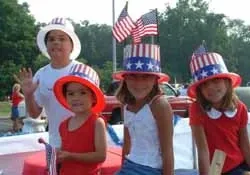
David Waldstreicher, a history professor at Temple University, notes that the traditions of the holiday began to take shape in the early 19th century. Now Independence Day implies parades, fireworks, and family picnics. There are also some regional peculiarities. For example, in the city of Seward (Alaska), a hiking trip to the top of Mount Marathon is held. Since 1818, residents of the town of Lititz (Pennsylvania) have been making candles throughout the winter, and on July 4 they hold a candle festival. In the city of Tecumseh (Nebraska), several hundred flags are hung on the courthouse in honor of the city's natives who served in the US armed forces.
The Turkey Legend
The emergence of another holiday – Thanksgiving – has historical and religious roots. However, the real circumstances of its origin were completely different from what they are commonly believed to be.
The commonly accepted version of the history of this holiday is as follows. Thanksgiving was first celebrated in 1621 by English colonists (Puritans) living in the Plymouth Colony. The previous winter had been very hard and hungry, and the new one also promised little good. Then the governor decided to raise the spirits of his subordinates and organized a holiday - Thanksgiving. It was celebrated together by British colonists and their neighbors, Indians from the Wampanoag tribe (thanks to whose help the settlers survived the first hungry winter). The Puritans brought a deep religious meaning to this holiday - they saw it as an opportunity to thank the Almighty for his mercies and to mark the end of the harvest. However, they did not consider this holiday truly religious - it is not mentioned in the Bible and, moreover, pagans were present at it.
Thanksgiving (celebrated annually on the fourth Thursday of November) became a nationwide US holiday in 1789, and acquired official status in 1863. On this day, all family members must go to church, and then gather at the festive table. The second most important attribute of the holiday is roast turkey. According to legend, at the first celebration, the colonists and Indians roasted and jointly ate four such birds. Since then, turkey and Thanksgiving have become synonymous.
On Thanksgiving, at a special ceremony, two of the most worthy representatives of the turkey family are shown to the US President: one bird will later decorate the festive table in the White House, and the second will receive a pardon and go to live out its life on a special farm, where it will feel completely safe. According to the US Department of Agriculture, Americans eat more than 45 million turkeys on Thanksgiving.
The third attribute of the holiday is costume parades and fun. In the 20th century, a new tradition appeared - on this day the final match of the American football championship is held.
Like many other holidays, Thanksgiving has become overgrown with myths and legends. For example, information recently appeared that this holiday has an older history, and it is connected not with English-speaking, but with Spanish-speaking Americans. In 1598, that is, 23 years before the canonical holiday, it was celebrated in the town of San Elizario, which was located on the territory of modern Texas. Its initiator was a certain Juan de Oñate, who led a group of settlers from the territory of modern Mexico across the desert. The celebration of the successful completion of the 500-kilometer crossing became the reason for gratitude to the Almighty.
In 1963, an official version appeared about another predecessor of Thanksgiving. Two years before the events in the Plymouth Colony, it was celebrated by British settlers who settled in Virginia. They celebrated a successful crossing of the Atlantic Ocean. However, neither the Spaniards nor the Virginians invited Indians to their celebration.
Traditional turkey is also nothing more than a legend. This is what historian James McWilliams, author of the book «Революция питания», writes, for example. The diaries of the governor of Plymouth Colony contain fairly precise references to the settlers' diet. They ate corn, apples, pears, pumpkin, potatoes, and even strawberries. The only meat dish at the celebration was venison. The archives are silent about turkey, and archaeological excavations have also not found turkey bones at the site of the supposed celebration (by the way, the feast lasted 4 days then, not one - as today). The pilgrims had no forks, and they managed the food with their hands and spoons (nowadays holiday tables in American homes are set and decorated with particular care). The turkey dish became a tradition only in the mid-19th century, primarily because at that time these birds were actively raised in the US, and their meat was the most accessible, including for poor Americans.
Historian Rick Shenkman notes that in the US it is believed that the pilgrims in Plymouth Colony lived in log houses resembling Russian izbas. However, this is also nothing more than a myth. The Puritans built houses from planks; log cabins appeared in America only at the end of the 18th century, and this technology was brought by German and Swedish immigrants.
At parades and theatrical performances held on Thanksgiving Day, actors portraying Puritans traditionally wear black hats, buckled shoes, and stockings. Historian James Baker, who published a series of articles about the clothing of the first Americans in the mid-80s, claims that the pilgrims dressed simply, each as he saw fit. Clothing was very expensive at that time, and there was no question of maintaining a single style. Black and dark colors were to be worn exclusively on Sundays, when religious services were held.
Participants of the first Thanksgiving celebration are often called pilgrims and Puritans. However, these are different concepts. The Pilgrims are the legendary group of the first British settlers who arrived on the famous sailing ship Mayflower and settled in the Plymouth area. The Puritans appeared in America a decade later and settled near Boston. The Pilgrims mostly moved to the New World in search of a better life and for the purpose of enrichment. The Puritans, who were persecuted in England, sought religious freedom.