
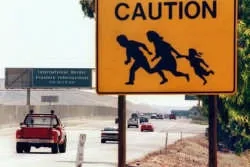
In history, it sometimes happened that Americans left their homeland en masse
Several tens of thousands of Americans permanently live in Mexico, while working in the US. Every morning they cross the border, and every evening they return. The fact is that housing, utilities, and other things are cheaper in Mexico, but it is more profitable to work in the United States. As Washington ProFile notes, in Mexico itself and dozens of other countries there are large colonies of American retirees who register for Offshore Registration, transfer their pensions, and move to new places because the cost of living is lower there.
Many Americans who lived abroad for a long time returned to their homeland. Probably the most famous of them can be considered Lee Harvey Oswald, who lived in the USSR for several years, returned to the USA, and shot President John Kennedy.
LOYALISTS
The first wave of emigration from the United States began immediately after the formation of the United States. At that time, the population of the 13 North American colonies of the British Empire, which declared their independence, was about 2.5-3 million people (exact figures, of course, are unknown). Hundreds of thousands of Americans refused to break with the British crown and assisted British troops as much as possible (as opposed to the American "patriots", they were called "loyalists"). The following example is indicative: a loyalist was William Franklin, the governor of New Jersey - the son of one of the founding fathers of the USA, Benjamin Franklin.
After the independence of the United States became a fact, about 60-80 thousand people left the new state and moved to Canada or the West Indies, which remained part of the British Empire (William Franklin left for England). In addition to white loyalists, there were a large number of black ones - the British guaranteed freedom to slaves who would join their banners and also resettled them after the war. Additionally, some Indian tribes who were allies of the British were expelled from the USA to Canada.
SLAVES
Mass immigration of runaway American slaves to Canada began in the early to mid-19th century, when slavery existed in the USA. With the help of a widespread abolitionist organization (called the "Underground Railroad"), black slaves fled to Canada (then part of the British Empire), which was free of slavery. However, formally this process was not considered emigration, since legally the slaves were not considered citizens of the USA.
In 1822, a unique project was created in the USA: the American Colonization Society, which began buying land in Africa and encouraged the mass departure of black Americans to their historical homeland. In 1847, immigrants from the USA declared the creation of the now-existing Republic of Liberia. The first president of Liberia, Joseph Jenkins Roberts, was a black (and free) native of the slave state of Virginia. Throughout this time, the USA was an ally of Liberia and provided significant economic assistance to that country. Interestingly, many Liberians - descendants of immigrants from the USA - often return to the New World and demand that they be granted US citizenship.
Various attempts to organize mass emigration of black Americans to Africa continued with varying success until the late 1920s.
CONFEDERATES
A new wave of emigration from the United States was recorded in the 1860s, during and after the end of the Civil War. The majority of the emigrants then were Southerners who lost the struggle with the North - supporters of the Confederacy. Among them were many prominent politicians and military men, as well as businessmen and journalists. For example, the former Secretary of Defense and Secretary of State of the Confederacy, Judah Benjamin, moved to England, where he had a successful legal career.
Former Confederates also settled in other countries under British rule - in Australia, India, and Egypt, but most of them moved to Latin American countries. Large colonies of American refugees appeared in Mexico, Brazil, Honduras, Cuba, etc. - the governments of South American countries encouraged this emigration and even allocated free plots of land for fugitive Americans. Interestingly, descendants of Confederates still live in Brazil, generally successfully preserving their language and culture.
MASTERS OF CULTURE
The United States several times experienced exoduses of artists, sculptors, and writers who moved to Europe, primarily to Great Britain, France, and Germany. At the end of the 19th century, the classic of American literature Henry James and one of the leading portraitists of the era, John Singer Sargent, moved to Europe.
In the 1914-1920s, writers Ernest Hemingway, Henry Miller, F. Scott Fitzgerald, Ezra Pound, Gertrude Stein, John Dos Passos, T.S. Eliot, Dashiell Hammett, and others ended up in Europe. In the 1950s-1960s, numerous American "Beats" ended up in Europe - in particular, Jack Kerouac and Allen Ginsberg. In the 1970s, legendary rock musician, leader of the Doors, Jim Morrison, moved to Europe. Around the same time, the relocation of American fashion designers to Paris began, the most famous of whom became Tom Ford.
Some of the "cultural emigrants" constantly circulated between the Old and New Worlds, others never left Europe after moving. Some retained American citizenship, others - like James and Eliot - changed their nationality. There were several reasons for this immigration: sometimes among them were mentioned an enthusiasm for modern European culture and a rejection of American culture.
A somewhat different story happened with Americans who left the US for political or other reasons. Charlie Chaplin, a classic of world cinema, actor and director, founder of United Artists film studio, was born in Great Britain but spent most of his life in the US. In 1952, he was forced to leave the US because he was accused of sympathizing with communism (not without reason). Chaplin spent the rest of his life in Switzerland.
Perhaps one of the greatest chess players in history, a fierce critic of the US and international Jewry, Robert Fischer left the US in the late 1970s. In 1992, the US government opened a criminal case against Fischer because he played a chess match in Yugoslavia, violating the existing international sanctions regime. The US long sought his deportation (including for tax violations) – he faced a long prison sentence. Fischer spent the last years of his life in Iceland, which granted him residency.
Also in the late 1970s, musician and actor Dean Reed left the US, who gained phenomenal popularity in the USSR, Eastern Europe and Latin America. Reed was a passionate fighter against American imperialism, which nevertheless did not prevent him from retaining US citizenship. He died in the German Democratic Republic.
Famous actor and film director, Oscar winner Roman Polanski was born in Poland but spent most of his life in the US. In the late 1970s, he was arrested for having sexual relations with a 13-year-old girl, after which he fled to France, where he still lives. Upon crossing the US border, he could be immediately arrested.
Besides them, African Americans moved to Europe, including prominent cultural figures who thus tried to escape discrimination. Among them, we should mention outstanding singer Josephine Baker, jazz classics Miles Davis and Charlie Parker, writer Richard Wright. Wright's story is quite indicative: in the 1930s, he was a member of the Communist Party USA. Subsequently, he married a white American woman, which absolutely did not conform to the norms of American life at the time. Due to persecution by racists, in 1947 Wright left for Paris, where he spent the rest of his days.
DRAFT DODGERS
One of the numerous categories of emigrants were military deserters and conscripts who refused to put on a military uniform. In the 1960s, during the Vietnam War, this was a fairly widespread phenomenon – according to some estimates, their number reached 40,000. Young Americans fled to Canada and Europe, where numerous pacifist organizations provided them assistance.
The following story is indicative. The aircraft carrier Intrepid (now in New York, with a museum on board) took part in the Vietnam War. When it called at a Japanese port in 1967, four sailors escaped and sought help from local pacifists. Japanese peace activists helped them move first to the USSR, then to Sweden, which granted them political asylum. After that, dozens of American draft dodgers and deserters began to move to Sweden.
As a result, large communities of Vietnam draft dodgers formed in several cities around the world. In 1977, President Jimmy Carter pardoned those draft dodgers who had not committed criminal acts. Many of them returned to the United States.
_