
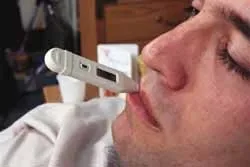
One nurse sees about 40 patients a day. The miniclinic does the same as an ordinary medical center: measures blood pressure, temperature, listens to the heart and lungs, gives vaccinations and injections, and performs some tests. Here you can also buy the same inhaler and get a prescription. The whole pleasure costs from $25 to $70. Currently, such clinics operate in nine states, and by the end of this year they will appear in 17 more.
During her lunch break, Julia dropped into a miniclinic complaining of a cough, and within 15 minutes a medication was selected for her. According to her, she is very satisfied: no need to set aside half a day for a doctor's visit, no need to sit in a queue, aimlessly flipping through glossy magazines while waiting for the doctor. 46 million Americans do not have medical insurance; for them, miniclinics are simply a salvation and a clear economic benefit: if they go to an ordinary medical center, a meeting with a doctor will cost $150.
Supporters of miniclinics believe that such a system saves time, money and effort. In their opinion, modern people do not have time to go to hospitals and have long conversations with a doctor; it is much more convenient to stop by a favorite store both for shopping and for "health." In addition, advocates of the new clinics cite the results of a survey by the Commonwealth Fund, according to which US residents are more dissatisfied with their medical system than citizens of Australia, New Zealand and Great Britain. In particular, two-thirds of American patients crave "instant help, want to see a doctor on the day they get sick, rather than wait two or three days." Interestingly, compared to other developed countries, the States spend more on medicine - two trillion dollars a year.
The advertising for miniclinics says: "Here patients do not have to be patient" (in English, the words "patient" and "patient" are spelled the same), and also: "You are sick, and they are quick." But critics of miniclinics also have their own logical arguments. They believe that in 10-15 minutes a nurse cannot provide serious help or accurately make a diagnosis; due to the lack of an ordinary medical record, it is impossible to fully determine the patient's condition. One of the important complaints of opponents of such a system is that fast service disrupts and gradually kills the necessary "doctor-patient" connection, the trust between the medic and the patient. Moreover, critics believe that a doctor in a hospital or clinic, knowing that he sees the patient not for the first and last time, feels responsibility toward him. Staff at the American Academy of Family Physicians warn Americans: quick does not mean high-quality and good. Moreover, there are many symptoms that can be caused by different diseases. For example, nausea can be a sign of stomach flu, gastritis and stomach ulcers.
Often, queues for doctors are caused by the fact that medical workers approach treatment and care with a great sense of responsibility. Such a feeling is caused not only by the teachings of Hippocrates, but also by the fact that in the States doctors often answer to the court. And not always for obvious mistakes, such as an incorrect diagnosis or an incorrectly calculated dose of medication, but also for actions that cannot even be called mistakes. So, in a provincial city, a diabetic patient did not listen to his doctor and did not start taking the necessary medications; six months later he went practically blind. The doctor was fined and deprived of his license for several years. The court considered that the patient went blind not because of his frivolous attitude toward his health, but because the doctor "did not persistently and convincingly enough persuade the patient" to begin a course of treatment.
There are widespread cases where hospitals are fined for medics forcibly saving lives. As a rule, this concerns religious fanatics who cannot be given blood transfusions because, according to their teachings, someone else's soul passes along with someone else's blood. The medical team has no way out: it provides assistance against the patient's resistance. Then the saved client files a lawsuit demanding large monetary compensation for moral damage, and most often wins, because the doctors did not respect someone else's religious feelings. But it is curious that if the medics had followed the patient's wishes and had not transfused the blood, and the patient had subsequently died, the hospital would still have been fined, but for failure to provide assistance.