
He makes history
Ovechkin has already gone down in NHL history, if only for the fact that he became the sixth League player to score 100 or more points in his debut season. The palm of primacy in this case belongs to Finn Teemu Selänne, who reached the 132-point mark in 1993. Slovak Peter Šťastný also performed well in 1981 – 109 points. Their figures are, in all likelihood, already beyond the reach of the Russian wunderkind – the finish is too close. But the achievements of famous hockey players Dale Hawerchuk (1981/1982, 103 points), Joe Juneau (1992/1993, 102) and Mario Lemieux (1984/1985, 100) are unlikely to withstand the pressure of the young Muscovite.
And in terms of goals scored, Ovechkin may also enter the top three rookies in NHL history. The unshakeable first place here, too, belongs to Finn Teemu Selänne (76 goals). But the second position of Mike Bossy (53 goals, 1977/1978 season) and the third of Joe Nieuwendyk (51, 1987/1988) may well not hold. The Russian scorer has already recorded 49 accurate shots and is one step away from the grandmaster mark of 50 goals. Fifty goals in a season is an excellent indicator even for an established scorer, let alone a 21-year-old guy. By the way, Russians have rarely reached such a mark. Alexander Mogilny did it twice – in 1993 and 1996 (and in the first case he set a record for Russian hockey players – 76 goals in the NHL regular season). Pavel Bure scored more than 50 goals five times (1993, 1994, 1998, 2000, 2001). Sergei Fedorov (1994) and Ilya Kovalchuk (2006) did it once each. Ovechkin has every chance to join the company of these titled snipers.
By the way, the general manager of the Russian national team, Pavel Bure, who led the team at the 2006 Olympic Games in Turin, said that now the entire Washington team simply must play for Ovechkin in order to help their leader score as many points as possible and score as many goals as possible before the end of the regular season. The celebrated scorer, who is considered the most productive NHL player of the last 15 years, probably knows what he is talking about.
However, Alexander has already set a host of records even without that. Many of them are unlikely to be of interest to absolutely everyone, but some cannot be ignored. Of course, the Washington rookie record for points scored fell, and this happened back in early February. The previous achievement had stood for almost a quarter of a century – since 1982. And back in January, the club record for goals was broken.
A little later, Alexander Ovechkin surpassed the famous Soviet hockey player Sergei Makarov, who became the NHL's top rookie in 1990 with 86 points. It was after this product of Chelyabinsk hockey that the League introduced an age limit for rookies. Not surprising, because Makarov was over 30 in 1990, and his track record included playing for Traktor and CSKA.
But the achievement of another Russian hockey player – Dmitry Kvartalnov (14 productive starting games in his debut NHL season) – remained untouched. Ovechkin lacked only a tiny bit to at least repeat that 1992 indicator.
In short, the Russian became one of their own in North America so quickly that they decided to come up with a loud nickname for him. One that would match his potential and current significance. After all, he won hands down the argument that NHL experts had been talking about for a long time – the argument with Sidney Crosby. The Canadian talent is, of course, also great. He has already scored more than 90 points and, quite possibly, will be able to conquer the 100-point peak. He is even in the top 10 leading scorers of the season (Ovechkin is third on this list, behind Jaromir Jagr and Joe Thornton).
Actually, an official nickname in the NHL is due to any hockey player with star status. So on March 31, 2006, Ovechkin was admitted to the ranks of the League's elite hockey players. A month earlier, an online contest had been announced among hockey fans, who proposed about 4,000(!) nickname options. Of these, Ovechkin chose the top five. So, the list: “O.V.-1” (OV-1), “Alexander the Great” (Alexander The Great), “Agent 008” (Agent 008), “The Russian Magician” (The Russian Magician) and “The 8th Wonder of the World” (The 8th Wonder).
And on March 31, Ovechkin officially became Alexander the Great. One of the versions of the American spelling of the nickname plays on the number eight, under which Ovechkin plays for Washington and the Russian national team – Alexander The Gr8. The hockey player himself, answering questions from the media, made it clear that he considers this season the best in his career: “My goal now is to work hard on the ice and score the fiftieth goal.”
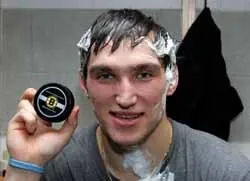
And the season really turned out to be excellent. Alexander immediately burst into the ranks of the best NHL forwards, scoring more points in a year than in four years of playing for Moscow Dynamo. In Washington, he is beyond competition. The team's second scorer, Dainius Zubrus, a product of Kharkiv hockey, scored almost 50 points less. The gap is a veritable abyss. Not surprisingly, in Washington they almost pray for the guy, and after his hundredth point they gave him the very puck Ovechkin scored as a keepsake. True, according to the long-standing NHL tradition, his teammates played pranks on the hero of the occasion. Team captain Jeff Halpern, for example, smeared the Russian wunderkind with shaving cream...
Family traditions
Ovechkin, apparently, was destined by birth to become an athlete. His father is a footballer, and his mother is a famous basketball player who played for Moscow Dynamo in the 70s. As part of the USSR national team, Tatyana Ovechkina twice won at the Olympic Games (1976 and 1980), won the World Championship and six times the European Championship. First she gave birth to a son, Mikhail, and then Alexander. The elder cannot boast of any special achievements, but the younger...
Alexander Ovechkin's rapid rise could not go unnoticed by strong clubs. In 2004, the Moscow Dynamo graduate was selected first overall in the NHL draft, and before that he had been "written down" as one of the world's brightest young stars. Perhaps Ovechkin would have debuted in the League back in 2004, but then a lockout broke out in North America, and the strongest players were playing in Russia. Ovechkin too.
And in 2005, when life in the NHL improved, keeping the twenty-year-old forward on Russian soil proved to be no easy task. Although lawyers had to work hard. The fact is that after the 2004-2005 championship season, Ovechkin signed a contract with Omsk's Avangard, but stipulated a clause under which he could leave for the NHL before the start of the season. Moscow Dynamo, in turn, tried to bring the hockey player back to their ranks. The capital club sought to prove that it retained the rights to Ovechkin and expected either monetary compensation from Washington ($2 million) or the forward's playing for Dynamo. The Americans refused to pay compensation, citing a number of documents that we will not cite here to save time and space. In short, Washington won the case, and Dynamo took offense at Avangard, which had untimely interfered in the Muscovites' affairs. Be that as it may, Ovechkin made it to the NHL, which he must be incredibly happy about now.
Another capital
Washington is the capital of the United States. Almost all the main state institutions are located in this city. The NHL team Washington Capitals, in whose ranks Alexander Ovechkin plays, is also based here. At the Olympic Games in Turin, the Russian wunderkind showed excellent play and made the tournament's all-star team. Also included were Finns Antero Niittymaki, Kimmo Timonen, Teemu Selanne and Saku Koivu, as well as Swede Nicklas Lidstrom. But the Russian national team did not perform very convincingly. After a series of victories at the start, it failed in the decisive games, after which strife began again among the Russians.
Ovechkin, meanwhile, returned to Washington. His older brother Mikhail lives there with him, who for some time worked for the women's basketball club Dynamo, where he helped his mother as a manager and video operator. The older Ovechkin played water polo but then gave it up. But he could have successfully tried his hand on the basketball court. The younger brother claims that Mikhail's shot is something else. The plans of the one who did not become an athlete include studying in the United States, at Georgetown University. Management, finance, accounting, and so on.
Many envy Mikhail. But Alexander has even more envious people. He understands this himself. "I am often told: look, Sasha, you have a good opportunity to see all of North America. But we came to Tampa. They advise me: there are cool stores here, lots of fashionable clothes. I like beautiful things. I walked through the boutiques – what's cool, what's fashionable? Americans have different taste. In this it is difficult for us to understand each other. They think the high-fashion city is Tampa Bay, but I think it's Milan.
In Washington I am often recognized. Not only on the street, but even in the car. I drive by – they wave their hands, wish me luck. In Russia I drove a Lexus, but in America I switched to a Cadillac. The club owner Ted Leonsis gave two iPod audio players, one to me and one to my brother. Each has 30 GB, a library of one and a half thousand songs. I listen to them before a game to concentrate. True, I haven't managed to download Russian hits there yet, but that's fixable. My brother is now studying at a language school. I am also trying to improve my English. I don't read Russian books, and I watch films only in the local language."
In the first year of his NHL career, Ovechkin was convinced that his home was in Moscow and that he was only at work in Washington. Let's see what he says in seven or eight years. "I don't really walk around the city. I'm not a fan of gazing at ancient monuments. But in everyday terms everything is fine. I am very comfortable in America, I quickly got used to everything. But home is better. Definitely. I will return to Moscow with great joy when the season ends.
Yes, in the States it is believed that if you already think in English, then you have completely immersed yourself in the environment. And I started right away – intensively studied the language, talked a lot with teammates. Sometimes I'm driving in a car, a Russian word is spinning in my head, and I automatically wonder how to translate it into English. How do I spend my free time? I rest, lie on the couch, click through TV channels with the remote. Or sometimes my brother and I go to the movies to polish my English."
It is hard to say how things are going with Ovechkin's language now, at the finish of his first NHL season. Maybe not perfect yet. But in terms of play, everything is simply super for the Russian. And now the main thing is not to fall below the bar he has set for himself. And that is the level of at least another Great One – Canadian Wayne Gretzky, who scored 100 or more points in a season 13 times.