
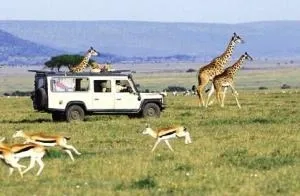
In the reserve, curious tourists are greeted by the wild nature of Africa.
Continued. Read the previous publication:
AKUNA MATATA: IN THE CAPITAL OF KENYA
With us are four Catalans from Barcelona and an Indian girl from England with, as she assured us, the English name Sweta. Everyone was genuinely surprised and delighted to meet us – Russians rarely make it here; they usually settle in Egypt, where for this money you can relax with five-star comfort.
And indeed, we arrived during the period of mass migration of animals from Serengeti Park to Maasai Mara, the difference between them being only in names and the Kenya-Tanzania border dividing the savannah, marked by a stone in the shape of a truncated pyramid carelessly left by civilization. Huge herds of migrating antelopes, slowly trudging across the scorched savannah, formed long chains stretching for several kilometers, as far as the eye could see.
Joseph stopped the jeep; we greedily aimed our lenses at impalas, buffaloes, zebras, wildebeests scattering in all directions; the delighted Catalans shouted in half-voice: "Nyush! Buffalo!" The zebras, probably aware that they are very photogenic, posed for cameras, turning at different angles, freezing for a few minutes. Joseph argued that zebras, unlike wildebeests, are very tasty; Nuria translated to Ricard, Chavi and Esther into Catalan; Chavi and Esther translated to me into French; and I translated to Victor into the great and mighty.
We were incredibly lucky with lions! The jeep was equipped with a radio – a radio device through which guides informed each other where which animal could be seen at the moment. So we didn't have to drive around for long – cautious calm elephants, cautious to the point of worry hyenas, warthogs (like from the cartoon "The Lion King"), ostriches, a lonely marabou... and, of course, the truly graceful giraffe. Most cars gathered around lions, unburdened by the problems of obtaining food and basking peacefully in the sun. Lionesses lazily walked around tumbling cubs.
Life went on as usual; the strong ate the weak, and we simply drove by, seemingly almost unnoticed by them – no one reacted to the cars roaring ten steps away. I was surprised how so many different populations could coexist on the same territory; although, of course, gnawed skeletons, over which flocks of vultures were already diligently working 30 meters from the departing herd, were a common sight.
The jeep, rattling, bounced along the roads; we, standing on the seats, clinging to the hatch covers, tried not to fall out along the way – getting out of the cars is strictly forbidden. This rule ceased to apply as we approached the banks of the Mara River.
From afar came the snorting of hippos, which lazily surfaced and, wiggling their ears, submerged again, just at the moment of pressing the camera shutter. After splashing to their hearts' content, they flopped onto the bank, squeezing between the sprawled carcasses – nineteen purple hippos, like rubber boats washed ashore by a storm.
"Crocodiles!.." we crowded by the water. The camouflaged guide waved an AK, pointing to the opposite bank, where twenty meters from their lair a huge crocodile indifferently dragged a freshly caught baby hippo.
Read the continuation of the material: AKUNA MATATA: MASAI