
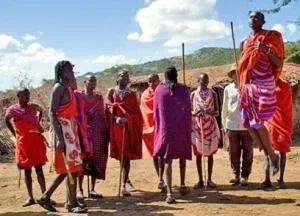
The Maasai usually demonstrate their national dance to tourists
Continued. Read the previous publication:
AKUNA MATATA: MASAI MARA NATIONAL RESERVE
The Maasai are an extremely poor people, perhaps that is what pushes them into contact with the "outside world," forcing them to leave their own homes for minimal earnings in big cities, where they hire themselves out as guards in hotels, parking attendants, cleaners, or simply put on street performances, collecting fees from connoisseurs of aboriginal art in a currency convenient for you. Joseph immediately warned us: "No photo!" – because everything must be paid for. The price for shelter in the city is the loss of a name, depersonalization, and being perceived only as a representative of the tribe: "Maasai, come here! Maasai, bring that!"
A Maasai village resembles a farmyard where herds of sheep and cows have grazed freely for centuries, so the ground underfoot is densely packed manure. We were unlucky – we were caught in the rain... These scarabs even build their dwellings from what they find underfoot, smearing manure over rounded frames of branches. Low huts (1.2 meters) are arranged in a circle and surrounded by a fence of thorny bushes, which protects the village from lions and hyenas. Entry to the village costs 500 shillings. For this money, an unsophisticated European becomes a welcome guest in every hut, where they are allowed to inspect the home, sit by the fire, take plenty of video of the interesting natives, participate in a traditional Maasai dance, and they will make every effort to ensure that he does not leave without a souvenir.
The Maasai led us in a chain into the den. Bending down and holding hands, we carefully made our way one after another in pitch darkness, feeling our way and protecting our eyes (the Maasai dwelling is arranged so that not a single ray of light penetrates inside). The narrow corridor turned sharply, and we found ourselves in a room lit by a paraffin candle. Our eyes were still struggling to pick out any object from the gloom when the Maasai were already thrusting beads, necklaces of colored beads, a lion's claw, and a price list written on a piece of cardboard at us.
I have always wondered where they get so many beads and identical fabric! "Good? Good?" they pressed. Esther and Ricard were enthusiastically examining bracelets similar to our "friendship bracelets," trying them on, speaking in low voices, occasionally protesting: "No! Very much!" And the excited Maasai, jostling, hurried: "Ok! your price! For you of good price!" – he picked up a stick from the ground and scratched zeros on the black skin, Kenyan and American.
Having chosen an item I liked, whose price did not seem good to me at all, I remembered my Chinese watch. The time could not be set on it, and one strap had come off, but the battery still had enough power for the bright blue backlight. In the dark, it shone especially beautifully... "Change?.. Change?" the people bustled. The Maasai replaced one another, each presenting their own creations. But none of it was quite right...
Suddenly, on the neck of one of the Maasai, I saw a pendant made of impala bone, carved in the shape of a tooth (I recalled a similar one Mowgli had)... I clutched the pendant in my hand: "This!" The Maasai flinched in surprise and began hurriedly unfastening the necklace. Another Maasai, older and wiser, caught me in deception. To visually demonstrate the essence of such comfort, I put the wristwatch on his arm... I saw in his eyes: he almost believed me. The deal was made!
The Maasai refused to dance in the rain, promising us a performance tomorrow. For free. The basis of the traditional Maasai dance is a special breathing technique that allows one to enter a trance. Men in red togas, reminiscent of the garments of ancient Romans, walk in a chain on half-bent legs with necks stretched forward, describing geometric shapes, accompanying each step with a sharp short exhale. Their hands, held at their sides, clutch two special sticks – an essential attribute of the tribe's men – one to ward off monkeys, the other to drive sheep. The chain is led by a Maasai in a fur helmet, arranging everyone in a circle, into the center of which each person steps out in turn and jumps on straight legs, very high, emitting along with a strong exhale some completely animalistic groan, wheeze, or grunt. The best dancer is considered to be the one who jumps the longest and highest.
The Maasai live in polygamous families of 5-7 families in one village. Women take care of children and livestock, men protect the village and sometimes hunt. Despite the huge number of livestock, meat is eaten only on exceptional occasions, subsisting on milk and animal blood. They pierce the carotid artery with a short arrow, draining the blood into a special vessel and mixing it with something, eat it, and smear the wound with... that's right, manure.
At the age of 7-8, Maasai children have their earlobes pierced with a shard of horn. Then the hole is stretched with pieces of wood, forming long loops hanging to the shoulders, into which they either insert wide plugs or thread thick bundles of bright beaded threads attached to clothing so that they rotate in the loop when turning the head.
The village has a "market" where you can buy various interesting trinkets. On boards nailed in a circle, items made of wood, beads, stones, and leather are displayed: beads, bracelets, necklaces, chokers made of beads, seeds, pieces of wood, beads woven into intricate patterns, various ebony figurines (natives, giraffes, elephants, rhinos), masks carrying the secrets of ancestors, kitchen utensils with African motifs, traditional musical instruments, and much more. The stalls belong to individual owners who are competitors. In the middle are weapons of the Maasai tribe: clubs, spears decorated with wildebeest manes and beads, shields with tribal attributes, and warrior cloaks.
The same souvenirs can be bought in shops throughout Kenya and Tanzania. When choosing gifts, the question of the possibility of unhindered customs clearance arose acutely. Strangely enough, the sellers honestly explained that spears would cause big problems, but that did not stop them from offering them with great enthusiasm.
Even in shops you can bargain – sellers are lenient with tourists and happy to receive foreign souvenirs. So, I bought 4 necklaces that cost $4 each for $10 and 2 Ukrainian hryvnias, proudly claiming that it equals $1. Even on country roads and in small towns, souvenir shop owners, boasting entire collections of foreign coins increasingly supplemented by euros, are ready to exchange a chosen item for a cap, T-shirt, flashlight, glasses – but then with an extra payment. Getting excited, one "entrepreneur" offered the entire contents of the shop in exchange for my permanent residence in Narok (probably because I talked a lot), the Catalan quartet treacherously agreed, and my genuine indignation only provoked even more laughter.
But it is most profitable to make purchases directly from the Maasai; it is easier to bargain with them and reduce the price by two or even three times, depending on how much time you have for negotiations. Believe me, the Maasai are more interested in the deal than you are. For example, a spear offered for $25, I supplemented with a mask, paying $20 for everything, and I took a warrior cloak for $5 out of the requested 15, a chest ring trimmed with beads valued at $50 was bargained down to 20 – could have been cheaper, but we had to leave.
The Maasai, who win you over with their primitive naivety, are actually not so simple. The intervention of civilization manifested itself not only in wearing sneakers, smoking cigarettes, lighting a fire with a lighter, and a few freshly bartered watches on the wrist, but also in a fairly broad informational contact with the outside world. So, three hundred meters from the village is a local school where children study... honestly, I don't know what, but the Maasai speak English well, and one even tried to speak French, though neither I understood him nor he understood my French, but the fact itself... They immediately determined that Sveta was an Indian, and the Catalan quartet were Spaniards! The word Ukraine meant nothing to them, but they shook their heads meaningfully. And Russia caused immense delight.
Incredible but true: among the Maasai there are two students! The tribe carefully collects money for their university education, as well as for the improvement of the village and school. A few years ago, they sent a young warrior, Kimeli Naiyoma, to Stanford University, who wanted to become a doctor. For this, the tribe sold their cows, which are considered sacred animals, and raised $5,000, and when the university learned of this story, Naiyoma was awarded a scholarship.
Recently, having accidentally learned about the terrible tragedy of September 11, the Maasai offered their condolences to the American people and gave them 14 cows – the most valuable thing they have. Naive? Touching!
What must be going on in the mind of an average Maasai, what colossal struggle of a naive little person with an uncompromising world!
We were returning to Nairobi – Kilimanjaro awaited us. The Catalans were staying for another day, and Sveta was late for a friend's wedding. Our paths diverged. We said goodbye joyfully and with a bit of regret – great guys!
Read the continuation of the material: AKUNA MATATA: KILIMANJARO (part 1)