
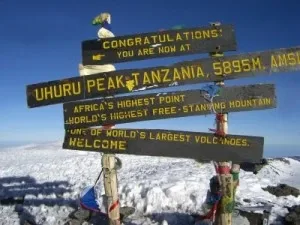
Not all tourists reach the formidable Uhuru Peak at 5,895 meters
Conclusion. Read the previous publication:
AKUNA MATATA: KILIMANJARO (Part 1)
There are no signs of life, though traces of civilization still appear: wooden tables, solitary toilets, and neatly arranged stone inscriptions in various languages like 'Vasya was here', complete with dates. Mawenzi drifted by (an amazing mountain – wherever you go, it follows you everywhere).
Kibo. 4,740 meters. We settled in a stone barracks, where every 12 people were assigned a separate room with bunk beds and a common table. Severe headache, ringing in the ears, fingertips swollen from high blood pressure, intense fever, red eyes, some had nausea. No pills helped. The physical condition was affected by two main factors: rapid altitude gain (we covered 1,000 meters in 3-4 hours) and lack of sufficient time for acclimatization – at best one night, which we were deprived of today. After dinner, we had to go straight to sleep – around 6:00 PM, because at 11:00 PM we would get up and leave at midnight to meet the sunrise at the summit. Romulus and Maria suggested leaving 2 hours later, citing the severe cold: 'Very, very cold! About 15 degrees below zero!' Yes, for the Mediterranean, that is indeed a serious frost...
It was interesting to watch the introverted Japanese man, swaying on the bunk, applying black hieroglyphs to the outer and inner sides of his palms. The good-natured American decided to perform his feat in his underwear and, standing stark naked, searched for something in his backpack for a long time, ignoring us – three attractive representatives of the opposite sex, enthusiastically discussing with cheerful Italians.
We went to bed early, took a long time to fall asleep, but as it turned out in the morning, no one slept. Tomorrow it would be decided who would ascend Uhuru Peak, who would meet the sun as a true victor on the roof of Africa. Each experienced the upcoming push in their own way, in their own sleeping bag.
11:00 PM – wake up. 11:30 PM – breakfast. 12:00 AM – start.
A crowd of sleep-deprived but ready-for-a-feat individuals, equipped with aspirin, chocolate, tea, sunscreen, flashlights, and ski poles, moved upward in a long shimmering chain. I was annoyed by the flickering light of flashlights, the incredibly bright jumping stars, and the flashing legs of the person ahead – all of this made my already aching head spin even more. The ice axe strapped to my side, which not only didn't help (I couldn't even lean on it – it didn't touch the ground) but frankly got in the way, was somewhat irritating.
The chain persistently moved upward, splitting into groups depending on the chosen pace. The guides trampled paths, encouraged the walkers, loudly and suddenly called out to each other in Swahili, sang 'Macarena', and danced amusingly while walking, asking 'Are you ok?' and answering 'Akuna matata!' But this didn't last long. Trying to stay with the column only made the ascent harder. Viktor went far ahead, the Catalan foursome stayed behind. Romulus finally fell ill and, together with Maria, was forced to return to Kibo.
Ahead of the main stream of potential heroes, Stanley and I (guides do not allow improvisation on the dangerous slope) stubbornly climbed, trying to make it before dawn. Each step sank into sliding sand, boots blindly stumbled upon slipping stones, which grew larger, higher, sharper, turning into a rocky ridge. All that was required of me was to take just one more step, mindless, mechanical. Just a step. Step. Step. Lack of oxygen manifested in crazy shortness of breath. Every 15 minutes we took a minute-long break, and with a wheezing inhale that hurt my chest, I gulped the thin air, gradually restoring my breath, and only then continued walking.
Stanley walked ahead at a calm, measured pace – guides serving 'expeditions' have long developed a strong immunity to all manifestations of altitude sickness. Noticing the lagging glow of my flashlight, he stopped, patiently waiting for my next bout of shortness of breath, understandingly patted me on the shoulder: 'It's okay.' I unzipped my down jacket to speed up heat dissipation; the light frosty air refreshingly cleared my head.
Taking off gloves, we poured tea from an icy steel thermos. The bitter, barely warm, and cloyingly sweet liquid with a smell of kerosene, characteristic of all food prepared in camps, somewhat spoiled the overall pleasure. On particularly steep sections, Stanley extended his hand in a furry mitten, helping me climb onto the next unyielding rock.
After 5-6 hours of battling the elements and my own fatigue, we reached Gilman's Point, located at an altitude of 5,681 meters, where in pitch darkness two Englishmen and an Italian were already crowding. Breathing a sigh of relief – the first height conquered – without wasting time on rest, we hurried to beat the sunrise.
According to Stanley, there were 45 minutes left to Uhuru Peak. 'No! 45 minutes is half an eternity!' We moved higher and higher, taking breaks more often. At the sight of another steep climb, despair momentarily blocked my strength; Stanley said that it was just a little more, that I would become the first Ukrainian girl to conquer the peak. I don't know how true his words were, but I had my own incentives, much more important. There was no way back: behind me stood a wall of all those who believed in me and were waiting for me. I puffed, snorted, and repeated only one question: 'Is this Uhuru Peak?'
But it still didn't appear, though glaciers had already come into view. We didn't make it – dawn caught us on the way... I turned around as I walked to enjoy this grand spectacle. The first ray, a wide bright red stripe, flashed over the horizon. The sun slowly emerged from behind Mawenzi Peak, spreading a bloody glow over the milky glaciers, cutting them with lilac shadows. By the way, Kilimanjaro is most sensitive to the problem of global warming – five years ago, expeditions completed their triumphant march leaving footprints in the snow. Today, the gray giants stand aside, shining as before in the sun.
Finally, the long-awaited goal opened ahead, real, tangible. Now there was no need to rush – there it was, the formidable Uhuru Peak at 5,895 meters, like on the palm of your hand, humbly bowing its head before you. Now you know: you made it! The first to arrive was the Italian Masi. The second was Viktor, and that despite having slept at Gilman's Point! I ended up only in the top ten. In a fever of pain, swaying from fatigue on the edge of almost six thousand meters, drunk with boundless joy bordering on madness, in different languages we rejoiced, congratulating each other, hugging until we were breathless, as much as our strength allowed. There were no losers here, only winners equal in their triumph. Stanley noted my persistence and determination, which flattered me greatly, and also confessed that from Gilman's Point it was about two hours. He lied! Thanks for that too.
Everyone who so stubbornly strives to reach the summit completely forgets about the descent... And that, believe me, is no easier, though faster. We walked towards the general flow, congratulating those who in a minute, an hour, an hour and a half would feel themselves in our place. We already had that right, the right to congratulate, to initiate, so to speak, and they deservedly accepted congratulations, because if you made it to Gilman's Point, you are destined to reach the roof of Africa. On the way back, it was especially joyful to meet our Catalan foursome, though now there were three of them – Nuria didn't make it. Many didn't make it.
We descended quickly, sliding down in the shifting sand. The sharp change in altitude made things even worse. Everyone was sleepy, tired, sick, and completely white from the sands of Kilimanjaro. The descent to the 'Marangu Gate' took two days. 'New recruits' were coming up, whom we greeted with a cheerful 'Jambo!' and a smile hiding a barely perceptible smirk. Romulus was to be hospitalized in Arusha if he didn't get better. Nuria stayed in Kibo to try again – believe me, that decision deserves respect. And we received certificates of ascent, signed by the director of Kilimanjaro National Park.
We flew home. The plane hastily retracted its landing gear to prevent our return. Below, in faded diminishing geometry, remained my Africa, now mine. Only now am I beginning to realize what line has been drawn under the equator. No, it is not a boundary between, it is a connecting thread, of which you are the knot. Honestly, it still remains a mystery to me how we managed to achieve understanding – memory searched for once-heard words from foreign songs and American thrillers. The people around us were so open, friendly: each sincerely tried to understand you and be understood by you. Kenya-Tanzania accepted us without the arrogance of a foreign country and did not at all seek to label us as 'white crows', in the literal sense of the expression. At the edge of the world, on another continent, in the opposite hemisphere, you simply are here and now.
Here and now, my Africa was lost in the clouds, remaining as borders on geographical maps, stamps in passports, frames on exposed Fuji film, and continuing in six weeks of medical prophylaxis. By the way, is it Tuesday today? Remind me on Thursday to take my malaria pill.