
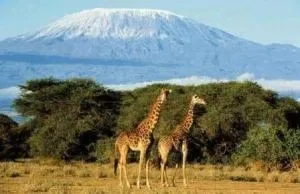
Kilimanjaro is the highest peak in Africa
Continued. Read the previous publication:
AKUNA MATATA: MASAI
Kilimanjaro awaited us. After all, the goal of our expedition was to conquer the highest peak in Africa, the highest volcano on the planet, located 300 kilometers from the equator.
Kilimanjaro is the highest mountain in the world that non-professionals can climb. And this is exactly what the inexperienced European, jaded by pure comfortable ordinariness, needs. The course of the expedition, its duration and degree of extremity depend on your desire and financial capabilities. The prices were no joke; due to the hopelessness of the situation, we were ready to shell out $750 each, when suddenly we were informed that Anthony, the same Anthony from the airport who called me Wanjiku, was waiting for us in the hotel lobby.
Among the acrid cigarette smoke and scraps of paper scribbled with destination names, a compromise of $600 per person was found. This severely shook our financial situation. We knew that for five days (three days of ascent and two days of descent) we were provided with food, water, and shelter, and then we would have to figure something out, but that was later. This immodest sum covered expenses for food, accommodation, guides, porters, transfer from Nairobi to Arusha and to the "Marangu Gate" and back.
In the morning, a jeep came for us, Anthony helped load the backpacks and handed over a cover letter for a certain Benjamin, who was supposed to meet us, help us find our bearings in Arusha, and also tell us how to get to Zanzibar. Moreover, we were allowed to stay at the hotel for free for an unlimited amount of time.
We raced past wretched settlements, one rickety hut after another exposing shabby walls. The local population was openly idle, probably in constant anticipation of unemployment benefits. "Hi! Jambo!" – grimy children played in the rusty bodies of broken cars. "Jambo!" Banana plantations gave way to coffee ones; fields smoothly transitioned into endless savannas; zebras occasionally flashed by; Maasai herding cattle along the roads cheerfully waved at us: "Jambo!" – and we only had time to capture it all with the camera.
Barely filling out declarations on the go, we approached the Namanga border crossing. In the crowded department, people wishing to enter Tanzania jostled, gradually forming two tight lines. Sweaty necks, colorful passports stamped with coats of arms, rustle of clothes, shuffling feet, slamming doors, whimpering of a child, sharp clatter of stamps... A girl in a blue customs uniform, pushing through the crowd, led us to a counter littered with white forms. Our passports disappeared behind one of the doors for a few minutes and returned with a green Tanzanian visa already glued in, costing us $25.
My gaze glided smoothly along the horizon, pausing on Kilimanjaro rising ahead. A huge giant, bound by the sleep of millennia, its peak drowning in clouds, bearing a heavy low sky. And there was something alarming about it, yet inspiring trust. Its calmness concealed a challenge, flattered by our admiration.
Arusha did not receive us very hospitably. The weather changed quickly, becoming cold and gloomy. Evening caught us off guard: banks and shops had already closed an hour ago, while our pockets still jingled with Kenyan shillings. The jeep carefully pulled up to the Guest House hotel. The neighborhood where it was located frankly resembled a local Harlem: dirt, barred windows, burnt-out house walls. The porch of our hotel was enclosed by a grating with thick bars and bolts resembling prison ones. A tall, sturdy key holder opened the door – the "administrator" Alan came out. A male figure immediately appeared before him. Stealthily looking around, the stranger decided to sell him a gold chain, deftly extracted from the inner pocket of his jacket, possibly just taken off some onlooker. Whoa! This is where we ended up. Alan, driving him away in a low voice, led us inside...
The room was designed for five people; fortunately, no one wanted to share it with us. Above the wide beds, which were the only furniture in the room, hung dirty mosquito nets – fine tulle covering the bed, intended to protect against mosquitoes – which for some reason strongly reminded me of gallows. The gray concrete floor did not encourage taking off dirty sneakers. The shared bathroom was finished with yellowed stains from eternal high humidity. Above, a bare light bulb hung on a piece of wire. Directly above the toilet gaped a blind window, from which cold emanated. True, the room had PVC plastic windows protected by three grilles – large vertical bars, a semblance of some pattern, and a fine metal mesh – pressed against a high gray wall. Probably, if a window had opened in the door, and Alan with a fake smile had pushed through an aluminum bowl with dinner, we would not have been surprised.
Everything turned out more optimistic: since we were not recommended to go outside after five in the evening, Alan offered to take us to a cafe a block from the hotel. Ordering a lavish dinner with first course, second course, third course, beer, and a portion of strong drink, we tried to explain to Alan that Ukraine is far from southeastern Africa. Alan kindly treated himself, though he did not limit himself to a bottle of beer, ordering a full menu for himself. We noisily struggled with the terminology in the list of dishes; the man with a bottle of Safari opposite quietly amused himself, occasionally glancing at us. On the way back to the hotel, we ran into three stoned guys who, with an unhealthy gleam in their "oily" eyes, immediately started shouting an incomprehensible text, from which I caught only "black", "white" and "it's my country". My timely "Peace!" immediately triggered the desired reflex. "Peace and love! West coast!" – they perked up, accompanying the words with conventional gestures.
We slept on the beds, but in sleeping bags – the prospect of catching some typhus temporarily lulled common sense.
The evening before, it rained in Arusha – I had no idea what this little inconvenience would turn into. We left early, drove in silence; it was damp, cold, nasty; even the wet Maasai flashing in the fogged-up windows no longer cheered us. A few hours later, we arrived at the "Marangu Gate" (1,860 meters above sea level) of Kilimanjaro National Park. First, we waited a long time for the porters to pack the things, then we went through a detailed registration, where we were assigned numbers (only on paper, of course), met our guides, and also a Catalan couple from Barcelona, with whom we formed one team. Meraya and Romulus turned out to be French teachers at the university; they also spoke English, German, Portuguese, and a little Italian – a real find for us.
We started. The road ran upward, cutting through the tropical forest, in places connected by wooden bridges. The rain turned into a downpour – step by step we kneaded the slippery red clay, clinging to the roots of black trees entwined with hairy green vines on which droplets trembled. The bizarre tropical vegetation stuck to our already soaked clothes. Romulus and Meraya, leaning on ski poles, talked about a safari in Amboseli National Park, about the lions they saw climbing trees, about the similarity of the Catalan language to other European languages, periodically lamenting our lack of raincoats. Groups were descending towards us, greeting us with a cheerful "Jambo!" and a smile that, as it seemed to me, hid a slight smirk.
After 4 hours, we climbed to the first mountain shelter, Mandara, located at an altitude of 2,744 meters. The camp consists of wooden lodges built like Carpathian houses, with a common dining room on the first floor and a barracks-bedroom on the second. After waiting for the guide and porters with backpacks, we registered at the Reception and hurried to take places in the "bedroom".
It turned out that all the contents of the backpack, including things packed in bags, were soaked through! A quiet panic seized me: nothing to change into, whether the rain would stop was unknown, and climbing onto the glacier in wet clothes is not recommended by the Ministry of Health... I didn't know what to do; Victor advised drying them on ourselves. Hanging the most necessary items on the walls, bunks, beams, windows, and putting on the least wet clothes, we went downstairs – we were promised hot tea and popcorn. Suddenly – what laughter from Esther! Our Catalan foursome! Soaked to the bone, but, as always, cheerful! Akuna matata! Everyone got wet. And together, even catching a cold is not scary! Everyone gathered in the dining room. Despite it being quite cold, the stove was not working. Everyone looked comical. Lanky climbers scurried about in tights. The air smelled of rain, kerosene, and boiled lentils.
This year, many Spaniards, especially Catalans, and Italians, as well as equal numbers of English and Japanese, and also French, Germans, and Americans, volunteered to conquer Kilimanjaro. I wondered how they managed to stay clean; later it turned out (with numerous translations) that all these people were not random, and each had at least one serious ascent to their credit. In all languages, they trumpeted about Mont Blanc and Elbrus, Fuji and Mitchell, Galdhøpiggen and Etna. When I said that this was my first ascent, the response was "you crazy!". We went to sleep long after midnight.
The morning threatened to be sunny; due to high humidity, the drying things only absorbed water; after breakfast, we set off. The road became steeper, sometimes rising up, sometimes descending. Tropical forests gave way to alpine meadows, roots to stones; streams became more frequent, grassy meadows soaked with water, on which grew trees resembling huge pineapples, juniper bushes. Sky above, sky below... We met porters hastily lowering a man unconscious on a stretcher, wrapped in a sleeping bag. We made two assumptions – manifestation of altitude sickness or injury – the latter less likely if following strictly along the trail.
We covered the distance from Mandara to Horombo in four hours out of the expected six and then waited a long time for the porters. At an altitude of 3,700 meters, we discovered an incredible number of striped mountain mice; perhaps they, like the wildebeest in Maasai Mara, were making some grand migration. People bustled no less, hanging the still wet clothes on juniper bushes. While dinner was being prepared, we climbed another hour along the trail for better acclimatization – 10 minutes away was Mawenzi Peak, to the left – Zebra Rock. Descending to the camp, we entered a cloud. It sharply obscured the sun, the sky became overcast and gloomy, a piercing cold blew; condensation settling on the skin makes it sticky. Clumps of fog hover before the eyes, dissipating from the movement of the hand.
At Horombo, the main topic of international communication was the sensation of altitude: 3,700 is no joke! Many felt the pressure and thin air. Relaxing fatigue, slowed reaction, temperature, fever, mild headache. And tomorrow another 1,000 meters up! One aspirin in the evening, one aspirin in the morning, a vitamin C tablet, and water with glucose during the day.
Read the continuation of the material: AKUNA MATATA: KILIMANJARO (Part 2)