
In the savanna, the wind raises intricate, small tornadoes. They can be easily seen at a considerable distance: columns of dust, swirling, go up into the sky. The Maasai, indigenous people of Kenya, call them “amboseli”. And exactly the same name is given to one of the first national parks of this country.
Rare bushes, low grass, infrequent small lakes – lifesaving watering holes for numerous inhabitants of the savanna. Here you can see “big cats”: lions, leopards, cheetahs. True, seeing members of the cat family during the day is great luck – as a rule, they go hunting at night, preferring to rest during daylight hours in the sparse shade of scrawny acacia thickets. There are many elephants, antelopes, zebras, buffaloes, giraffes. At first, at the sight of each animal, you automatically reach for your camera, but after an hour or two you get so used to seeing the inhabitants of Africa nearby that only individual moments of encounters cause surprise. Animals are not afraid of cars, but as soon as one of the passengers gets out (which is strictly forbidden), the animals quickly run away, raising a thick plume of red dust. They know too well what a meeting with a human can mean for them: despite a serious protection service, poachers with automatic weapons are a scourge for the inhabitants of all parks of the Black Continent. Rhinos and elephants are especially unlucky, whose tusks are used for jewelry so popular among Western tourists. Despite requests not to buy such souvenirs, the demand for them is huge, which determines the fate of the animals.
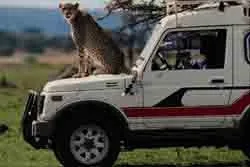
You can move around the reserves only in a car with a specially trained driver, and despite all my requests to drive “just a couple more meters,” the driver invariably replied: “Sorry, sir, that's impossible.” The rules of the reserves are strict, and violating them threatens tourists with huge fines, and employees with severe punishment up to criminal prosecution. Traveling through the savanna by car, I more than once caught myself thinking that I was sitting in the cabin of a Land Rover as if locked in a cage, while freely roaming animals looked at me with curiosity. It turns out to be a reverse zoo.
From Amboseli Park, perhaps the famous mountain of Africa – Kilimanjaro – is clearly visible. Kenyans claim that quite recently this peak was on the territory of their country, but under political pressure from more warlike neighbors, Kenya ceded part of its territory to neighboring Tanzania. Nevertheless, the most beautiful view of the mountain is from the Kenyan side.
Not far from one of the numerous entrances to Amboseli Park there is a small settlement of Maasai – a modest village. Village is, of course, too strong a word for a dozen unclear shacks, the main building component of which is dung. Children and goats scurry cheerfully between them. Flies swarm in such a dense cloud over all this and buzz so loudly that the most cautious foreign tourists prefer not to get out of their cars and shoot the local color from the roofs of jeeps. Like on safari.
The Maasai are a proud tribe and, as a rule, really do not like having their picture taken: at best, they will turn away, or they might easily throw a spear or a hefty club. However, not everything is so hopeless – $20-30 from each foreign guest, and the elder will immediately settle the problem.
The elder of the Maasai village is respectfully called “papa”. “Papa's” affairs, apparently, are going well: near one of the huts, clearly “papa's”, stood a fancy jeep. Five Maasai of lower rank were diligently polishing the product of the Japanese auto industry with some goatskins. “Papa's” hut is built of boards, but in the style of the rest of the “standard housing” it is slightly covered with a thin layer of dung – this shows a certain element of democracy.
The Maasai claim that Kenya is their land, they just long ago allowed other tribes to settle on it. What came of this is no secret: once the proud Indians allowed white people to settle on their territory and even sold a small island they called “Manhattan” for next to nothing... Now the Maasai, like today's Indians, live in small reservation villages: someone else's experience teaches no one sense. Seeing how they reluctantly jump in front of a group of well-fed French tourists is a bit unpleasant. Several older Maasai stand aside and with poorly concealed irritation look either at the eldest, slowly counting a wad of dollars and euros, or at their fellow tribesmen, doomed to jump in front of the video camera of a penguin-like grandmother from France, who is either laughing or coughing.
The other parks – West Tsavo and East Tsavo – are four to five hours' drive from Amboseli. A dark-skinned guard with a machine gun sits in the front seat next to the driver. “Why?” I ask. “Just in case,” he replies, “it'll be calmer. Who knows – the border is nearby.” Amboseli occupies a huge area and borders Tanzania. Equipping the border is an expensive matter, and money, as we know, is always in short supply... hence the guard. One of the rangers told me that illegal immigration from neighboring states to the more prosperous Kenya had become widespread until the park management wisely relocated several prides of lions closer to the border. The number of illegal immigrants sharply declined, and suddenly there were many more lions... But the topic of tourist safety continues to be one of the most important: police on the streets, checkpoints on the roads, armed guards on every floor in hotels. Kenya very much wants to be considered a safe country in Africa. The efforts are not in vain: today Kenya is perhaps the most civilized state in central Africa, and tourism is of paramount importance to the country's economy. “The tourist is sacred!” – this commandment is instilled in everyone. It works. Basically, it is still safe here, but, of course, in remote areas you should not walk alone at night or flaunt an expensive video camera in front of idle youth.
Tsavo Parks are a special place, and, of course, they differ from Amboseli. Here it is no longer savanna, but classic bush, the same as in the southern part of Africa. The safari here is somewhat different: many animals hide behind bushes of thorny acacia, as if behind an impassable barrier. The red trails of Tsavo stretch in thin threads, now among majestic trees, now hiding in impassable thickets of thorns.
Tsavo is famous for its inhabitants - large animals. The optimal time to observe them is either early in the morning or before sunset. It is better if there is a small lake nearby. You can witness the hierarchy of African fauna with your own eyes: elephants are the first to go to the watering hole: imposingly, unhurriedly. Next are buffaloes. Huge, with heavy horns; at first glance these bulls are clumsy. But this is far from the case: in case of danger, they rush away no worse than the almost weightless impala. Then comes the turn of zebras, antelopes. The order is strictly observed: here, buffaloes that arrived a little earlier than usual patiently wait aside and will approach the water only after the elephants finish their noisy water baths.
I was lucky to spend a night in one of the most popular lodges of West Tsavo, Satao Camp Rock: here, on a small rock, several cozy tents are pitched. Nothing distracts from communication with nature, and at night you can hear either frightened or furious cries of animals: night is the time of hunting. I raise my head, my eyes habitually search for the Big and Little Bear... of course, what Bears! Across the entire huge and black sky, among myriads of shining stars, the constellation Cancer stands out brightly. Henry Miller came to mind. Laughter erupts by the fire: one of the rangers is telling another tale. Favorite topic - blacks and monkeys. Surprisingly, they themselves are all black. Self-irony. A rarely encountered quality!
The next day, after the dusty roads of the savannas and the most interesting safari, a completely different landscape opens before us. Just a three-four hour drive from the park are luxurious hotels right on the shore of the Indian Ocean. Magnificent beaches in a wide strip of clean white sand extend into the crystal waters. You can go fishing and catch a shark and a blue marlin. You can hire a boat with sailors black from the sun and white from sea salt, with an experienced captain - a sea wolf, and set off towards the sun, wind, and wave! By the way, Zanzibar Island is very, very close...
Or you can simply lie on the sand and listen to the whisper of the surf, looking at the high African sky, recognizing in the floating clouds the silhouettes of antelopes, giraffes, elephants... And, having returned home, for a long time you will remember this quiet voice of the ocean, gently humming in the foam of the waves - 'jambo-jambo-jambo'...