
1. UNDER A KITE
A kite is an air kite. But not a simple one, but a piloted one. And kiting is riding with a kite. They ride literally on anything: in summer - on water on a surfboard and on land on a buggy, roller skates, skateboard. In winter - on alpine skis and snowboards. And this is wonderful, because in winter we have snow, but almost no mountains. And where can skiers and snowboarders ride? The answer - on the plain, only with a kite. Because for kiting, mountains are wind. Such a universal sport is kiting. One air kite - and such a variety of windy sports activity! Modern models of air kites allow you to develop huge speeds and move against the wind, and also make giant air jumps several kilometers long and even glide up a slope. If you don't want to jump, choose light half-hour walks or multi-day hiking-flights. By the way, travelers on alpine skis under a kite have reached the North Pole several times.
All large flat surfaces are suitable for kiting. The main thing is that there should be no wires above them. For this reason, it is better to ride on frozen lakes. Kiting is done in the Baltic States, Austria, Slovenia, Canada.
Winter kiting has huge opportunities in the field of freestyle. Under a kite you can fly low and fun or high and extreme. The kite is easy to control, and you can adjust the speed, length and height of the flight. In any case, an incomparable feeling of flying glide is guaranteed. You can learn to control a kite in half an hour. It is better to do it with an instructor.
The air kite has an undeniable advantage: it takes up so little space that it fits in a small backpack. And it weighs 1.5 kg. What is needed for kiting? Alpine skis or a snowboard, on clear ice - ice skates, as well as a winter kite (also known as a parafoil) and a harness. For freestyle, you will need a helmet, elbow pads, back protection, knee pads like volleyball ones. A new kite costs from €350 to €650.
2. WILD ICEBOAT
An iceboat is what replaces a yacht for yachtsmen in winter. It was invented in Holland. In principle, an iceboat is a hybrid of a yacht and a sled. That is, a boat standing on three skates or wheels, equipped with a five-meter mast with a sail. The iceboat is the fastest sailing vessel. No non-motorized vehicle can compare with it: acceleration from 80 to 120 km/h takes only three seconds, and on ice it races at a speed of 150 km/h.
You can ride an iceboat on any ice, but on a large area. Ideally, the ice should be smooth, without snow. The best place for iceboat racing is considered the Gulf of Finland, because there is exactly such ice. The first race took place on the Gulf of Finland in 1882. At that time, multi-seat iceboats were built. Now iceboating is developed in the USA, Canada, Sweden, Russia. In Italy and Switzerland, they ride on alpine lakes. The cheapest this pleasure is in Poland. There they race on lakes and snowy fields. Tourists have access to equipment rental and experienced instructors.
Iceboat racing is an extreme sport. Controlling an iceboat is similar to controlling a yacht, but requires more skill. Because the speed is much higher, and this thing has no brakes, everyone brakes as best they can. At the same time, iceboaters manage to control the boat half-lying, and when changing direction, they also manage to crawl under the sail, demonstrating miracles of equilibristics.
Most athletes around the world ride iceboats of the DN type. It is named after the newspaper Detroit News, which in 1937 announced a competition to develop a sports iceboat. The main condition was its compactness: when disassembled, the iceboat had to fit on the roof rack of a passenger car.
An inexpensive new iceboat costs about $2.5 thousand, while a broken-in and tuned one costs about $5 thousand. The price of an expensive one can reach $15-20 thousand. This is because they are made individually, to order. True, some craftsmen make boats themselves, which costs about $500.
3. SNOW BOARD
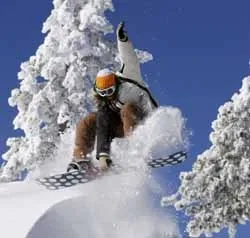
"Snowboard" translated from English is just "snow board". And how much pleasure it promises! In appearance, it is a wide ski with curved ends, reminiscent of both a hunting ski and a water board. In essence, it is a tool for extreme sports, for an urgent injection of adrenaline. Some skiers are frightened even by the sight of a person strapped by both legs to a board and flying sideways, almost turned inside out, along the virgin snow of an untouched mountain slope.
You can snowboard on any snowy slope. At advanced resorts, a half-pipe is set up for snowboarders and skiboarders - a rigid chute with raised edges, along which you can ride at very high speed.
In snowboarding, as in alpine skiing, there are different riding styles. They determine not only how to ride, but also on what. For example, carving. Essentially, it is slalom, similar to ski slalom and ski carving. In this style, you can ride on smooth, "groomed" slopes. Its highlight is the amazing speed at which the snowboarder flies, making smooth turns.
Freestyle is based on crazy adrenaline. It is considered the most spectacular and wild style. It includes tricks based on all kinds of rotations, turns, grabs - both in the air and on the snow. This style is ridden everywhere - in snowboard parks, halfpipes, and simply on mountain slopes.
Jibbing is riding on everything except snow. Railings, trees, edges of various pedestals are suitable.
Freeride is riding on any wild slopes. Freeride allows you to ride, spin, goof around, and jump in any terrain regardless of the presence of trails. It also includes all kinds of jumps and tricks in the air, but that is no longer an end in itself, but a way to overcome obstacles.
A snowboard for carving is a long and stiff board. It comes with stiff boots and stiff bindings. A freestyle snowboard is shorter, lighter, and thicker, and therefore more maneuverable. Such boards often have a twin-tip construction, meaning the nose and tail are the same width. For freestyle, soft boots and regular soft bindings are used, along with various protective gear - helmets, knee pads, and so on. For jibbing, the equipment is the same as for freestyle, only boards that are not a pity to use are taken.
A good snowboard with bindings will cost $1,800, boots separately from $120. A down jacket from $720.
4. SNOWMAN WALKS
Snowshoes are a very ancient invention. When the Ice Age came, a Neanderthal looked out of his cave, said 'Yeah...', and went to make snowshoes. Recently, at many ski resorts, it has become fashionable to walk on these Neanderthal inventions. They say this fashion came to Europe from Finland, where the Sami still go to visit each other on snowshoes. However, now snowshoes no longer resemble a tennis racket with a sawed-off handle and straps instead of strings, as before. They are made of metal and bright plastic. Snowshoes are not only for walks - they are a means of transportation on fresh snow, willingly used by snowboarders to climb up slopes, and by mountaineers.
You can walk on snowshoes anywhere: in mountains and plains, fields and forests. At almost all ski resorts, snowshoes can be rented.
The most important thing about snowshoes is the snowshoes themselves. Some hiking enthusiasts use ski or mountaineering poles, some walk with empty hands. Snowshoes come in different models. For example, for beginners. For mixed terrain and snow. With automatic bindings for difficult terrain. In principle, they are divided into frame, plastic, and traditional. There are models with a mode switch that allows you to lock the binding platform or leave it free, provide heel lift, or lower the heel of the platform below the plane of the snowshoe.
In general, all this is very complicated. Also, snowshoes have spikes that make walking on snow as comfortable as on asphalt. The size and weight allow you to carry snowshoes in a backpack: they weigh less than 2 kg and do not exceed 65 cm in length. The best models are from Tubbs, TSL, GV, Inook. Depending on the model, snowshoes cost from $65 to $200.
5. BELOVED SKATES
Skates themselves raise no questions - they are a familiar, native, and beloved thing from childhood. Only one question arises: where to skate?
You can even skate under the shade of palm trees on the Italian island of Sardinia, at the Forte Village Resort. The rink offers a wonderful view of the mountains. It's a pity that the sea is not visible from there!
In Paris, there are several large skating rinks: in front of the City Hall, on the esplanade of the Montparnasse station, at Place de Stalingrad. The coolest one is on the Eiffel Tower. It is flooded on the first level, at a height of 57 m. The rink area is 220 m, and 100 people can skate at the same time. Skating is from 9:30 a.m. to 11:00 p.m., only the entrance ticket to the tower is paid.
Ice skating is very popular in Finland. In the eastern lake region of Kuopio, an international speed skating marathon is held. The Dutch, whose canals no longer freeze, now also skate in Finland. The most beautiful Finnish skating rink is in the center of Kuopio. It is a frozen lake where a speed skating track and lighting are set up.
The London skating rink in Hampton, near the Palace of Justice, is beloved by everyone. It is located in the historic part of the city and surrounded by fortress walls. Both tourists and Londoners of all ages come here.
In Prague, a free skating rink operates in the city center, at the Fruit Market. Visitors have at their disposal: changing rooms, rentals, and even a jukebox. Skate rental costs €1 per hour.
Residents and guests of Seoul really love the outdoor ice skating rink that operates at Seoul Plaza. The ticket costs 1,000 won, and includes skate rental, with a helmet and gloves provided.
6. OUTRUNNING THE WIND
An excellent means of adrenaline injection - snowmobiles. Even the trendsetting ATVs cannot push them out of the lives of extreme sports enthusiasts. Meanwhile, snowmobiles vary greatly from each other.
Tourist snowmobiles are designed for long hikes or trips on fresh snow near a dacha. Their equipment may include various useful things: heated handles and seats, warm air blow, luggage rack. Sports snowmobiles are needed to 'rock' on the snow, making turns 'on one knee' with drifting and racing on slopes. They are characterized by lightness, a powerful motor, and the best suspensions. Work snowmobiles, also called hunting, are of little interest to us - these are reliable and durable machines with wide tracks.
The most snowmobile country is Finland. There, in winter, more than 15,000 km of specially prepared snowmobile trails are laid. Each resort has its own routes of 400-500 km in length, so you can cross all of Finland from south to north on a snowmobile. Snowmobiles are very popular in Canada and Scandinavian countries. They can be rented at almost any resort in Finland, Sweden, and Norway.
Snowmobiles are ridden in different ways. For example, in Finland and Sweden, snowmobiles are subject to traffic rules similar to those for cars, and police enforce them. Speed limit: 40 km/h in the forest and 80 km/h on lakes. Snowmobile trips are called safaris, and they can last from several hours to a week. In a week, enthusiasts cover at least a thousand kilometers. Such safaris are especially popular in Scandinavian countries - with rest in forest chums and overnight stays in cottages in Finland.
To ride comfortably, you need to wear a jumpsuit, helmet, waterproof gloves, and warm footwear. Ski goggles are suitable. The cheapest snowmobiles can be bought for $6,000. Good models cost about $16,000, and very good ones over $40,000.
7. SLEDDING DOWN THE HILL
Sleds are a very ancient invention, older than the wheel. If you harness a horse or reindeer to them, you get travois. If you adapt an airplane engine and propeller, you get aerosleds. A toboggan is a sled without runners, while a sled with runners is called a "narty" (Russian sledge). There are also "snowbeagles" — these are round inflatable sleds, completely without runners. In Germany, they are called "jumbo". In summer, you can float on them. Strictly speaking, these are no longer sleds, but something like sliding mats, but their essence remains the same—to zoom down a hill at full speed. If a sled is placed on skis and equipped with a steering wheel, it becomes a snow scooter. There are even sleds on rollers—when there is no snow, the front of the sled is lifted by a rope and it rolls on wheels. You can also go down a snowy mountain inside a ball, and this activity is called zorbing, but so far few people are into it.
Sleds are found at almost all European ski resorts. One of the most "sleddy" countries is Austria. In the ski region of Wildkogel, in the heart of the Kitzbühel Alps, is the longest sledding run in the world — 14 km, with a vertical drop of 1,300 m. In the Tyrolean region of Karwendel, you can take a free sled bus or lift to the top. The run from Weidener Hütte stretches down for 8 km. After dark, lights illuminate the way down to the Alpine shelter Loas am Hochpillberg (every Wednesday, 9:00 PM – 11:00 PM) and during night sledding to Stans (on Thursdays, until 8:30 PM) — both events are part of the weekly SILBERcard program. In Ischgl, on the 7-km descent, special sledding evenings are held on Mondays and Thursdays. Schladming is the main sports town of Styria.
Sleds come in children's, speed, and sport models. They can be simple or flashy. Lovers of the good life can buy sleds from Porsche. They are characterized by lightness, excellent design, and great speed performance. Their frame is made of aluminum, the runners are covered with steel, and the seat is comfortable and soft.
Sleds from Porsche cost $180. The "Argamak" snow scooter — $50. Plastic sleds "Crazy Bob" — $70. Wooden sleds Davos — $75. Snowbeagle — from $60 to $100.
8. LET'S HIT THE OFF-ROAD WITH FREERIDING
Freeriding is the coolest ski activity. Strictly speaking, it is skiing on any slopes, at any speed, with carved and smooth turns, on different types of snow. In other words, any way you like. However, most often freeriding refers to extreme descents through fresh powder on skis or snowboards. Real freeriding is frantic speed, series of crazy jumps, and circus acrobatics beyond the possible. Freeriders need fresh snow and a wild slope.
The best place for freeriding in Europe is Chamonix, France. Another popular spot for freeriders is Val Thorens, the highest resort in Europe and the largest ski area in the world. In Italy, freedom lovers prefer Cervinia.
In Canada, Chile, Alaska, Kamchatka, and New Zealand, they practice very dangerous skiing where skiers are dropped off at the top by helicopter. The Mecca of freeriders is the Chugach mountain range near Anchorage, which has 60-degree slopes.
Many European resorts have freeride schools. The best place to start training is in Austrian Carinthia, at the resort of Heiligenblut — there is an excellent school and great slopes for beginners. In Europe, even experienced freeriders ski with a guide — he ensures the safety of the descent.
Freeride snowboards are marked with FR. They are longer and wider than usual — this prevents getting stuck in fresh snow. The nose of such a snowboard is longer, and the rider stands closer to the tail — again, to make it easier to "float" out of the snow. The board comes with soft boots, regular soft bindings, special clothing, and special backpacks that must be packed with all necessary freeride gear: starting with a shovel and probe and ending with an avalanche beacon "beep".
Freeride skis are also marked FR. They are softer in the tip and wider. Boots must have an internal thermoforming system to mold to the shape of the foot. A helmet is mandatory.
Freeriding is a fairly expensive pleasure. A two-week training course at a freeride school costs €2,000–3,000. In Europe, guide services cost €25–300 per day. Freeriders need special insurance, which is more expensive than usual. Renting a helicopter for dropping off at the descent point in Kamchatka costs $1,200 per hour, in Alaska — $3,000. A freeride snowboard or skis cost $300–800, jacket and pants — $400–700.
9. A ROOF FOR SKIERS
The construction of indoor ski resorts began in Europe about 15 years ago. Now they exist in Japan, Germany, the Netherlands, Spain, China, Korea, the United Arab Emirates, and other countries. So a total loss of skiing is not in store for us after all!
In Korea, Tiger World is located in the city of Bucheon, an hour's drive from Seoul. It has two slopes: a large one (270 m long and 40 m wide) and a smaller one. Snowboarders also ride on the smaller slope.
In Spain, the world's largest indoor ski resort is in Madrid. It is called Parque de Nieve Madrid Xanadu and covers an area of 24,000 square meters.
In Dubai, the Ski Dubai ski resort is hidden inside a giant glass cube of a shopping mall. There you can sit in a restaurant and watch through a glass wall the daring turns of slalom skiers and snowboarders. Behind another glass, palm trees sway in the wind and the sea is visible. Ski Dubai is the largest indoor ski resort in the Middle East. Its total area is 22,500 square meters. The height of the artificial sky is 85 m, equivalent to a 25-story building. What is most impressive about Ski Dubai is the snow - it is real. It is made from good clean water that is sprayed from the ceiling. The complex produces 30 tons of snow daily. It lies on the slope in a 70-centimeter layer.
The Dubai complex has four slopes with trails of all difficulty levels - from black to green. The longest is 400 m. There are jumps and a 60-meter 'cliff', a special track for tobogganing, a double bobsled track, snowball, chairlift and T-bar lifts, equipment rental and instructors. Two-hour skiing with ski and warm clothing rental costs about $35. The children's park area is 3,000 square meters, it is a Guinness World Record holder.