
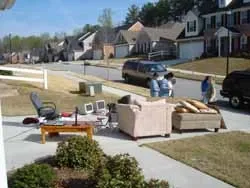
America was the first to put its citizens on the needle of constant 'shifting of landmarks.' Here no one clings to old stuff, there are practically no hoarders. Fashion in clothing forces constant wardrobe updates, especially among the fair sex. Rotation in electronics and communications is also swift and ruthless. Where are the notorious beepers now? Cellphones are changed like gloves. Flat monitors appeared - old, bulky 'boxes' are immediately retired, even those that work well.
Pre-sale preparation
For example, clothes, shoes, toys can be given to charitable organizations, of which there are, without exaggeration, hundreds here. The largest of them are the Salvation Army, the Red Cross, and Goodwill Industries. Every city has their drop-off points. In front of the entrance there are huge containers with opening lids. That's where people unload their stuff. However, charities scrutinize a gift horse in the mouth. Items must be in good condition, necessarily laundered, without holes or wear. They then go on sale in special thrift stores. Volunteers work there mostly. Prices, of course, are very low, to the delight of the low-income public. The proceeds from sales go to humanitarian needs according to the specifics of each organization. Charitable organizations are not allowed by law to profit from their activities, so there is no talk of commercial gain.
Of course, one could consider everything that has become unnecessary as trash and throw it away. But America came up with a brilliant solution! In Oscar Wilde's 'The Picture of Dorian Gray' there is such a paradoxical maxim: 'There are many things that we would throw away if we were not afraid that others might pick them up.' The Yankees turned the logic of the phrase upside down. It's good that others can pick them up! And a life-affirming aphorism was born, which is heard everywhere in America: 'One man's trash is another man's treasure.' That is the unofficial motto of such an all-American phenomenon as the garage sale.
From the name it's clear that items are sold in the garage. Or in the yard, and then it's called a yard sale. There are many other kinds of sales. Tag sale - when each item is tagged with a price. Convenient for buyers, but for sellers it's an extra hassle. Barn sale means that a barn or other outbuilding is used for the sale. Rummage sale is organized by a group of donors, providing items for sale for charitable purposes (rummage is the process of searching when people dig through huge piles of clothing). Often you see a sign saying 'moving sale,' which means a sale due to the owners' planned move to a new residence. If the sign says 'estate sale,' it means the sale is related to sad circumstances, namely the death of the owner, when practically everything is sold - from furniture to pencils.
But still, the most popular way to get rid of clutter is the garage sale. Note that this is a privilege of the suburbs, the great American country of Suburbia, lined with one- and two-story single-family homes, which almost always have a one- or two-car garage, in front of which is an asphalt or concrete driveway, and in front of the house is a lawn. In cities with apartment buildings, the function of garage sales is performed by flea markets, where on designated days people bring out all sorts of things. This form of getting rid of the 'past' exists everywhere, on all continents.
Sometimes sales are held in winter, in bad weather, especially when it's related to a move or death. But the most popular times are summer and fall, definitely on weekends. Thanks to one Dan Rhodes from the Alabama city of Hoover, a national garage sale day was even established - the second Saturday of August. But that's purely symbolic. Goods for the future sale are accumulated throughout the year and stored, as a rule, in the garage or basement. The assortment consists of various items. The most typical: clothes, kitchen utensils, dishes, jewelry, toys, electronics, household appliances, tools, furniture. Neat and experienced homeowners sort items by category in advance, putting them in labeled bags, so that early in the morning on the day of the sale they can calmly, without fuss and confusion, display them 'face out'.
A permit for a garage sale and its other modifications needs to be bought for a few dollars at the local municipality, which will take a minute or two. If the weather is bad on the day of the sale, it is postponed to another weekend, as previously stipulated in the issued 'permit'. The next step is putting up several advertising signs in the area so that passing motorists can see where and how to turn in to you. In the suburbs, only day laborers (Latin Americans) walk; everyone else experiences the outside world from behind the wheel, at a speed of 25 miles per hour (the speed limit in residential zones). Therefore, signs must be placed or hung in visible places. They are made on the 'anything goes' principle. Most often they write with thick markers on cardboard signs: 'where, what, when' and put an arrow. I also did homemade creations, but then I gave up and spent money at a hardware store on branded reusable plastic signs. Often friends or relatives join together for a joint sale, and then the whole residential block begins to resemble a market station.
Junk diggers
Sales usually start around nine in the morning. It's a kind of fascinating, albeit very specific sport - searching through a pile of various junk for a nugget, be it an antique lamp, a vintage plate or a rare engraving, a collectible record or a rare watch.
From time to time the press reports another sensation. One lucky guy in a pile of junk being sold for a pittance spotted a dusty brass lamp. He bought it for one and a half dollars. When the dust was wiped off and it was attributed, it turned out to be a rare piece by the prominent San Francisco master Dirk van Erp, which is worth $50,000 at auction.
There are all sorts of collectible items, like toy cars or baseball star cards. Rare Hot Wheels cars with red rims around the wheels today cost up to $15,000 apiece. You might come across a fake, but there is a site that explains how to distinguish genuine cars from counterfeits. The Barbie doll, invented by Ruth Handler in 1959, cost $3. Today, collectible dolls from the first production run can be sold for $10,000. And so on. And, of course, the number of dreamers who want to become famous all over America and get rich overnight by finding a rare copy of the Declaration of Independence never diminishes. There are only a few dozen of them, and a lucky fellow recently bought an 1823 copy in Nashville for $2.50 at a thrift store, and at auction it fetched nearly half a million.
Yet most buyers are not treasure hunters, but simply practical people, and not necessarily poor. There are very wealthy Americans who love to buy a lot for a pittance. At garage sales, people can get practically new items for mere cents. Prices here are not just low, but ultra-low - two or three dollars, 50 and 25 cents. No one tries to get rich selling things; that is considered bad form. I have often witnessed owners willingly lowering the price to a ridiculous level just to get rid of something unnecessary. You often see a sign: 'Take it for free.' Mishaps happen too. In early August, Anita Lewis, a resident of Elmira, New York, hastily sold a ceramic turtle-shaped container at a rummage sale for half a dollar. But then it turned out that Anita's husband had kept the ashes of his first wife in that container. The Lewises rushed to find the buyer. And here is the latest news: the turtle was found and will be returned to its previous owners! The price of the matter is not disclosed.
The Circulation of Trinkets
There is another numerous category of buyers. They seek out nostalgic items from their childhood and youth. Postcards, books, records, figurines, sports souvenirs, any retro stuff. An acquaintance of ours, a 65-year-old American woman, decorates her home with cheap decorative trinkets (in American they are called chachka or tchochke, a clear borrowing from Yiddish and Polish) - mostly silly and tacky porcelain and bronze dolls. But periodically she conducts a review - some trinkets no longer satisfy her high aesthetic taste, and she puts them up for sale for a pittance. At the same time, she prowls neighboring garage sales and makes trips to flea markets in nearby towns, replenishing her collection. Thus occurs the circulation of trinkets in nature.
Major garage sale experts travel even to other states. In Florida, for example, they hunt for rare dishes, Tiffany lamps, and silverware. Furniture experts know that the best merchandise in this category is in Palm Springs, California. In the mountainous regions of New York, Pennsylvania, and Massachusetts, there is a lot of 'old money,' and at estate sales you can profitably buy old valuable items like Chippendale furniture and jewelry by Rene Lalique. Pros know how to behave so as not to alert an unsuspecting seller. They can keep a poker face when asking to lower the price from $5 to $2, perfectly aware that the item they want is worth, say, $3,000.
Legend has it that the first garage sale in history was organized by Clara Ford, wife of automobile magnate Henry Ford. She got tired of her husband's ever-growing collection of tools that clearly had no practical use, and she put it up for sale without informing her spouse. The largest garage sale in America - and this is no legend - has been held annually since 1979 in Warrensburg, New York. On one autumn weekend, about a thousand (!) sellers gather from all over the region. The town's population jumps from five thousand to one hundred. Ten miles of continuous sales space in the form of garages, yards, tents, and churches! The world's longest yard sale runs along Highway 127 and stretches 630 miles across five states. Typically American scale. General statistics: a new garage sale starts in America every 15 seconds. Up to 500 million transactions occur annually in these micro-markets.
This seemingly penny-ante industry generates an annual turnover of $3 billion. But no one thinks of paying taxes - neither buyers nor sellers. This is perhaps the only area of commerce in the US where the tenacious and ruthless federal tax agency, relentless towards other violators, knows perfectly well that money is flowing past the treasury but can do nothing about it. Apparently, Uncle Sam himself also has to periodically update his wardrobe, getting rid of old top hats and frock coats at garage sales.
Oleg SULKIN.
Itogi