
Despite the fact that Croatia is located considerably further north than most of its "beach" neighbors, this does not affect the quality of tanning and swimming. The nominal length of the Croatian coast is just under 1.300 km, but the heavily indented coastline contains nearly 6.000 kilometers of beaches on the mainland alone, not counting those on the additional 1.185 islands. In terms of proximity of beaches to attractions, Croatia is second only perhaps to Cyprus or Greece, and compared with the Italian Adriatic, the local one is much cleaner. Moreover, this is a true paradise for nudism fans: Croatia was the first in Europe to open its beaches to them half a century ago. Naturally, naturists relax not on public beaches, but in special centers.
Complaints about a holiday in this country arise only from those who want to find club-style entertainment of the Turkish kind or have stayed in a three-star hotel without air conditioning, which is not uncommon in Croatia.
Istria
The peninsula is popular with tourists for its unhurried, relaxing atmosphere that cures the "big city syndrome". This region has a rich history; there is plenty to see here. The beaches of Istria are mainly concrete platforms, as well as pebble plateaus. The coasts are characterized by picturesque rocky scenery, and a third of the territory is covered with coniferous and deciduous forests, so the air here is considered healing for the respiratory system. It is always a few degrees colder in Istria than in Southern and Northern Dalmatia, but it also rains less, and the national flavor is most pronounced.
Porec is rightly considered the tourist center of Istria. Tourist complexes, hotels, and campsites began to be built around the city back in the 50s. Their heyday came in the 70s-80s, and their revival in the late 90s (by the way, after the Balkan War, it was the authorities of Porec who were the first to restore hotel infrastructure and bring tourists back to Croatia). Of course, not all local hotels can boast major renovations and excellent service, but people come to Porec not for luxury apartments, but for the amazing nature and rich historical heritage.
Porec is the leader among Istrian resorts in the number of EU "beach" Blue Flags. All the tourist zones around - Lanterna, Cervar Porat, Plava Laguna, etc. - are located in picturesque parks where trusting squirrels frolic and blackbirds dart about in flocks. In the sea, no mask is needed to see the bottom and its inhabitants: visibility is perfect at any depth. Perhaps the only drawback is sharp boulders along the shore: it is better not to go into the water without special footwear.
As for attractions, first and foremost is the Euphrasian Basilica - a unique example of Byzantine art, listed as a UNESCO World Cultural Heritage site. Built back in the 6th century, this church still gathers parishioners for Masses. All Porec guidebooks also mention Marafor - the ancient part of the city with the remains of antique structures. Indeed, walking around the city, one can get lost in time (it feels like you have stepped into the Middle Ages) and space (the hawkers from local restaurants are in no way inferior in temperament to their Italian counterparts). And it is also great to rent a bike here and ride around the nearby villages in a day.
Umag is another medieval town in the middle of a nature park. Its life is entirely devoted to the sea and tourism. Hotels and campsites are located in immediate proximity to the historic part of the town, which at night turns into one big party. The local hotels are not just places for tourists to stay overnight, but entire cultural and entertainment complexes with numerous group programs for all ages: from hunting and fishing to organizing picnics.
The island of Krk almost directly adjoins the mainland of Croatia - a one-and-a-half-meter bridge has been built across the Rijeka Bay. Although this is not the only way to reach the island - it has its own airfield. There are six relatively large towns and many small settlements on Krk. A holiday here encourages a creative understanding of man's place in nature. Here every tourist can find their own beach - a tiny cove where you can swim alone or only with your own company.
If you feel a lack of communication, you can make up for it in the evenings in the taverns of one of the towns: innkeepers from Baska, Punat, Malinska, Omisalj, Njivice, or Krk await guests at their establishments every evening. They have considerable experience in satisfying tourist demands: Europeans have been coming to this island in industrial numbers for over a hundred years already. By the way, this year the island's municipal services have seriously taken up the re-equipment of beaches. In the near future, they even plan to set up a beach for tourists with pets.
One of the most unusual cities in the region is Pula, founded in the 1st century AD as an ancient Roman settlement and later becoming a major Austrian port. Monuments of the Byzantine, pre-Romanesque, and Venetian eras have also been preserved here. True, tourists often speak of Pula as a somewhat cold (not in terms of climate, of course) city. There are also no sandy beaches here - concrete plateaus and large pebbles.
Central Dalmatia
This region is located in the central part of Croatia's Adriatic coast. The nature here is also lovely - many cozy coves are washed by the sea surf, pebble beaches are backed by pine-covered cliffs, and coniferous forests stretch for kilometers along the sea and into the interior of the country. Among them, as if in clearings, small charming towns and villages are nestled. And no matter how small a particular town may seem to you at first glance, you should not pass it by with a wave of your hand. Almost all towns trace their history to the Middle Ages, the era of noble knights and treacherous robbers. The memory of all the vicissitudes of their struggle against each other has been preserved by the mindful Croatian land.
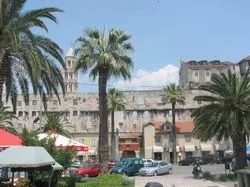
Split is often called the most majestic city in Croatia. Over 17 centuries of its history, the city on the restless Balkan Peninsula has seen a lot! The very name of the city comes from its main attraction - the palace of the Roman emperor Diocletian, built in 295 AD. In the 7th century it was rebuilt into a fortress city, more than once giving local residents refuge from enemies who came to this land. Now the palace is inscribed on the UNESCO World Heritage List. Besides it, in Split you can see the Temple of Jupiter, the Cathedral, Prokurative Square, and the Silver and Golden Gates. A special charm is given to the city by the whimsical mixture of all architectural styles characteristic of the Adriatic coast. It is also unofficially believed that the most beautiful girls in Croatia live in Split. True, to spot them among the crowd of visiting tourists, you need a sharp eye.
The city of Šibenik, located at the mouth of the Krka River, is 700 years younger than Split. Like its older neighbor, it grew out of a fortress city. Even now you can see well-preserved fortresses and ramparts, narrow stone streets and steps. However, the charm of Šibenik lies in the tiny streets, churches, theaters, and squares built in the Venetian style. It is this feature that the organizers of the International Children's Festival, held here every summer, successfully use. Lovers of passive recreation will appreciate another advantage of Šibenik: here there is the sea, a river, and a lake, so you can enjoy all kinds of water pleasures in three completely different conditions.
The islands of Brač and Hvar are two more places popular with tourists in Central Dalmatia. Apart from that, they are united only by their geographical status. Brač is the third largest island in the Adriatic. It is covered with forests, vineyards, and olive groves. White stone has been quarried here since ancient times (the local building materials were used, for example, in the construction of the White House in Washington). The island has sandy beaches, which are so rare for Croatia. Particularly popular is the 300-meter pebble cape "Zlatni Rat" ("Golden Cape"), which constantly changes its shape under the influence of wind and waves. Brač is also known for its excellent fish cuisine and solid rosé wine.
The island of Hvar has been inhabited for sixteen centuries. Greeks, Byzantines, and Arabs have lived here. The main sights are the oldest public theater in Europe, the Cathedral of St. Stephen with its original bell tower and rich treasury, and if you approach from the sea, the city panorama is crowned by a high hill, on the top of which rises a "fairytale" knights' castle with high towers. Year-round Hvar delights its guests with a mild Mediterranean climate (the sun shines here more than 2,700 hours a year), charming bays, crystal-clear sea, and the aromas of lavender, aloe, rosemary... They say that local hotels even installed specially designed air conditioners to avoid spoiling the natural smell of the local air.
Southern Dalmatia
The local coastal waters are considered the cleanest and most transparent in the entire Adriatic Sea. The microclimate that has formed here is unique: due to the unique mutual arrangement of the wind rose and the mountains of the Balkan Peninsula, in this part of the Adriatic the sun shines on average more than 12 hours a day in summer - the same as in Egyptian Alexandria.
The center of Southern Dalmatia is the city of Dubrovnik, which tourist brochures have firmly dubbed the "pearl of the Adriatic". The city is also inscribed on the UNESCO World Heritage List. Listing the sights that have accumulated in Dubrovnik over the 14 centuries of its existence could take a long time: the Marin Držić Theatre, the Art Gallery, the University Center, the Maritime Museum, the Ethnographic Museum, the Cathedral Treasury, the Church of Saint Blaise - the patron saint of the city, and 80 summer residences of the nobility, built in the Renaissance style. Music lovers should go to a concert by the local Dubrovnik Symphony Orchestra. And all this is contained in a small town with a population of 50,000 people!
Of course, Dubrovnik is not only a monument to bygone days, but also a unique resort that allows you to harmoniously alternate beach and educational recreation, and numerous cultural festivals and sports competitions, held here almost non-stop, will not let anyone be bored.
Cavtat, like all Croatian cities, is also not deprived of historical monuments. However, it is valued primarily for its tourist infrastructure. The sand-and-pebble beaches here are in a very, very well-groomed condition, and the reconstructed hotels are able to accommodate large flows of tourists. At the service of the latter are many bars and restaurants, where welcoming hosts will treat guests to the most delicious national dishes. A holiday on the Adriatic can be well supplemented with walking or cycling, diving, fishing, and tennis.
Bays and coves untouched by civilization can be found on the island of Koločep, famous for its sandy beaches and lush Mediterranean vegetation. From Dubrovnik you can get here by boat in 15 minutes. In addition, there are good conditions for windsurfing here, and there is practically no automobile transport. Those interested in art should definitely see the exhibition of works by the famous Italians Tintoretto and Leonardo da Vinci, as well as the local collection of ancient icons.