
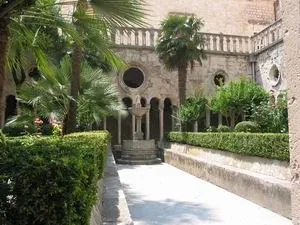
We set off to this popular resort country to meet an old virtual friend in person. Of course, she was invited alone, but faithful Zhenka stood her ground: she would leave her homeland for 10 days only with her friend. The Croatian side unexpectedly gave in quickly, and I saw the prospect of seeing the legendary Plitvice Lakes with my own eyes, strolling along ancient streets, visiting famous Croatian islands and massaging my soles on the pebble beaches of the Adriatic.
According to the plan proposed by the restless friend, after landing at Pula airport we were to drive across the whole of Croatia from north to south in Ivan's car (stress on the first syllable) with stops at local attractions, a mandatory trip to some island and to the Plitvice reserve. And also bask on beaches we liked. The final point of our route - Dubrovnik - was the homeland of our friend, where he so wanted to lure my friend. Thus, we had to master almost 1,800 km of the Adriatic coast, which included all of coastal Croatia from the Istrian peninsula to medieval Dubrovnik.
Istria: Hello and Goodbye
We left Pula on the day of arrival, having only time to hurriedly run around the ancient amphitheater. Actually, I did not mind a more detailed acquaintance with the majestic structure from the times of classical Rome, but Ivan had his own plans for my friend and our cultural program, frankly, very cursory. And that is understandable: he least of all expected to act as a guide. Therefore, the time allotted for getting to know the country was minimal, and Ivan decided to introduce us to Istria in absentia, giving basic information along the way. However, I knew something without him.
"Istria is the largest peninsula of the Adriatic Sea with a total area of 3,160 square kilometers, of which Croatia owns 2,820 square kilometers," the boring lines from some guidebook surfaced in my head. "And Mount Učka, covered with forests on picturesque slopes, with medieval towns, creates a landscape that can only be compared with the most attractive corners of Tuscany and Provence," - and here Ivan's voice with the text from his guidebook cuts in. The running landscape outside the window perfectly illustrates the meager information received, showing us cozy houses, impossibly entwined with cheerful ivy, small vineyards and land of an unusually red color.
Kvarner: Mosaic of Sensations
Next on the course was the Kvarner coast, where the oldest European resorts are located, the most famous of which - Opatija - has been firmly chosen by European nobility for more than a century. In 1840, the Vienna Society of Doctors officially recognized Opatija as a seaside resort thanks to its picturesque nature, mild climate and the presence of healing waters. Members of the imperial families of Habsburgs and Hohenzollerns, representatives of the highest aristocracy of Austria-Hungary and Germany regularly rested here and at the same time improved their health. Old luxurious villas and hotels, which are now rented out to tourists, have seen a lot of European nobility in their lifetime.
In general, it is worth coming here for the sake of leisurely walks along the endless embankment, which is crossed by frequent descents to the sea. Opatija charms with its lush gardens, poetic parks and simply rare diversity of the plant world, which is actually characteristic of the whole of Croatia. The country is immersed in greenery: cypresses, laurel, olive groves, tangerines, lemons, grapes, myrtle, lavender and more than four thousand species of plants growing in this giant botanical garden.
And what I remember most of all is the winding path connecting Opatija with the neighboring Lovran. The fact is that it is cut right into the rock. They say that at one time it was laid for almost 70 years and named in honor of Franz Joseph I, Emperor of Austria-Hungary, who ruled Croatia at that time. Numerous cafes and restaurants are equipped on small rocky ledges and platforms, where our company spent a warm evening.
And yet I was irresistibly drawn away from the bustling and brightly lit civilization to the silence and tranquility of tiny seaside towns. From the brief phrases dropped by Ivan, it was clear that the Kvarner Riviera is not only an incredibly indented coastline, beckoning islets and the sparkling surface of the bay, but also dozens of picturesque towns and villages between Labin and Rijeka. To this day, with a sinking heart, I remember the special mood that overtakes you during a leisurely walk along the narrow ancient streets of Crikvenica or Lovran... Not a soul around - and only lush greenery on balconies hanging overhead says that this is not a delightful open-air museum, but a residential part of the city. In almost every town we found perfectly preserved luxurious villas of the late 19th century. And near the ancient churches facing the city market square, I persistently asked to stop and immediately take a photo of me.
While driving through the tidy Novi Vinodolski, I decided to remind my companions that it was time to go to the sea. Moreover, we found a wonderful embankment decorated with magnificent pines and a view of a snow-white pebble beach. Having found myself on a pebble beach for the first time, I cautiously listened to the sensations in my feet: after all, I had been warned that walking barefoot on stones is quite difficult. But either the pebbles were special, or I was in too enthusiastic a mood, but I reached the water without much trouble. Its amazing transparency struck me to the depths of my soul. Probably, the strongest shock is experienced by tourists who first plunge into the waters of the Adriatic after relaxing at Turkish or Egyptian resorts.
Dalmatia: Delightful Cocktail
Moving further south, we gradually moved from the refined and reserved Kvarner to luxurious Dalmatia - a divinely beautiful place with a thousand picturesque coves and bays. A wonderful cocktail of sea breeze, the aroma of pines heated by the southern sun, and the purest sea is the best explanation for the popularity of the resorts of Šibenik, Split, and Trogir, as well as cozy spots like Brela or Baška Voda.
The resort town of Brela is nestled on the slopes of the Biokovo mountain range and is built up with charming little houses surrounded by lush southern vegetation. Swimming in Brela is quite special. First, the beaches here have fine pebbles. Walking on small, very smooth stones is not difficult, and the thought that you are getting an excellent foot massage even arouses enthusiasm. Second, besides the water being fantastically clear, as is traditional for Croatia, underground springs flow in Brela not far from the shore. Therefore, when cool layers of water are brought in by the current, the sensations while swimming are indescribable.
The town of Makarska is located in a quiet, beautiful bay in the center of Dalmatia. Therefore, it quite naturally combines the best features of a cultural, economic, sports, and tourist center. On charming shady streets there is always a lively bustle. Only in the morning and afternoon does the old part of the town with small restaurants and shops enjoy pleasant silence. In Makarska, we decided to visit the 17th-century Cathedral of Saint Mark, a Franciscan monastery, and then sincerely admired the ancient Venetian fountain. A small maritime museum pleasantly surprised us. Dried sharks, huge lobsters, and langoustines looked very impressive.
Dubrovnik, founded in the 7th century, bears the honorary title of an open-air museum. During walks between fortress walls and towers, admiring ancient temples, contemplating the crystal-clear sea, one distinctly feels the passage of history and the unbroken connection of centuries. Dubrovnik is able to put even the most carefree guests into a philosophical mood, striking them with the genuine antiquity of its architectural monuments and the eternally young turquoise sea.
Dubrovnik's satellites deserve special attention: for example, the small resort town of Cavtat, located on a small picturesque peninsula. The town has many carefully preserved historical and architectural monuments: the Baroque church of Saint Nicholas, a monastery, the Vlaho Bukovac art gallery, fortress walls, and grottoes. And lush flowering gardens and numerous beaches make Cavtat a true resort.
Everything else: islands, lakes, and secret dreams
The small European country has a huge collection of the most beautiful islands: the vast Brač with pine forests, olive groves, and vineyards; the island of Hvar (the longest island of the Adriatic Sea), known for its vibrant nightlife; the unique Krk, connected to the mainland by a powerful bridge. Then Ivan told us that the island of Susak is entirely made of sand. It is estimated that there are about 20 million cubic meters of it here. And the island of Rab is the most forested Adriatic island, with three hundred water springs. In the picturesque park of Kormčar, Indian fig and rosemary, century-old agave and bay leaf grow. And in summer, many artists come to the town of Rab, known for its fortress walls, ancient temples, bell towers, and palaces, and it turns into a huge gallery. The problem of choice...
But with lakes everything was clear and well-defined: Ivan had been notified in advance of our desire to visit the Plitvice reserve. Half a day of walks along wooden boardwalks that cross the entire giant territory of the reserve - and we are simply overwhelmed by the power and majestic beauty of the many waterfalls and most beautiful lakes. True, we also concluded that to fully experience it, one needs to stay in a local hotel for at least a couple of days.
My journey ended with a couple of days spent on the beach in Dubrovnik. Lying in the shade, I was intently planning my route around Croatia for the next year. I had not the slightest doubt that I would come here again. At the same time, I harbored a secret selfish hope: what if things work out between my friend and Ivan. Who knows, maybe I'll come to Croatia as if it were my home. Beautiful!
• Often people, returning from an exciting trip, try to create a similar environment at home. And they start another or even unscheduled renovation, making their apartment a kind of mini-Paris or turning the loggia into an "Italian" villa. In any of these design scenarios, ceramic lamps will come in handy, which will help create a unique atmosphere in any room. With the help of such retro lamps, you can transform any dwelling - whether it is an apartment in a city high-rise or a wooden house in the suburbs.