
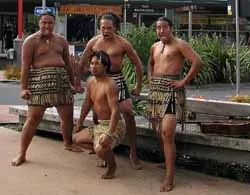
The people who inhabited the islands of New Zealand from the 7th century, whose numbers by the beginning of the 19th century amounted to 100 thousand people, and by the end of the century had dropped to 36 thousand, continue to seek ways to coexist with the descendants of European colonists. According to government data, currently 14% of New Zealand's population, which is 4.4 million people, identify as Maori. Many Maori have left the country and mainly live in Australia (about 100 thousand people).
In 1974, the terms of the peace agreement (Treaty of Waitangi), which proclaimed British sovereignty over Maori territory in 1840, were revised. And for 33 years now, the New Zealand government has been trying to integrate the ethnic group, consisting of many tribes, into the country's political and economic system.
Social indicators related to the Maori are currently discouraging. These people are more likely than other New Zealanders to commit suicide. Half of all prisoners in the country are representatives of the indigenous population.
However, significant positive changes have also been noted. Since 1999, the unemployment rate among Maori has almost halved: from 35 thousand to 15 thousand unemployed. Tourism is developing in areas of traditional Maori habitation. In the New Zealand parliament, 7 out of 120 seats are reserved for Maori deputies, which does not prevent them from competing for additional seats. To preserve and promote the culture of the people, a television channel broadcasting in the Maori language was created in 2004.
Today, every seventh Maori lives in Australia (the total number of Maori is around 660 thousand people). According to the New Zealand government, about 100 thousand Maori live in Australia. The main reason for their departure from their homeland was the low standard of living. Many Maori believe that it is in Australia that they are more motivated to 'move forward' and have more opportunities for this.
However, some features of the mentality of Maori emigrants give hope that many of them will return to New Zealand, and that too in the near future. It is these people that Parekura Horomia called on to 'seriously think about returning' and 'contribute' to the revival of their historical homeland. It is known that not all emigrants intend to apply for Australian citizenship. Moreover, in conditions of some isolation, all Maori diligently preserve their culture and language. Many Maori, noting the extreme hospitality of Australians, say that they cannot come to terms with having to break away from their community.
By the way, Maori began sailing to Australia soon after they settled New Zealand (they arrived from various Polynesian islands). But even then, in the 7th century, they always returned to their homeland. The connection to the land is one of the most important concepts for the Maori. 'People of the land' (another name for the tribe) try to cause as little harm as possible to the surrounding nature and are ready to defend their land to the end. This is why European colonists in the 19th century met fierce resistance from the tribes that inhabited New Zealand. In the course of three wars, the tribes failed to defend their independence, but they managed to preserve their cultural identity.