
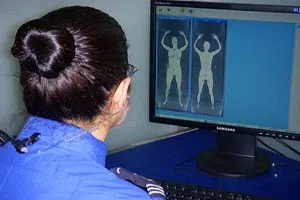
Americans oppose 'strip scanners'
In the United States, a number of public organizations have called on citizens to boycott American airports. The reason for the growing discontent among Americans was the recent tightening of security rules on domestic and international flights. In October of this year, US intelligence officers managed to intercept several bombs disguised as parcels on cargo planes heading from Yemen to Chicago. After that, the White House considered that the mere presence of security officers on each domestic flight was no longer enough and decided to tighten the rules.
Now, writes The Washington Post, 350 new-model scanners that can detect non-metallic objects have been installed in 70 US airports. By the end of 2011, their number is planned to increase to a thousand.
So-called strip scanners, say US transportation security officials, can really help in the fight against terrorists who try to smuggle plastic explosives under clothing and underwear. In addition, if the machine detects a suspicious object during scanning or the passenger refuses to enter it, airport staff have the right to conduct a thorough manual search. At the same time, internal rules state that during a search, an airport employee has the right to touch the passenger's chest and genitals. Only same-sex employees can search suspicious individuals.
According to CNN, most Americans viewed the new security rules as an invasion of privacy. Last Friday, concerned representatives of 20 major US travel companies met with US Secretary of Homeland Security Janet Napolitano. They said that over the past few days they had received several thousand calls and letters from customers dissatisfied with the new counter-terrorism methods.
The meeting was organized on the initiative of the US Tour Operators Association, "so that the ministry understands what the innovations threaten." "We are receiving hundreds of thousands of letters from customers who directly tell us: 'Cancel flights until they cancel these outrageous rules,'" one tour operator said on CNN.
Meanwhile, an online campaign has been launched calling for a 24-hour boycott of US airports. The organizers of the action urge everyone who has bought plane tickets for November 24 to return them. As representatives of the initiative group explain, this date falls on Thanksgiving, considered one of the busiest days of the year for US airlines.
The public organization Electronic Privacy Information Center (EPIC) sent a letter to the Secretary of Homeland Security, in which it called for the removal of 'body scanners' from all airports, because, in their opinion, they are not only an invasion of privacy but also dangerous to health.
Members of the Allied Pilots Association also speak about the harm of 'strip scanners'. Its president, Dave Bates, claims that for airline pilots, who also have to go through the scanners, this innovation is 'humiliating'. According to him, in the cockpit, pilots are already exposed to radiation, which is harmful to their health, and the scanners expose them to additional risk.
However, the greatest dissatisfaction among passengers and pilots is caused by the scanning procedure itself, when airport employees actually see them naked on the device's screen. In addition, several images have already ended up on the Internet. 'What about our privacy? Why are my rights forgotten because of the fight against terrorism? Do they think these methods will help?' writes one participant of the group against 'body scanners', created on the social network Facebook. 'My wife and I always told our children that only mother, father, and doctor can touch their intimate parts, and now airport employees will be added to this list?' another participant angrily writes.
Employees of the Department of Homeland Security are not yet ready to answer the questions of outraged passengers and continue to hold consultations with representatives of the US Tour Operators Association.
'Strip scanners' are not the first time they have caused a scandal. In January of this year, they appeared in European airports and also caused a storm of indignation among passengers. Their installation began after the failed terrorist attack on December 25, 2009 on an Airbus 330 flying from Nigeria to Detroit with a stopover in Amsterdam. Nigerian Umar Farouk Abdulmutallab managed to smuggle a homemade explosive device on board in his underwear and intended to activate it while approaching Detroit, but by pure chance he was unable to carry out his plan. The bomb misfired, detonating prematurely and not with full force. Abdulmutallab was first subdued and then sent to the hospital with multiple burns.
After that, the presence of a security officer became mandatory on every US flight, and the mass installation of 'body scanners' began in Europe. However, public organizations immediately criticized this idea, calling it 'outrageous invasion of privacy'. The organization Action for Rights of Children, in particular, proposed banning the use of scanners for people under 18.
Dmitry KARELIN.
