
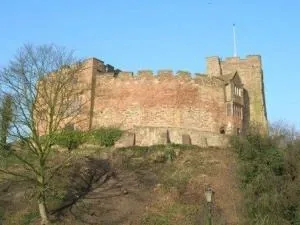
In general, needless to say, the Middle Ages turned out to be a difficult time, and numerous stone castles remind today's generation of it. A holiday in the UK would be incomplete if you do not visit a couple of medieval fortresses.
This article will focus on Tamworth Castle. It is located in the very center of England, amidst the green fields of Staffordshire. The fortress is a powerful stone keep standing on top of a high hill. Construction of Tamworth began in the first years after the Norman invasion. Initially it was hastily built from ordinary wood and earth, but in 1180 the short-lived timber was replaced with strong red sandstone and Tamworth turned into a mighty stone stronghold. The owners of the castle always paid a lot of attention to it; they sought to embody in it a successful combination of a comfortable residence and an impregnable fortress.
Tamworth left a very noticeable mark in English history, and a number of facts from the past deserve mention. Over the entire period of its existence, the fortress several times stood on the brink of complete destruction. For example, in 1215 King John Lackland wanted to raze Tamworth to the ground because its then owner, Sir Robert Marmion, fully supported the rebellious barons. However, the king's order was never carried out.
A similar situation occurred in the 17th century, when Britain was shaken by the cannon volleys of the Civil War. In 1642-1643, Tamworth was the headquarters of the Royalists. For two days it was besieged by the Parliamentary army; they showered the castle walls with a hail of cannonballs, which had a quick effect, and the garrison surrendered. Now Oliver Cromwell wanted to destroy the fortress, but, by some miracle, the order was again not carried out.
Tamworth, like most other English castles, has its own ghosts, at least some people believe they have seen something strange in the night corridors. According to one local legend, the ghost of the Black Lady sometimes wanders the castle – the spirit of Saint Edith. In life, this good woman was a respected nun. In addition to a righteous life and many good deeds, she is also credited with founding the priory of Polesworth in the 9th century. The monastery was located on lands that William the Conqueror gave for faithful service to Baron Robert de Marmion. The local monastery somehow displeased him, and he ordered the nuns to be dispersed.
In response to such insolence, they cursed Marmion and his entire lineage, summoning Saint Edith to help them. For some time the curse did not manifest itself, until in 1139 the ghost of the Black Lady appeared to the third Baron Marmion. She demanded that he restore the priory, and threatened him with imminent death if he did not fulfill her will, and for good measure she struck the lord with her ghostly staff. The otherworldly weapon left a painful wound, and it healed only after the monastery was restored.
In 1897 the castle was bought by the Tamworth Corporation, and in 1899 it became a museum. The fortress was restored, cleaned of centuries of dust, and became like new. The castle has interiors from different historical eras from the 12th to the 20th century. Tourists in Tamworth have access to 15 rooms, among which the greatest interest is the Great Hall, the bedroom with ghosts, and the dungeon. Also noteworthy is the impressive collection of antique furniture specially brought from the Victoria and Albert Museum. After a walk through the ancient corridors of the fortress, we recommend visiting the local park. In it, tourists are greeted by beautiful flower beds, trimmed bushes and lawns, as well as a river inhabited by a flock of white swans.
Tamworth Castle is just one of many witnesses to events of the distant past. On the British Isles, besides it, there are plenty of other no less interesting places. So buy tours to the UK, pack your bags, and boldly set off on a quest for adventure.
Based on materials from the Colibris website.
_