
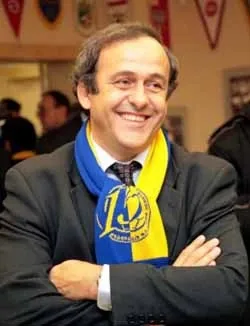
The impressive track record of the sixth president of this highly influential organization makes many of his fans shrug in bewilderment: with such merits for football, why does he need a high administrative post? As a rule, wizards of the ball become coaches. There are many examples: Konstantin Beskov, Franz Beckenbauer, Frank Rijkaard, Johan Cruyff... Great players sometimes succeed in administrative positions at clubs – like Karl-Heinz Rummenigge or Jorge Valdano, and as journalists, like Vladimir Maslachenko. But such players have never led world or European football.
Skeptics believe that Michel has taken on something not his cup of tea and will soon fail. Thus, former UEFA executive director Gerhard Aigner sourly remarked: "We created a UEFA that is strong with its business specialists. If this organization is reformed now, we might lose our effectiveness. If Platini thinks he has enough experience for such a position, then I wonder where he got it? About 20 out of the 27 who voted 'for' have little idea what UEFA management is, they simply succumbed to the charm of the personality."
Platini's Game
It is hard not to succumb to Platini's charm. Simplicity and openness were Michel's trademarks even during his time with the national team. He played brilliantly while maintaining an image of an absent-minded maestro. Saggy socks, untucked shirt, disheveled curls. He often showed off, but did it elegantly, earning admiration even from those who rooted against his team. Without any research or opinion polls, we dare to assume that at the 1982 World Cup, after the USSR team left the tournament, most of our (and others too) citizens rooted for the magnificent French: the stocky midfielder Giresse, the huge but surprisingly agile defender Trésor, the level-headed Bossis, and above all Platini.
"Once the USSR national team played a couple of friendly matches against the Kuwait team," Nikita Simonyan, first vice-president of the Russian Football Union, told us. "Platini had already left big football by then, but accepted an invitation from the Kuwait team to play for them. The Frenchman's skill on the field was striking, and we all wondered how he managed to maintain such grace even after putting on weight?"
Michel was born on June 21, 1955, into the family of Aldo Platini, a former professional footballer and later coach. Aldo did not limit his son's football imagination and did not rush him into a sports academy that could have leveled his talent in early childhood. So the future legend of French football honed his skills on the streets of the town of Jœuf. Only at age 11 did Michel join his first club, which was near his home. From his father, Platini Jr. inherited excellent dribbling and learned to deliver pinpoint passes. The rest he had to refine at the club. At 16, scouts from the club Metz noticed the talented boy. But as luck would have it, Michel suffered a serious injury in a game and could not take advantage of that offer. Later, when the young player was invited to the same club again, he simply failed the medical exam: with a conclusion "has breathing difficulties and heart problems," he was rejected. As a result, in 1972 Michel ended up in the reserve team of Nancy.
However, talent is talent, and it was impossible not to notice it. So in seven years at Nancy, he grew from a reserve player to a French champion. Moreover, it was with Platini's help that this modest team climbed from the lower depths of French football to the elite division.
But Michel's health was indeed not heroic: the player constantly got injured and complained about his health, but invariably returned to action due to his strength of character. When Platini's contract with Nancy expired in 1979, Milan's Inter, Paris Saint-Germain, and Saint-Étienne were already in line. Platini chose Saint-Étienne, where he spent three seasons. It was then that Michel's peculiar sense of humor manifested itself. For example, during an away match, he bought firecrackers and put on a fireworks display in public. Stunned spectators stared at Platini, and he suddenly fell "dead". The crowd rushed to save the football genius, but he just burst out laughing in response. And when the French national team was at the 1978 World Cup in Argentina, Platini squeezed several tubes of toothpaste onto the players' beds. History, however, is silent about the friends' reaction to these jokes.
After Saint-Étienne came Juventus, with which the footballer signed a contract in 1982. Getting used to Italian football was not easy: the omnipresent journalists alone were worth it! At first, all this so tormented Platini that already in the winter of the first season he was close to desertion. But it worked out - and the second half of the season turned out to be much more successful than the first: Juve reached the final of the European Cup and won the Italian Cup. This was the first major title in Platini's career, soon followed by others. For example, the European Cup in 1984, the European Super Cup the same year, the European Cup in 1985. He finished the Italian championship three years in a row as top scorer and was three times voted European Footballer of the Year (1983, 1984, and 1985).
It was difficult for the great footballer to fit into a single role. He scored like a striker, passed like a playmaker, took free kicks like a jeweler. Once the referee asked him to repeat a free kick he had already taken, and Platini scored again, placing the ball in the same 'top corner'. He did not belong to the category of goal scorers, although even in Italy he scored about twenty goals a season; he was not a pure playmaker, even though he provided many assists; he played the role of 'one-man orchestra' - the one who determines the outcome. One such player is enough to turn a good team into an outstanding one, and an outstanding one into a great one. The only thing Platini failed to achieve was becoming world champion. He played in three final tournaments, two of them as the leader of the national team, and each time his team was just a trifle short. In the semifinal of the 1982 tournament, when Platini played for the French national team, his team produced perhaps the best match in World Cup history, even though they lost on penalties. Before the fateful penalty shootout for France, there were two goals in regular time and four in extra time, and each of them was a masterpiece. It is pointless to describe it - one must see it. Even now, 25 years later, it looks amazing. Two years later, in 1984, the French won the Euro, and Platini scored nine goals in five matches. An astonishing result for a game that had long turned into a hunt for players like Michel.
There is such a paradoxical football law. In order to eventually win a title, one must first lose it. So Platini, through his own efforts, did the first, not-so-pleasant part of the work for his country, and a decade later, Zidane and his comrades accomplished the second. However, Michel was also involved in that, but in a different role.
Another Football
Platini left football easily - with optimism and hope for a miracle. He was immediately appointed head coach of the national team. However, this solo was not from Michel's opera. The French achieved nothing substantial under him, but the coach took it philosophically. He always said that fair play is when you lose with a smile. He never returned to coaching, and probably was right in his decision. But his next project - the World Cup in France in 1998 - returned Platini to the nation's idols. He became co-chairman of the organizing committee and brought luck to his country: France became champion for the first time in its history, and even beat Brazil in the final with a large score! It felt that the tournament was organized by those who are not only knowledgeable in football but also love it with all their hearts.
It was after this championship that FIFA President Sepp Blatter invited Platini to his team, offering him to work as his special advisor. The legendary playmaker also joined the executive committees of FIFA and UEFA. It is hard to imagine a serious gentleman who admits that he is a romantic, that he wants to make football a game again, not just a business. In recent years, football has seemed to hit a wall of contracts, advertising, ambitions and money. Football clubs are becoming toys for the rich. Transfers of players generate almost more interest than the game itself. Football now needs exactly this type of official like Platini.
After all, the Frenchman, in addition to his charisma, presented a new concept for the development of football. For example, he plans to pay attention to the 'second tier' of European football - countries and clubs that have been overshadowed by giants like those of Italy, Spain or England. The plans of the sixth UEFA president also include expanding the number of participants in the Euro final tournament from 16 to 24 teams. This is a chance for national teams such as Russia, Norway, Scotland, Wales, Slovakia and Ukraine. Moreover, Platini intends to change priorities in UEFA policy and give the green light primarily to national teams, not clubs.
As Andrea Sadecki, a PR department employee of the FIFA President's office, told Itogi, such a solid program and support from Blatter predetermined the outcome of the elections (Platini won with a slight majority - 27 to 23, with two invalid ballots). According to Blatter himself, there has been a battle between FIFA and UEFA recently - UEFA wanted to become independent and separate from the rest of the football family. Recall that the richest clubs in Europe formed the G-14 group and with this 'mighty handful' are trying to impose their opinion on European football. However, with Platini's arrival as president, FIFA gained a point in its favor. Blatter has the right to expect that UEFA will now less shield rich clubs and think about the fate of the less wealthy.
'It is clear that in football today there are two levels - the rich and everyone else. But how they should interact is a matter of governance. This is a problem that needs to be solved,' Blatter said. With Platini's arrival, many hope that the emphasis can finally be set correctly. Other football officials also welcome Platini's election. For example, RFU President Vitaly Mutko hopes that with fresh energy, the UEFA president will tackle such Augean stables as corruption, match-fixing, and biased refereeing.
In a word, Platini has grandiose plans, and to implement them, he will probably have to move to Geneva, closer to UEFA headquarters. True, Platini's wife is unhappy with the prospect of moving to Switzerland: she and their two children much prefer living in their own villa near Marseille or in their Paris apartment. By the way, Platini's marriage is very strong and has lasted since the 80s. Initially, there were many quarrels between the spouses - blame it on idle gossips who were disturbed by the marriage of their favorite. However, people who know Michel closely say that he is very home-loving, a gourmand, and never denies himself a glass of good wine and tasty food.
In short, if the mill of the UEFA apparatus does not grind down the life-loving Platini and make him like most respectable figures, football itself could change for the better. Of course, fighting against routine will be hard. But after all, Platini himself said after the elections that an 'exciting adventure' awaited him. Clearly, this will be a unique president. A Don Quixote doomed to ridicule and misunderstanding, or a noble Batman who can stand up for himself and save others along the way? One can admire Platini's directness and sincerity, but an official of this rank must be a great diplomat: without allies, one is not a warrior in the field. It is also unclear whether our hero will gather a worthy team. Good intentions alone are not enough. Once, Michel changed football from within—as a player—and now he intends to do so from outside with the same passion, which is much more difficult. And most importantly, it should be without Michel's favorite jokes—they might not be understood.