
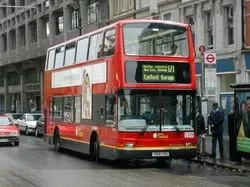
Last week, after a new series of explosions in the London Underground, New York City (USA) authorities decided to begin random checks of subway passengers as a preventive measure. According to Associated Press, the mayor's office issued an instruction to conduct random inspections of passengers and their luggage, 'paying special attention to large items and people sweating heavily.' New York transit police have a big job ahead: the city is in the grip of a heat wave, and there is no shortage of sweaty people in the subway.
By order of Mayor Michael Bloomberg, inspections of sweaty citizens and their luggage will be carried out at the entrances to subway stations, before passengers pass through the turnstiles. Bloomberg does not deny that personal searches of those entering the subway to some extent restrict their freedoms. 'But what can be done, we live in a sad world and are forced to seek a balance between freedoms and security,' he stressed.
As New York Police Commissioner Raymond Kelly explained, the inspection will be carried out as follows. A police officer will approach a passenger, ask what they are carrying, and request them to open their bag. If anything suspicious is found in the luggage, the passenger will be immediately detained. This task will be assigned to specially established police checkpoints. 'Those who refuse to undergo inspection will simply not be allowed into the station,' the police commissioner warned in advance to those who are dissatisfied.
The New York authorities have not specified exactly how the checks will be organized, although law enforcement officers in the subway took their positions already on the night from Thursday to Friday. A night inspection is not difficult, since there are few passengers in the underground at that time. However, starting with the morning rush hour, the inspectors will have a hard time: about 4.5 million passengers pass through the 486 subway stations of the largest US metropolis on an average day. So, apparently, not only passengers will have to sweat heavily in the New York subway.
Many New Yorkers are clearly not delighted with the authorities' new idea. According to one of them, William Williams, with the introduction of inspections, 'there will certainly be a lot of tension. Sometimes you are late for a meeting, and then a cop stops you. Who will like that?' Experts believe that the introduced measures will cause irritation among the majority of New Yorkers, who are not known for excessive restraint anyway.
Already now, as The New York Times writes, the introduction of inspections has provoked sharp criticism from American human rights activists. In addition to the inevitable crush in the lobbies that police actions will cause, they speak of violation of the rights of millions of people, as well as the creation of enormous inconvenience for them. Some human rights activists have already promised to file complaints against the authorities in court. According to one of them, Donna Lieberman, 'the police can and should investigate suspicious cases, but the decision to search everyone is a direct violation of the 4th Amendment to the US Constitution, which prohibits the police from searching anyone without substantial suspicion of illegal activity.'
Apparently, some restriction of action threatens not only the 4th, but also other amendments of the American Constitution responsible for the observance of human rights. Last week, immediately after news of new terrorist attacks came from London, the US House of Representatives voted to extend the 'Patriot Act' in the United States. This document was adopted after September 11, 2001 and is the main instrument of counter-terrorism activity in the country. The Act significantly ра%F
Marina LEMUTKINA.
Газета.Ru