
From the new year, tourists will have to pay to enter Venice
The proposal to charge for entry to Venice has been discussed in Italy for several years, but now it has taken concrete form. As reported by the publication "Redaktion Germania", the authorities plan to make visiting the city paid even for "day-trippers," not just those who stay overnight.
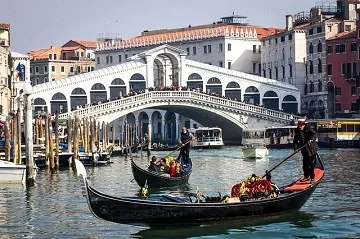
The flow of tourists to the city has never stopped – it was briefly interrupted by the pandemic, but this summer visitors again flooded the narrow embankments of Venice. On some canals, gondolas even line up to drop off passengers and pick up new ones. City guests have almost no chance to take a photo on the famous Rialto Bridge without dozens of other vacationers appearing in the frame.
The city authorities and local businesses in Venice have long learned to earn millions from tourists. But local residents, especially those not employed in the tourism industry, regularly protest against the overcrowding of their hometown by visitors. For many years, citizens protested against the entry of large cruise ships into the lagoon; their persistent requests, supported by environmentalists, have been granted – this is now prohibited.
For many years, a city tax has been collected from tourists staying in hotels: depending on the hotel level, it can range from 1 to 5 euros per night for each adult guest. This is common practice for European cities and resorts, but Venice was one of the pioneers of this initiative, which brings millions to the treasury every year.
Now the task of the city authorities is to try to prevent the crush of tourists for which Venice is known, besides its canals and artistic treasures. The local population is shrinking year by year, but the city must remain attractive to its residents and preserve its unique appearance for all humanity.
The introduction of an entry fee was planned earlier, but the pandemic prevented this innovation. Those city guests who have booked an overnight stay in a hotel will be exempt from purchasing an entry ticket – they already contribute to the preservation of Venice by paying the resort tax. The city administration prefers to call the new measure not a ticket but a contribution – because it will go towards maintaining the cultural heritage in proper condition.
The head of the city council for tourism, Simone Venturini, emphasizes that the purpose of introducing the fee is not to make money. The authorities aim to control tourist flows in this way, to better distribute them across days of the week and prevent overcrowding of major attractions, which has become common in recent years. Presumably, for some, the new regime for visiting Venice will become an incentive not just to stop by the city for half a day for a few photos, but to stay longer to get acquainted with the cultural heritage.
The amount of the contribution will not be fixed – depending on the season, day-trippers will have to pay from 3 to 10 euros. The fees will be highest during the carnival, at Easter, and in summer, while in autumn and winter months the amount will decrease. A simple mobile app will be available for payment; it can also be paid by registering on the city's website (this function is about to start working in test mode). Entry to the city will remain free for now, but discounts on museum visits will be offered for pre-registration.
The control authority appointed to monitor the flow of tourists is located in the west of the city on the artificial island of Tronchetto. Footage from 610 video surveillance cameras installed throughout the city converges here. The authority's employees can see what city guests are doing in almost every part of the historic center, in order to send patrol officers if necessary to stop violations. For example, in Venice it is officially forbidden to sit on the steps of many churches and bridges, to eat or drink alcohol on the street. Substantial fines can be imposed for this.
Surveillance is conducted not only over tourists. The authority's employees monitor the movement of water transport through the city's canals, whether stops or any streets are overcrowded – then, with the help of the same patrol officers, they can redirect the flow of people to avoid congestion.
Counters have already been installed at the entrances to Venice, which count the number of people arriving and leaving the city. All the infrastructure was created four years ago, but commissioning was constantly postponed. The final introduction of the entry fee to Venice is scheduled for January 16, 2023.